
Quick Answer:
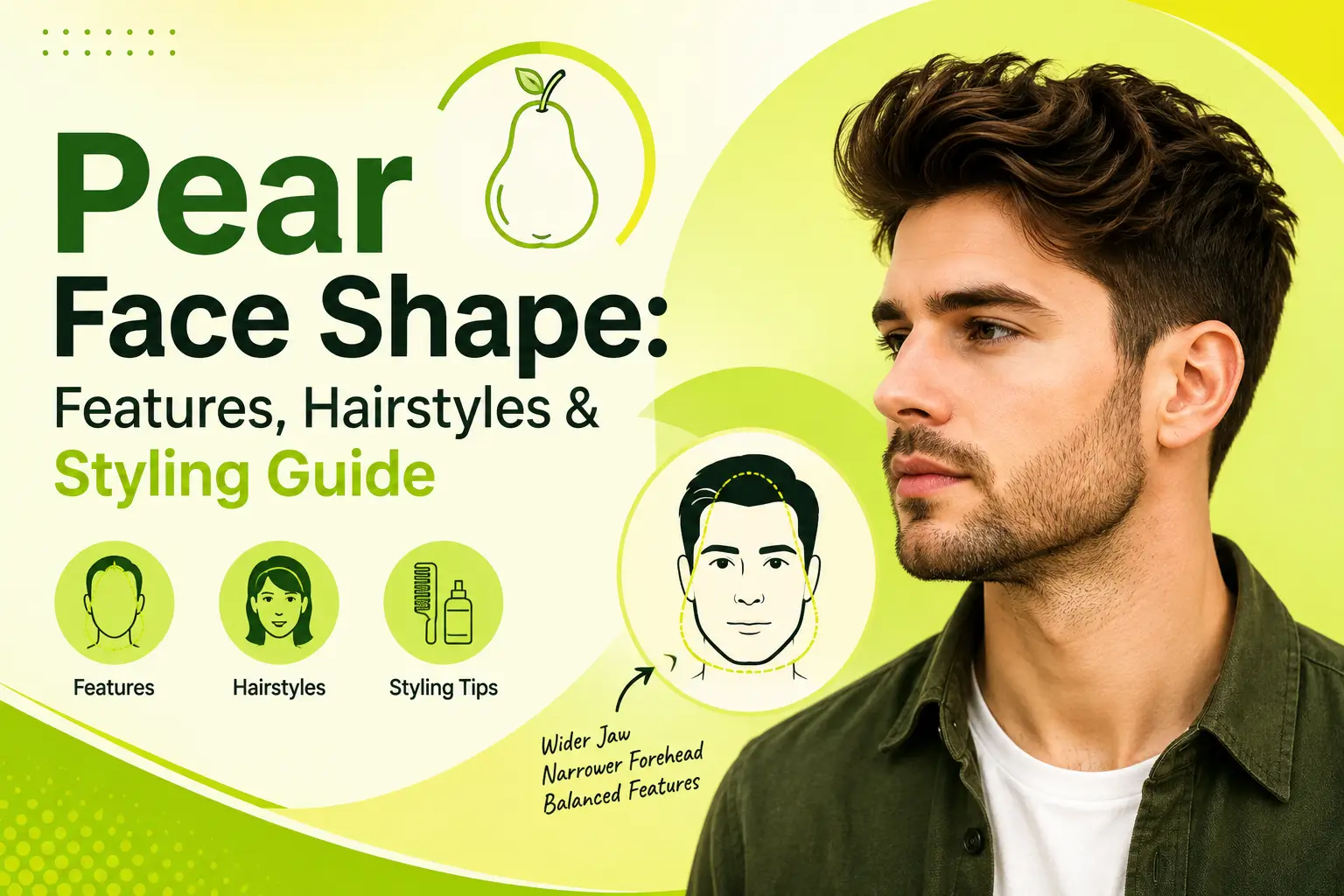
A pear face shape has a narrower forehead and temples that widen toward a fuller jawline — the opposite taper of a heart-shaped face. It’s closely related to, and often confused with, the triangle face shape.
Pear Face Shape: How to Identify It and Style It Right?
If you’ve been told you have a pear face shape, you’re dealing with a face that’s narrower up top and wider at the jaw. This guide is for anyone trying to confirm that shape before making a real decision — a new haircut, a pair of glasses, or a beard style — using OvalFaceShape.com’s face-shape guidance and AI Face Shape Detector.
What Is a Pear Face Shape?
A pear face shape is defined by a forehead and temple area that are noticeably narrower than the jawline, with the width building gradually down the face. The jaw is the widest point, often with a rounder, softer edge than a true triangle’s sharp angle.
This is the direct inverse of a heart-shaped face, where the forehead is the widest point and the chin narrows sharply.
Pear vs. Triangle Face Shape: What’s the Difference?
Most confusion around this keyword comes from one fact:
“Pear” and “triangle” describe the same basic taper — narrow top, wide bottom — and many stylists use the two interchangeably. Where they’re sometimes distinguished is jawline character.
| Feature | Pear Face Shape | Triangle Face Shape |
|---|---|---|
| Forehead | Narrow | Narrow |
| Jawline | Wide, rounder edge | Wide, more angular edge |
| Chin | Softly rounded | Can be squarer |
| Overall feel | Softer taper | Sharper taper |
If your jaw feels rounded rather than sharply cornered when you trace it in a mirror, “pear” is the more accurate label for you — but the styling advice below applies to both.
How to Confirm You Have a Pear Face Shape?
A mirror check is a starting point, not a diagnosis. Three things to look for:
- Your forehead width is visibly the narrowest measurement on your face.
- Your jawline is the widest measurement, wider than your cheekbones.
- There’s no sharp angle at the jaw corner — it curves rather than points.
For a measurement-based answer instead of a visual guess, run a photo through OvalFaceShape.com’s Face Shape Detector, which uses a 468-point facial landmark model to compare forehead, cheekbone, and jaw width directly rather than relying on eyeballing a mirror.
Facial width measurements like these aren’t just a styling convenience — they’re a studied area of craniofacial research. A 2022 study in Biology Letters using a sample of over 6,000 adults found that bizygomatic (cheekbone-to-cheekbone) width carries a strong, measurable sex-based difference even after controlling for overall face size , based on a comprehensive analysis of thousands of men and women’s craniofacial measurements.
That’s part of why width-ratio comparisons, not just a single measurement, are what most reliable face-shape tools rely on. nih
Best Hairstyles for a Pear Face Shape
The goal is to add visual width at the forehead and temples while keeping volume off the jawline.
- Side-swept fringe or curtain bangs — builds width exactly where a pear shape is narrowest.
- Volume at the crown and temples — a blowout or layers that lift near the roots widens the upper third of the face.
- Avoid heavy volume or texture that sits at jaw-level, since it emphasizes the jaw’s existing width.
Best Glasses for a Pear Face Shape
Frames should draw the eye upward and outward at the top rather than the bottom.
- Cat-eye or browline frames — the classic recommendation for a narrow-forehead, wide-jaw shape, since the upswept top line widens the upper face.
- Frames with detailing on the upper rim (color, thicker brow line) rather than the bottom.
- Avoid bottom-heavy or rimless-bottom frames, which pull visual weight further down toward the jaw.
Best Beard Styles for a Pear Face Shape
For men with this shape, the beard’s job is the opposite of the hair’s job — it should not add more width at the jaw, since that’s already the widest point.
- Shorter, closer beards along the jawline, keeping length and fullness higher on the cheeks instead.
- Avoid boxed or squared-off beard lines that exaggerate jaw width further.
Key Takeaways
- A pear face shape is narrow at the forehead/temples and widest at the jaw — the opposite of a heart shape.
- “Pear” and “triangle” are frequently used interchangeably; the main distinction is a softer, rounder jaw edge on a pear shape.
- Hairstyles and glasses should build width at the forehead; beards should avoid adding more width at the jaw.
- A mirror check is a reasonable starting point, but an AI landmark tool gives a measurement-based answer rather than a visual guess..
FAQs
Is a pear face shape the same as a triangle face shape?
Largely, yes — both describe a narrow forehead widening to a fuller jaw. The distinction some stylists draw is that a pear shape has a rounder, softer jaw edge, while a triangle shape’s jaw corner is sharper.
What’s the rarest face shape?
Diamond and inverted-triangle/heart shapes are generally cited as less common than oval, round, or square in most styling references, though pear and triangle shapes are also less frequently reported than oval.
Does a pear face shape suit all hairstyles?
Not equally — styles that add width at the forehead work best; styles that add heavy volume or texture right at the jawline tend to work against this shape rather than for it.
Can glasses actually change how a pear face shape looks?
Glasses don’t change bone structure, but frame shape changes where the eye is drawn first — a browline or cat-eye frame shifts attention upward and can visually balance a narrow forehead against a wider jaw.
Why do different face-shape quizzes give me different results for the same photo?
Manual, visual quizzes rely on subjective judgment calls about where your face is “widest,” while AI landmark tools measure fixed points (forehead, cheekbone, jaw) directly, which is why results can differ between a quick online quiz and a measurement-based tool.
Is a pear face shape considered attractive?
Face shape isn’t a fixed marker of attractiveness in any codified sense — styling advice exists to balance proportions the wearer wants to emphasize or soften, not because one shape is objectively better than another.
How do I know if I have a pear face shape instead of an oval one?
An oval face has fairly even width from forehead to jaw with a slightly rounded chin; a pear face has a clearly narrower forehead than jaw. If the width difference isn’t obvious, a landmark-based tool will resolve it more reliably than a visual guess.
3 thoughts on “Pear Face Shape: How to Tell + Hairstyles for Men & Women”