
Quick Answer:
A round face shape has a length-to-width ratio close to 1:1, full curved cheeks, and a soft jawline without sharp angles. Check yours with OvalFaceShape.com’s Face Shape Detector.
Round Face Shape: How to Identify It and What to Wear
A round face shape means your face is close to as wide as it is long, with soft, curved lines and no sharp corners anywhere on the outline.
The cheeks sit as the widest part of the face, and the jaw curves gently inward toward a rounded chin. OvalFaceShape.com’s Face Shape Detector can confirm this in seconds by mapping your face length against your cheekbone and jaw width.
Who This Guide Is For:
This guide is for anyone who suspects their face is round and wants both an accurate way to confirm it and real styling direction — men choosing a haircut or sunglasses, women weighing glasses frames, or anyone comparing round against a similar shape like oval or square before making a grooming decision.
What Makes a Face Round?
Three measurements define a round face shape on the Face Shape Detector: A length-to-width ratio near 1.0–1.1 (roughly equal), a cheekbone width that is the single widest point of the face, and a jaw width noticeably narrower than the cheekbones with a curved, corner-free line down to the chin.
There’s no flat forehead-to-jaw column like an oblong face and no squared jaw angle like a square face — every transition on a round face is a curve.
This framework traces back to craniofacial anthropometry pioneered by Leslie G. Farkas, whose landmark-based facial measurement system remains the reference point modern face-shape tools, including AI landmark detectors, build on.
Round vs. Oval vs. Square
| Feature | Round | Oval | Square |
|---|---|---|---|
| Length vs. width | Nearly equal | Length clearly greater | Nearly equal |
| Widest point | Cheekbones | Cheekbones, tapering both ways | Jaw and forehead, equal width |
| Jawline | Soft, curved | Gently rounded | Sharp, angular |
| Chin | Rounded, no point | Slightly tapered | Squared |
If your face is roughly equal in length and width but the jaw has visible corners rather than a curve, you likely have a square face, not round.
If the face is clearly longer than wide with the same soft curves, that’s oval — see the full oval face shape guide for that comparison.
Is a Round-Shaped Face Attractive?
Yes — a round face shape is widely considered attractive, and there is no anthro-pometric or cultural consensus ranking one face shape above another.
Round faces are frequently described as giving a youthful, approachable appearance because the soft curves and fuller cheeks read as friendly rather than severe.
Attractiveness in face-shape research is about symmetry and proportion within a shape, not which shape a person has.
How Do I Slim My Round Face?
You can’t change your underlying bone structure, but you can visually elongate a round face through styling choices:
Hairstyles with height at the crown, side parts instead of center parts, vertical contouring along the cheeks and jaw, and glasses or sunglasses frames that are wider than they are tall.
These are the same techniques covered in the sections below, applied specifically to create length rather than width.
Best Glasses for a Round Face
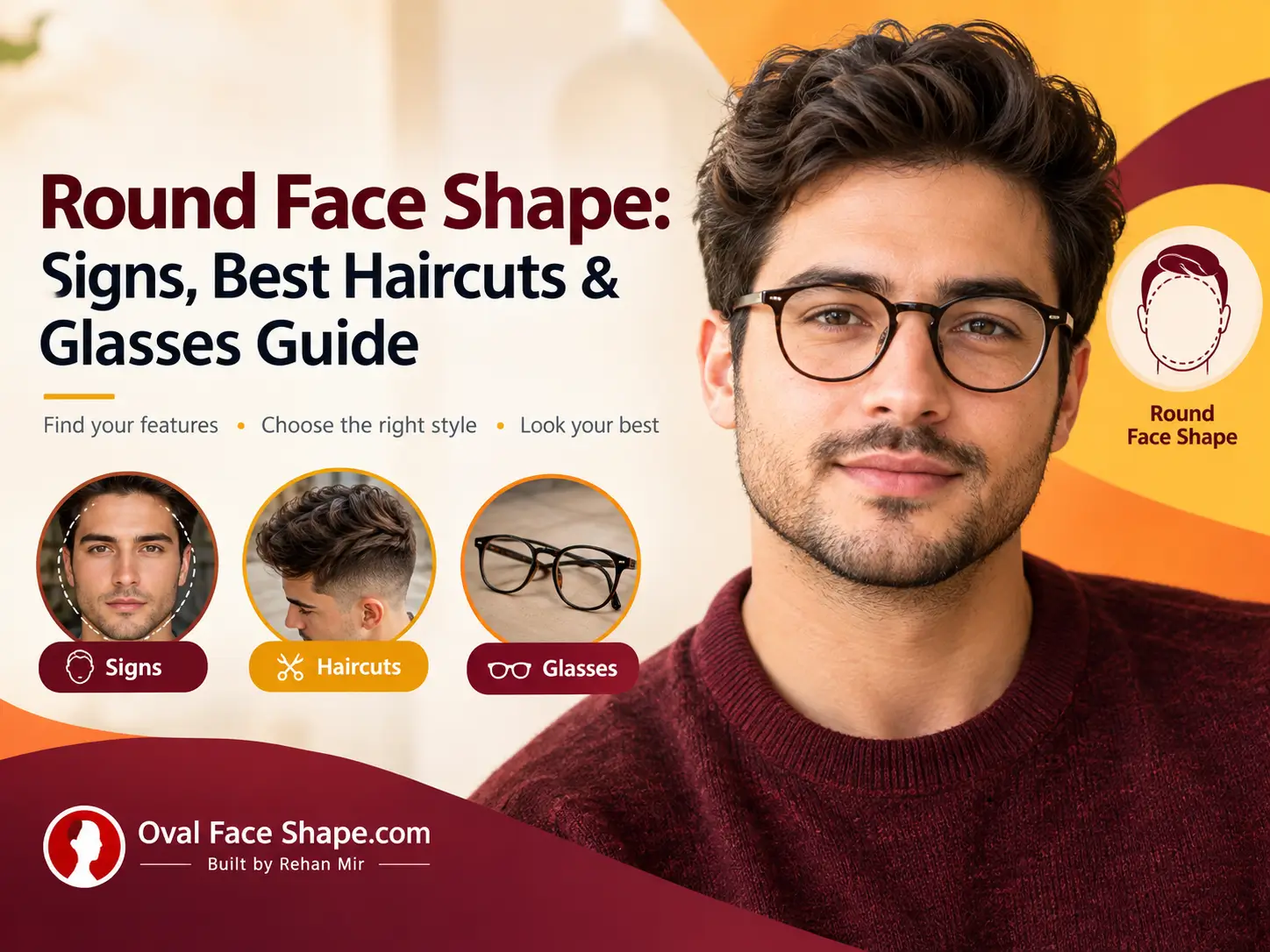
The goal with glasses for round face shapes is to add angles and length the bone structure doesn’t have. Rectangular and geometric frames, brow line (club master-style) frames, and angular cat-eye shapes all work well because their straight lines contrast with the face’s curves.
Avoid round or small circular frames — they echo the face’s existing shape and add width rather than balance.
Best Sunglasses for a Round Face
The same logic applies to sunglasses for a round-shaped face: angular, rectangular, or slightly oversized square frames create the length and structure a round face lacks.
Wayfarers and geometric square sunglasses are consistently strong picks. Round or small oval sunglasses frames should be avoided for the same reason as round eyeglasses — they reinforce roundness instead of countering it.
Best Haircuts for Round Faces
For men, the best haircuts for round faces build height at the crown and keep the sides tighter — a textured quiff, crop with volume on top, or a side-parted style with faux hawk elongation all work.
A very short buzz cut with no height tends to widen the visual impression of a round face. For a full breakdown of round face shape hairstyles for men, including step-by-step styling by hair type, see the dedicated men’s hairstyle guide.
For women, longer layered cuts that fall below the chin, deep side parts, and volume concentrated above the cheekbones (rather than at cheek level) create the same elongating effect. Blunt chin-length bobs and center parts tend to widen a round face further.
Cited Celebrities hairstyles for Round Face Shape
Leonardo DiCaprio and Selena Gomez are frequently cited examples of a round face shape — DiCaprio’s swept-back styles with crown height, and Gomez’s side-parted long layers, both demonstrate the elongation principle in practice rather than fighting the face’s natural curves.
Key Takeaways
- A round face has a length-to-width ratio near 1:1, cheekbones as the widest point, and a soft, curved jawline.
- Round is distinct from square (angular jaw) and oval (clearly longer than wide).
- Angular, rectangular, or geometric frames balance a round face better than round frames, for both glasses and sunglasses.
- Height at the crown and side parts visually elongate a round face in any haircut.
- Confirm your shape with the Face Shape Detector before committing to a style.
FAQs
Is a round-shaped face attractive?
Yes. A round face shape is widely regarded as attractive, often associated with a youthful, approachable look, and there’s no scientific ranking of face shapes by attractiveness.
How rare is a round face shape?
Round is a common shape, typically ranked third or fourth most prevalent depending on the dataset and classification method — treat any exact percentage as approximate.
What’s the difference between a round and a square face shape?
Both have roughly equal length and width, but a square face has a sharp, angular jawline while a round face has a soft, curved jaw with no corners.
Do round and oval face shapes get confused often?
Yes — the main distinction is length: oval faces are clearly longer than wide, while round faces are close to equal in both dimensions.
What hairstyle should men with round faces avoid?
Very short, uniform buzz cuts with no crown height tend to emphasize a round face’s width rather than balancing it.
9 thoughts on “Round Face Shape: Signs, Best Haircuts & Glasses Guide”