
Quick Answer:
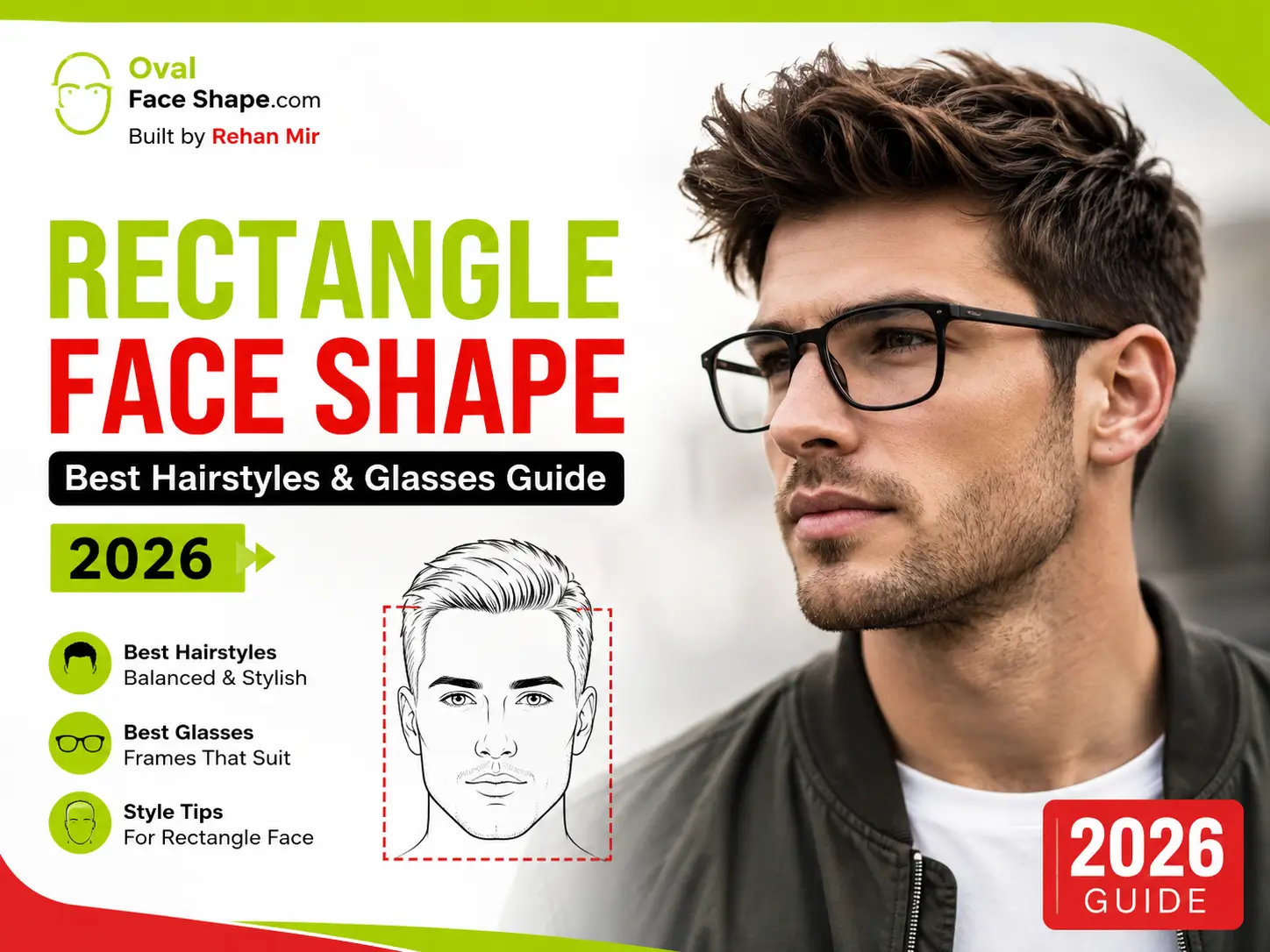
A rectangle face shape is clearly longer than it is wide, with a straight, squared jawline and a forehead, cheekbones, and jaw that are nearly equal in width.
Who this guide is for:
If you’re trying to confirm your face shape before choosing a haircut or a new pair of glasses, this guide is for you.
It covers what a rectangle face shape actually is, how it differs from a square, oblong, or diamond face, and which hairstyles, glasses, and beard styles genuinely balance its proportions — whether you’re a woman weighing a new cut or a man looking for the right frame shape.
What Is a Rectangle Face Shape?
A rectangle face shape is defined by a face length noticeably greater than its width — commonly around 1.5 times the width — combined with a forehead, cheekbone, and jawline that measure nearly the same across.
The jawline itself is the deciding detail: it’s angular, with a visible corner where it turns from the ear toward the chin, rather than a soft curve.
This combination is what separates rectangle from its closest relative, the oblong face shape: both share the elongated 1.5:1-or-higher ratio and even widths, but oblong faces have a rounded or gently pointed chin, while rectangle faces have a flat, squared one.
How to Measure a Rectangle Face at Home?
- Pull your hair back and measure straight down from your hairline to your chin for face length.
- Measure across your cheekbones (the widest point below your eyes) for cheekbone width.
- Measure across your jaw, about an inch below your ears, for jawline width.
- Measure across your forehead at its widest point.
If your length is clearly the largest number, and your forehead, cheekbone, and jaw widths land within a few percent of each other, you’re looking at a rectangle or oblong shape.
Run a finger along your jawline: A clear corner points to rectangle, a smooth curve points to oblong.
For a faster confirmation, OvalFaceShape.com’s Face Shape Detector checks these same proportions from a photo in seconds.
Rectangle vs. Square vs. Oblong vs. Diamond
| Shape | Length vs. Width | Jaw | Widest Area |
|---|---|---|---|
| Rectangle | Length clearly greater | Angular, squared | Forehead ≈ cheek ≈ jaw |
| Square | Roughly equal | Angular, squared | Forehead ≈ cheek ≈ jaw |
| Oblong | Length clearly greater | Rounded/soft | Forehead ≈ cheek ≈ jaw |
| Diamond | Length moderately greater | Narrow, pointed | Cheekbones |
Best Hairstyles for a Rectangle Face Shape
The goal for any rectangle face haircut is the same: add horizontal width and soften the jaw’s corners, without adding height on top.
- Women: A lob or shoulder-length cut with soft layers starting at the cheekbones adds width exactly where it’s needed. Curtain bangs shorten the visual length of the face and soften a broad forehead. Avoid pin-straight, waist-length hair with a center part — it pulls the eye downward and exaggerates length.
- Men: Medium-length cuts with volume on the sides, textured fringes, and side parts work best. Skip high pompadours or short fades that expose a lot of skin on the sides, since both add vertical emphasis. Arnold Schwarzenegger’s classic flat-on-top, fuller-on-the-sides cut is a well-known example of this principle in practice.
Best Glasses for a Rectangular Face
Choose frames that contrast the face’s straight lines rather than repeat them: round, oval, or aviator frames with soft curves work well, and slightly oversized frames help break up the length.
Avoid small, narrow, or sharply rectangular frames — pairing boxy glasses with an already-angular jaw only reinforces the hard geometry instead of balancing it.
Beard Styles for a Rectangle Face
For men, a fuller beard that’s slightly thicker along the cheeks and trimmed shorter at the chin adds horizontal width at the jaw.
Long, pointed goatees do the opposite and should be avoided, since they add length exactly where the face doesn’t need it.
Key Takeaways
- A rectangle face is longer than it is wide, with equal forehead, cheek, and jaw widths and an angular, squared jawline.
- The jawline’s corner — not the length ratio alone — is what separates rectangle from oblong.
- Hairstyles and glasses that add horizontal width and soften angles are the most flattering choice for this shape.
- A photo-based tool like the Face Shape Detector is faster and more consistent than eyeballing your own proportions in a mirror.
FAQs
What is a rectangle face shape?
It’s a face shape where the length is noticeably greater than the width, with a forehead, cheekbones, and jawline of roughly equal width and a squared, angular jaw.
Is a rectangular face shape attractive?
Yes. Strong, angular jawlines are widely associated with striking, photogenic features, and many well-known models and actors have this shape — attractiveness isn’t tied to a single face shape.
What hairstyle is best for a rectangular face shape?
Medium-length cuts with side volume, soft layers, and curtain bangs work best, since they add width and shorten the face’s visual length.
What is the lucky face shape? (a common but unscientific belief)
No, face shape has any evidence-based link to luck; this is a matter of personal or cultural belief, not styling science.
Is a rectangle face the same as an oblong face?
Not quite — both are elongated with even widths, but rectangle faces have a squared, angular jaw, while oblong faces have a softer, rounder one.
Which celebrities have a rectangle face shape?
Sandra Bullock, Ben Affleck, and Arnold Schwarzenegger are commonly cited examples of the rectangle face shape.
2 thoughts on “Rectangle Face Shape: Best Hairstyles & Glasses Guide (2026)”