
Quick Answer:
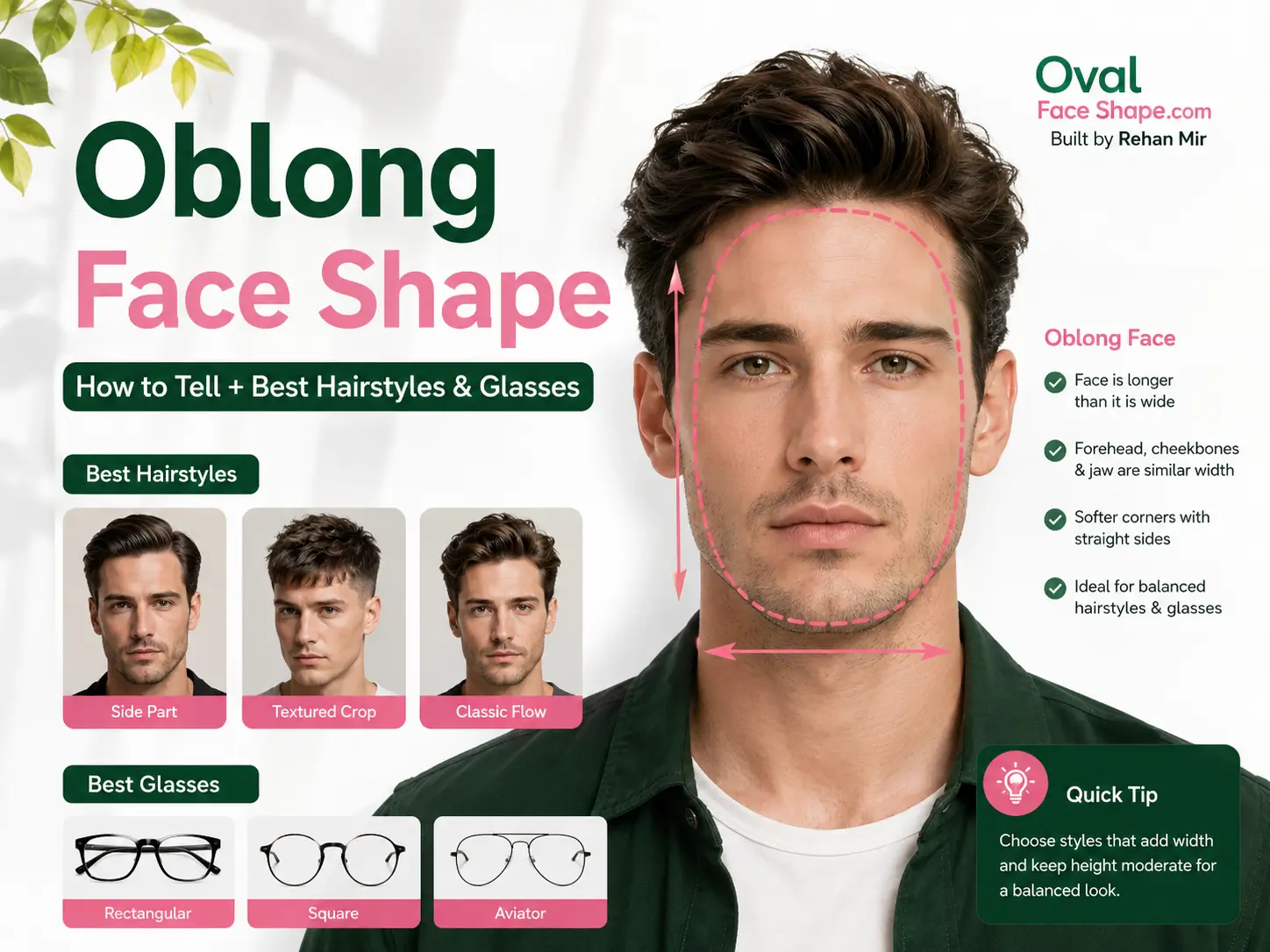
An oblong face shape is noticeably longer than wide, typically with a length-to-width ratio above 1.5, similar-width forehead, cheekbones, and jawline, and straight, non-tapering sides.
Oblong Face Shape: How to Identify It and What Actually Flatters It
If people keep describing your face as “long,” it’s probably oblong — not oval, and not rectangle, even though all three get confused constantly.
Who this guide is for:
This guide is for anyone trying to confirm that shape before making a hairstyle or glasses decision, using OvalFaceShape.com’s own measurement standard and Face Shape Detector.
What Is an Oblong Face Shape?
An oblong face shape is a face where length clearly exceeds width — a ratio of roughly 1.5:1 or higher — with the forehead, cheekbones, and jawline sitting at similar measurements rather than one zone dominating.
The sides run relatively straight from temple to jaw instead of curving inward.
That 1.5 threshold isn’t arbitrary. It’s the point where OvalFaceShape.com‘s oval category ends: an oval face tapers gently and tops out around a 1.5 ratio with visible curve at the jaw. Once the ratio passes 1.5 and the sides stop curving, the shape has crossed into oblong.
Why Sources Disagree on the Exact Ratio?
Search around and you’ll see the oblong threshold cited anywhere from 1.5:1 to 1.75:1, depending on the source.
That spread comes from real methodological differences, not sloppiness: some guides measure face width as cheekbone width alone, while others average forehead, cheekbone, and jaw width together, which produces a different denominator and shifts the ratio.
Farkas’s foundational anthropometric research (1994) on craniofacial measurement is the shared root citation behind most of these figures, but individual sites apply their own rounding and averaging choices on top of it.
Treat any single decimal point as a guideline, not a hard biological cutoff — the sides test below matters more than the third decimal of your ratio.
Oblong vs. Oval vs. Rectangle: The Decision Tree
- Do your cheeks curve inward toward your chin? Yes → oval. No, the sides run mostly straight → continue.
- Is your jaw angle soft and rounded, or sharp with visible corners? Soft/rounded corners → oblong. Sharp, near-90-degree corners → rectangle.
- Are your forehead, cheekbone, and jaw widths within about 10–15% of each other? Yes to both straight sides and even widths → oblong is confirmed.
Rectangle and oblong share the same underlying geometry — length exceeding width with even widths throughout — and some sources treat them as interchangeable.
The distinction that holds up is jaw angularity: a rectangle face carries a sharper, more defined jaw corner, while an oblong face’s jaw transition is softer. Because the two shapes are this close, the styling advice below applies to a rectangle face shape too.
“A full rectangle-specific breakdown lives on OvalFaceShape.com’s Rectangle Face Shape guide.”
How to Confirm an Oblong Face Shape Yourself?
Measure with a soft tape: Face length from hairline center to chin tip, then forehead, cheekbone, and jaw width at their widest points. Divide length by the average of the three widths.
A result at or above 1.5, paired with straight sides in the mirror, confirms oblong. If you’d rather skip the math, the Face Shape Detector runs the same calculation from a photo using facial landmark analysis.
Is an Oblong Face Shape Attractive?
Face shape is a geometry classification, not a ranking — no shape is more or less attractive by default. Oblong’s elongated, even-width structure is common in modeling and editorial photography specifically because that vertical line photographs cleanly. The goal of the styling advice below is balance, not correction of a flaw.
Best Hairstyles for an Oblong Face
The single organizing principle across every recommendation: add horizontal width, avoid adding height.
Layered cuts that flare at the cheeks and ears, blunt bobs or lobs that create a hard horizontal line at the jaw, waves and curls that expand outward, and curtain bangs that shorten the visible forehead all work for this reason. A side part breaks the vertical symmetry that a center part reinforces.
What to skip: Very long, flat, straight styles with no outward movement, high updos, top knots, and anything that stacks height at the crown — all of these extend the length the styling is meant to offset.
Best Glasses for an Oblong Face
Frame width is the deciding factor: the frame should be at least as wide as your face’s widest point. Cat-eye, browline (clubmaster-style), wayfarer, and oversized round frames all introduce a horizontal or curved line that breaks up the vertical face shape.
Round frames work through contrast, while browline and cat-eye add width directly through a strong upper frame line. Avoid small, narrow, or slim rectangular frames that echo rather than interrupt the face’s existing vertical line.
Key Takeaways
- Oblong = length-to-width ratio above 1.5, with even forehead/cheekbone/jaw widths and straight sides.
- The ratio you’ll see cited elsewhere (1.5 to 1.75) varies by measurement method, not by a different definition of the shape.
- Oblong and rectangle share the same core geometry; jaw angle (soft vs. sharp) is the practical difference.
- Every styling recommendation — hair or glasses — follows one rule: add width, don’t add height.
FAQs
Is oblong a good face shape?
Yes. Face shape is a classification, not a quality rating. Oblong’s even proportions and elongated line are common in fashion and editorial contexts specifically because that structure photographs well.
What are the top 3 most attractive face shapes?
There’s no scientifically validated ranking of face shapes by attractiveness — perceived attractiveness depends heavily on individual features, symmetry, and cultural context, not shape category alone. Any “top 3” list you find online reflects opinion, not established research.
What shape glasses for an oblong face?
Frames wider than they are tall work best — cat-eye, browline, wayfarer, and oversized round styles all add the horizontal width an oblong face benefits from. Avoid narrow or slim rectangular frames.
Is my face oblong or oval?
Check whether your cheeks curve inward toward your chin (oval) or run relatively straight (oblong), and measure your length-to-width ratio — around 1.5 or below with visible taper points to oval, while 1.5 and above with straight sides points to oblong.
What’s the difference between an oblong and a rectangle face shape?
Both have length clearly exceeding width with even widths across the forehead, cheekbones, and jaw. The practical difference is jaw angle: rectangle faces have a sharper, more defined jaw corner, while oblong faces have a softer transition.
Why do different sites give different oblong ratio numbers?
Because “face width” gets measured differently — some sources use cheekbone width alone, others average forehead, cheekbone, and jaw width. That changes the ratio’s denominator, which is why you’ll see figures from 1.5 to 1.75 across otherwise-agreeing sources.
Do bangs work on an oblong face shape?
Yes — curtain bangs and side-swept bangs cover part of the forehead (often the longest single measurement on an oblong face) and add a horizontal line across the upper face, which shortens the face’s apparent length.
17 thoughts on “Oblong Face Shape: How to Tell + Best Hairstyles & Glasses”