
Quick Answer
Head shape vs. face shape: Head shape describes the skull’s 3D proportions, often classified as long, intermediate, or broad using the cephalic index (skull width ÷ skull length × 100). Face shape describes the facial outline viewed from the front, such as oval, round, square, or pear. Face shape helps guide hairstyle and glasses choices, while head shape can influence hat fit.
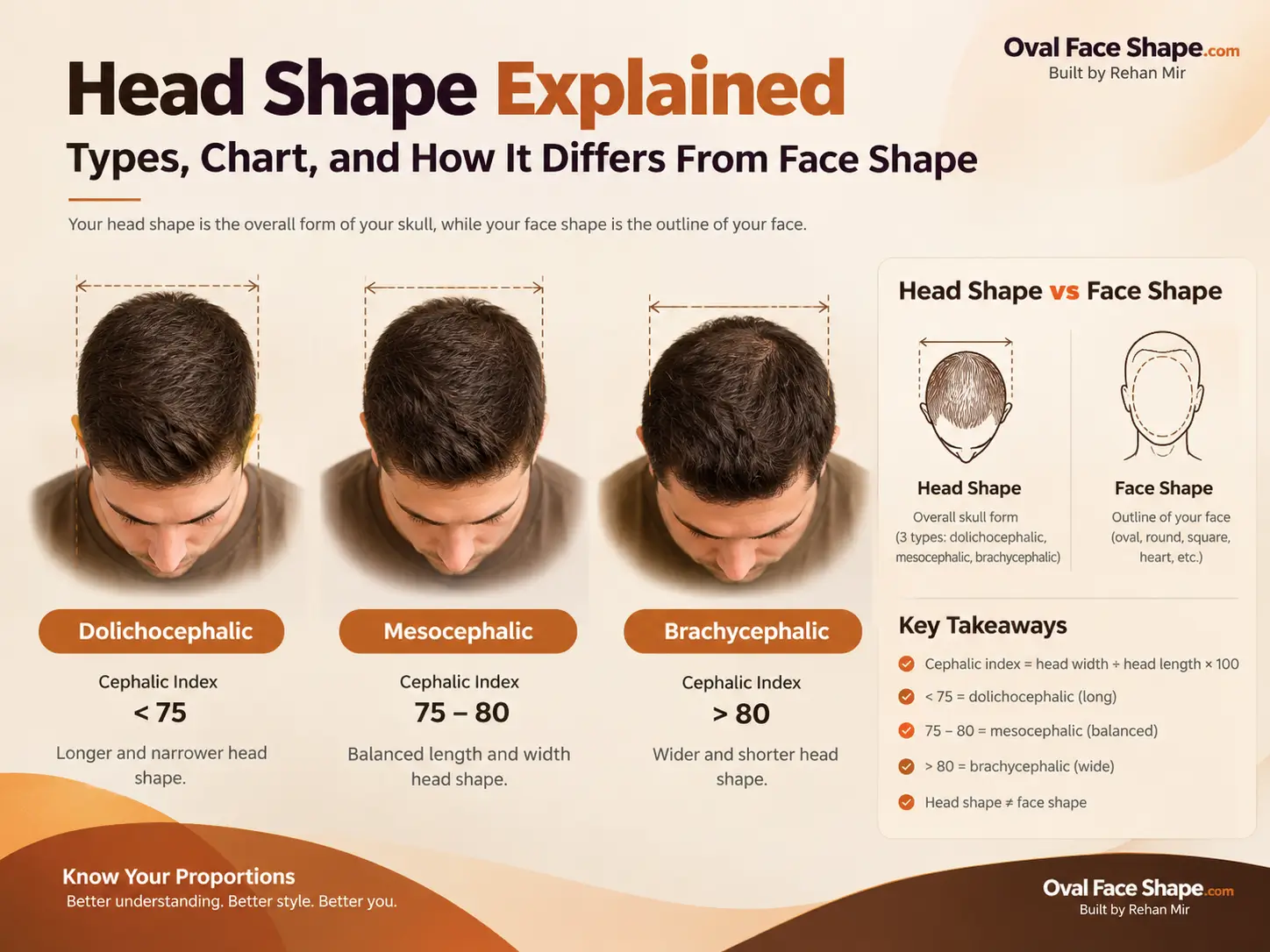
Head shape is the three-dimensional form of your skull. It is classified by the cephalic index as long (dolichocephalic), average (mesocephalic), or short and broad (brachycephalic). Face shape is the two-dimensional outline you see from the front, such as oval, round, square, or heart.
By Muhammad Rehan Iqbal, Founder and Developer of OvalFaceShape.com, specializing in face shape analysis, interactive facial assessment tools, and educational styling guides.
Who this guide is for:
Most people who search “oval head shape” or “head shape chart female” are really asking about face shape. This guide serves two readers on OvalFaceShape.com.
If you are choosing a haircut or glasses, jump to the face-shape sections. If you are buying a hat or helmet, or just curious about your skull, the chart below is yours. Parents asking about an infant’s flat spot should go to the last section.
Head Shape vs. Face Shape
| Head shape | Face shape | |
|---|---|---|
| What it describes | Skull proportions in 3D | Front-view outline of the face |
| Best viewed from | Above, behind, or the side | Straight on |
| Classification | Cephalic index: three main types | Oval, round, square, rectangle, oblong, heart, diamond, triangle, pear |
| Decides | Hat and helmet fit, very short cuts | Haircuts, glasses, beards, makeup |
The two share vocabulary but not measurements. A skull’s width-to-length ratio says nothing about forehead, cheekbone, or jaw width. That is why two people with the same face shape can need different helmet sizes.
Head Shape Chart: The Three Cephalic Index Types
The standard head shape chart comes from the cephalic index, introduced by Swedish anatomist Anders Retzius in the 1840s. The formula is maximum head width ÷ maximum head length × 100.
For example, a head 150 mm wide and 190 mm long gives 78.9, which is mesocephalic.
| Type | Common cutoff | Top-view look | In plain English |
|---|---|---|---|
| Dolichocephalic | Below 75 | Long, narrow oval | Noticeably longer than wide |
| Mesocephalic | About 75–80 | Balanced oval | In between |
| Brachycephalic | Above 80 | Short and rounder | Width close to length |
Treat these cutoffs as a guide. Sources print slightly different boundaries, and a 2026 Malaysian CT study defined its own ranges for that population. The Wikipedia entry on the cephalic index shows how much the bands vary. No type is universally the most common.
What “normocephalic” and “mesocephalic” mean?
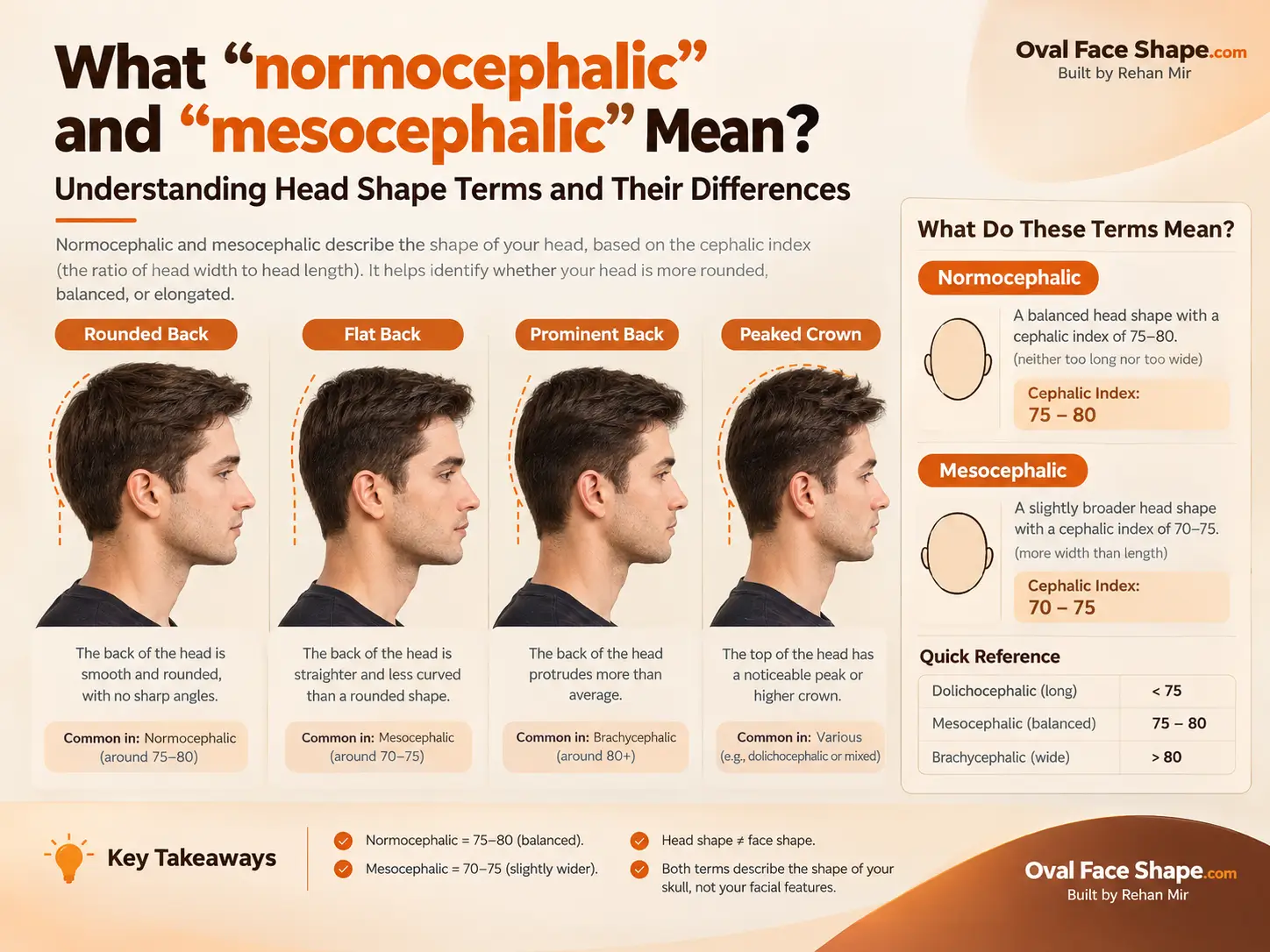
In medical notes, normocephalic means head size and shape fall within the normal range. It is a “nothing unusual” label, not a shape class. A normocephalic head can still be brachycephalic or dolichocephalic on the index. Mesocephalic is one of the three index classes above.
Brachycephaly: Normal Trait or Medical Term?
In adults, brachycephalic simply describes a skull that is broad relative to its length. It is normal variation and carries no health meaning.
In infants, the word has a medical use. Positional brachycephaly means symmetric flattening across the back of the head, often from time spent lying on the back. The Congress of Neurological Surgeons guideline notes that the term is also used when craniosynostosis is involved. That is a question for a pediatrician, not a styling page.
Types of Head Shapes From the Side View
There is no standard clinical vocabulary for the side view. These are the informal descriptors barbers and hat fitters use:
| Side-view feature | What you see | When it shows |
|---|---|---|
| Rounded back | Smooth curve from crown to nape | Short fades and tapers |
| Flat back | Back of the skull drops fairly straight | Buzz cuts. Often goes with a broader skull, but not always |
| Prominent back | Skull projects behind the neck line | Close tapers |
| High or peaked crown | Top rises to a gentle apex | Very short hair |
Head Shape Chart for Male and Female
Males and females are classified the same way, with the same three types. Population averages can differ slightly, but the ranges overlap heavily, and there is no accepted separate male or female skull chart.
When people search “head shapes female” or “type of head shapes male,” they usually mean face shape and styling. For that, use the face shape chart or the hairstyles by face shape guide.
Oval, Pear, Heart, Square: Those Are Face Shapes
| Search term | What it actually describes | Guide |
|---|---|---|
| Oval head shape | Balanced face, slightly longer than wide, soft jaw | Oval Face Shape |
| Oblong head shape | Elongated, softer-jawed face | Oblong Face Shape |
| Pear head shape | Jaw wider than forehead and cheekbones | Pear Face Shape |
| Heart head shape | Widest at the forehead, pointed chin | Heart Face Shape |
| Square head shape | Strong jaw, close in width to the forehead | Square Face Shape |
| Diamond, triangle, rectangle | Face outlines defined by cheekbone, jaw, and length proportions | Face shape chart |
| Round head shape | Both senses. A skull near equal in width and length, or a face of near equal width and length | Check which you mean |
None of these terms except “round” appears in the cephalic index.
How to Check Your Head Shape at Home?
- Take a photo from directly above with flat or tightly covered hair.
- Measure the widest and longest points on screen in the same units.
- Divide width by length and multiply by 100, then compare with the table.
Hair and camera angle add error, so this is an estimate. For hats, measure circumference with a soft tape, and use a professional fitting for helmets.
When Head Shape Affects Styling?
At most hair lengths, your hair sets the outline people see. Head shape only shows at a buzz cut, skin fade, or crop, where a flat back or peaked crown becomes part of the look. Face shape drives styling at every other length.
A Note on Babies!
Flat spots in infants are common and usually linked to sleep and resting position. The CNS guideline reports that repositioning helps virtually all infants with positional plagiocephaly or brachycephaly to some degree. Talk to your pediatrician rather than relying on a styling website.
Key Takeaways
- Head shape is a 3D skull measure. Face shape is a 2D front-view outline.
- The real head shape chart is the cephalic index: dolichocephalic, mesocephalic, brachycephalic.
- “Normocephalic” means within the normal range. It is not a shape type.
- Oval, oblong, pear, heart, square, diamond, triangle, and rectangle are face shapes, and “round” can mean either.
- Head shape matters for hats, helmets, and very short cuts. Face shape matters for styling at every length.
Not sure which face shape you have? Run the Face Shape Detector.
FAQs
What is the rarest head shape?
No authoritative global ranking exists. Prevalence of each class changes with the population and the cutoffs used. Within any group, the far ends of the index are the least common.
For face shapes, see the rarest face shape.
What head shape is most attractive?
No skull shape has been shown to be more attractive. Attractiveness research looks at faces, and hair hides most skull contour. If you mean face shape, our celebrity face shape guide shows how varied attractive faces are.
What is the correct head shape?
There is no single correct one. Healthy heads vary widely, and doctors use “normocephalic” for anything within the normal range. See a doctor if an infant’s head is clearly asymmetric or changes quickly.
Is head shape the same as face shape?
No. Head shape is the skull’s 3D form, and face shape is the front-view outline. They are measured differently and used for different decisions.
Is the cephalic index still relevant today?
Yes, in craniofacial medicine, forensic work, and anthropology. Its historical use to rank groups of people is outdated. Cutoffs vary by population, so use it as a descriptor.
Can head shape change as an adult?
The adult skull is largely fixed. Weight, hair, and aging change how the face looks, not the skull’s overall proportions. Infant skulls are soft and can be shaped by position.
How do I check my head shape at home?
Take a top-view photo, measure width and length, and compute the index. Treat it as an estimate and use a professional for hat or helmet fitting.