
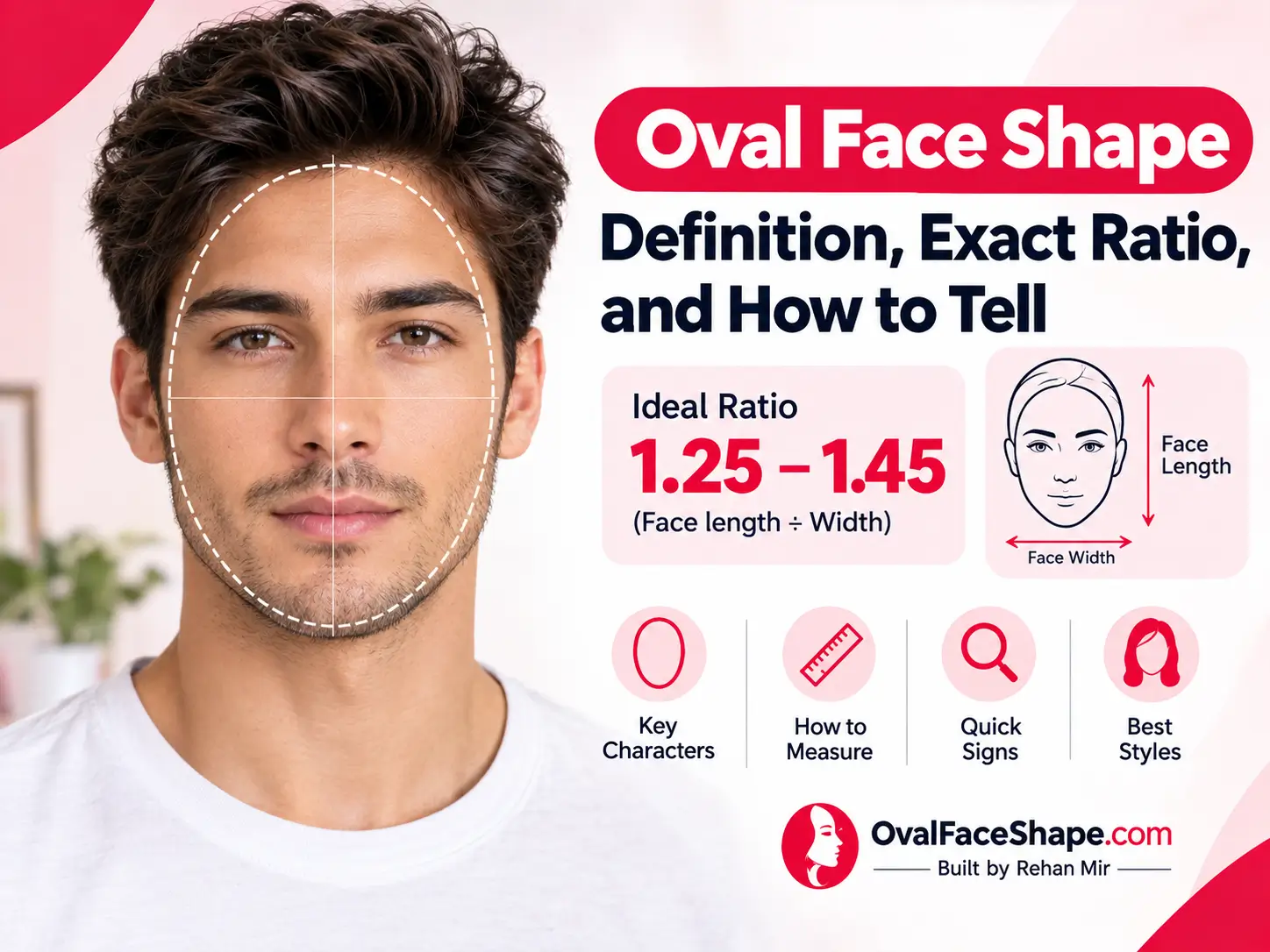
Quick Answer:
An oval face is moderately longer than wide — OvalFaceShape.com’s standard is a 1.3–1.5 ratio of face length to cheekbone width — with cheekbones as the widest point, a forehead slightly wider than the jaw, and a gently rounded chin. If your face reads closer to 1.5× longer than wide with straight sides, you may actually be oblong, not oval.
Who this guide is for:
If you’ve been told you have an oval face — or you’re trying to confirm it before booking a haircut or picking glasses — This guide is for you. It’s written for anyone confirming their shape for the first time, and for men specifically researching oval-face haircuts, who’ll find a short styling section below linking to OvalFaceShape.com’s full hairstyle guides.
What Is an Oval Face Shape?
An oval face is a face that’s moderately longer than it is wide, with cheekbones as the widest point, a jawline that curves gently inward, and a forehead a little wider than the rounded chin.
Nothing about it is angular — no corner in the jaw, no point at the chin, just one smooth curve from hairline to chin. It’s generally considered the most common face shape, and its balanced proportions are why it’s usually described as the easiest shape to style: no single feature needs correcting.
- Face length is moderately greater than face width
- Cheekbones are the widest point, but only slightly ahead of the forehead and jaw
- Jawline curves gently — no sharp corners
- Forehead is a touch wider than the chin
- Chin is softly rounded, not pointed or squared
This is different from a round face (length and width are close to equal), a square or rectangle face (the jaw is angular, not curved), and an oblong face (the ratio climbs past roughly 1.5:1 and the sides run straight instead of curving in).
Explore celebrities with an oval face shape and discover their defining facial features.
The Oval Face Ratio — and Why “1.5 Times Longer” Can Be Misleading
Face-shape classification comes from one core measurement: face length divided by cheekbone width. OvalFaceShape.com’s standard places oval between 1.3 and 1.5.
You’ll also see some guides describe oval as “about one and a half times longer than wide” — worth knowing that a ratio right at 1.5 is exactly where most systems, including ours, start classifying a face as oblong rather than oval.
That’s not guides contradicting each other maliciously; it’s a rounding difference at a real boundary, and it’s exactly why a precise measurement matters more than a rough mirror guess.
| Your ratio | Likely shape |
|---|---|
| ~1.0–1.15 | Round |
| 1.3–1.5 | Oval |
| ~1.45–1.55 | Borderline oval/oblong — check both guides |
| 1.5+ | Oblong |
If your number lands in that borderline band, the practical difference matters: oblong faces generally do better avoiding extra crown height, while oval faces have no such restriction.
How to Tell If Your Face Is Oval?
Pull your hair back and look straight into a mirror. Trace the outline with your finger:
- Is your face moderately longer than wide, without looking clearly stretched? → Oval leans yes.
- Are your cheekbones the widest point, only slightly ahead of your forehead and jaw? → Oval leans yes.
- Does your jaw curve with no hard corner, and your chin round off rather than point? → Oval leans yes.
Three “yes” answers points to oval. If you’re unsure on the first one — length is the dimension eyes misjudge most — measure it, or use a photo-based tool.
OvalFaceShape.com’s Face Shape Detector analyzes 468 facial landmarks and returns your exact ratio in seconds, rather than leaving you to guess in a mirror.
The Science Behind Facial Ratios!
This isn’t a stylist’s invention — it’s grounded in facial anthropometry, the field that measures standardized landmark distances on the face to classify facial bio-types.
Objective evaluation of facial surface anatomy through anthropometric measurement, while attractiveness itself remains subjective, is a long-established approach to analyzing facial structure.
In anthropometric research, the “mesoprosopic” phenotype — the medical term closest to what stylists call oval — is consistently the most commonly observed facial type in population studies.
One study of undergraduate medical students found the mesoprosopic type was the predominant phenotype, observed in over a third of participants, which lines up with why oval is generally described as the most common face shape in styling guides too.
Oval vs. Other Face Shapes at a Glance
| Shape | Length : Width | Widest point | Jawline |
|---|---|---|---|
| Oval | 1.3–1.5 : 1 | Cheekbones | Gently curved |
| Round | ~1 : 1 | Cheeks | Soft, full |
| Square | ~1 : 1 | Jaw | Angular |
| Oblong | 1.5+ : 1 | Roughly equal | Straight-sided |
Best Hairstyles for Oval Face Shape Men
Because an oval face has no feature that needs correcting, men with this shape have more freedom than almost any other. Buzz cuts, crew cuts, textured crops, French crops, and pompadours all work — the deciding factors become hair texture and how much daily styling you’re actually willing to do, not shape correction.
The general guardrails:
Keep some texture or volume on top so the face doesn’t read flat, and go easy on extreme crown height, which can slightly stretch an already-balanced proportion. For cut-by-cut guidance, hair-type notes, and barber scripts, see OvalFaceShape.com’s full Best Haircuts for Oval Face Shape Men and Oval Face Shape Hairstyles Men guides.
If you have curly hair and an oval face shape, read our complete guide to the best curly hairstyles for oval faces.
Key Takeaways
- An oval face is moderately longer than wide — 1.3 to 1.5 on OvalFaceShape.com’s standard — with cheekbones as the widest point
- A ratio near 1.5 sits on the seam with oblong; check both if you’re borderline
- The jawline curves gently, with no angular corners
- Anthropometric research confirms this general face type is the most common across studied populations
- A photo-based tool gives a more precise ratio than a mirror self-check
- “Ideal” framing aside, oval’s real, provable advantage is styling flexibility, not an objective beauty ranking
FAQs
Is an oval shape face attractive?
Yes, in the sense that its balanced proportions make it the most versatile shape to style — but attractiveness isn’t an objective, measurable category, so treat this as a flexibility advantage rather than a beauty verdict.
The “oval is ideal” framing traces back to classical styling convention, not a finding that oval measures as more attractive than other shapes.
What are the top 3 most attractive face shapes?
There’s no scientific ranking of face shapes by attractiveness. Oval, heart, and diamond are the three most often named in styling guides — not for beauty, but because their tapered proportions suit the widest range of hairstyles and glasses.
How do I know if my face is oval?
Check whether your cheekbones are the widest point, your jaw curves inward without sharp corners, and your face looks moderately longer than wide.
A photo-based tool like OvalFaceShape.com’s Face Shape Detector gives an exact ratio if a mirror check leaves you unsure — especially useful since oval sits right next to oblong on the ratio scale.
Is an oval face rare?
No — it’s generally considered the most common face shape, consistent with anthropometric findings that this general facial type is the most frequently observed across population studies.
Why do some guides describe oval as “1.5 times longer than wide”?
Because that figure sits exactly on the boundary most systems use to separate oval from oblong. A face at that ratio could reasonably be labeled either way depending on where a given guide draws the line — which is exactly why a specific measurement, not a rough description, is worth checking if you’re unsure.
Does an oval face change with age or weight?
Yes, to a degree. Weight changes affect cheek and jaw fullness, and aging can soften jawline definition, but the underlying bone-based ratio (length to cheekbone width) stays relatively stable through adulthood.
Can a face be “in between” oval and another shape?
Yes. Many faces sit near a boundary — most often between oval and oblong, or oval and round — rather than fitting one category perfectly. Treat your result as a leaning, not a rigid label.
17 thoughts on “Oval Face Shape: Definition, Exact Ratio, and How to Tell”