
Quick answer:
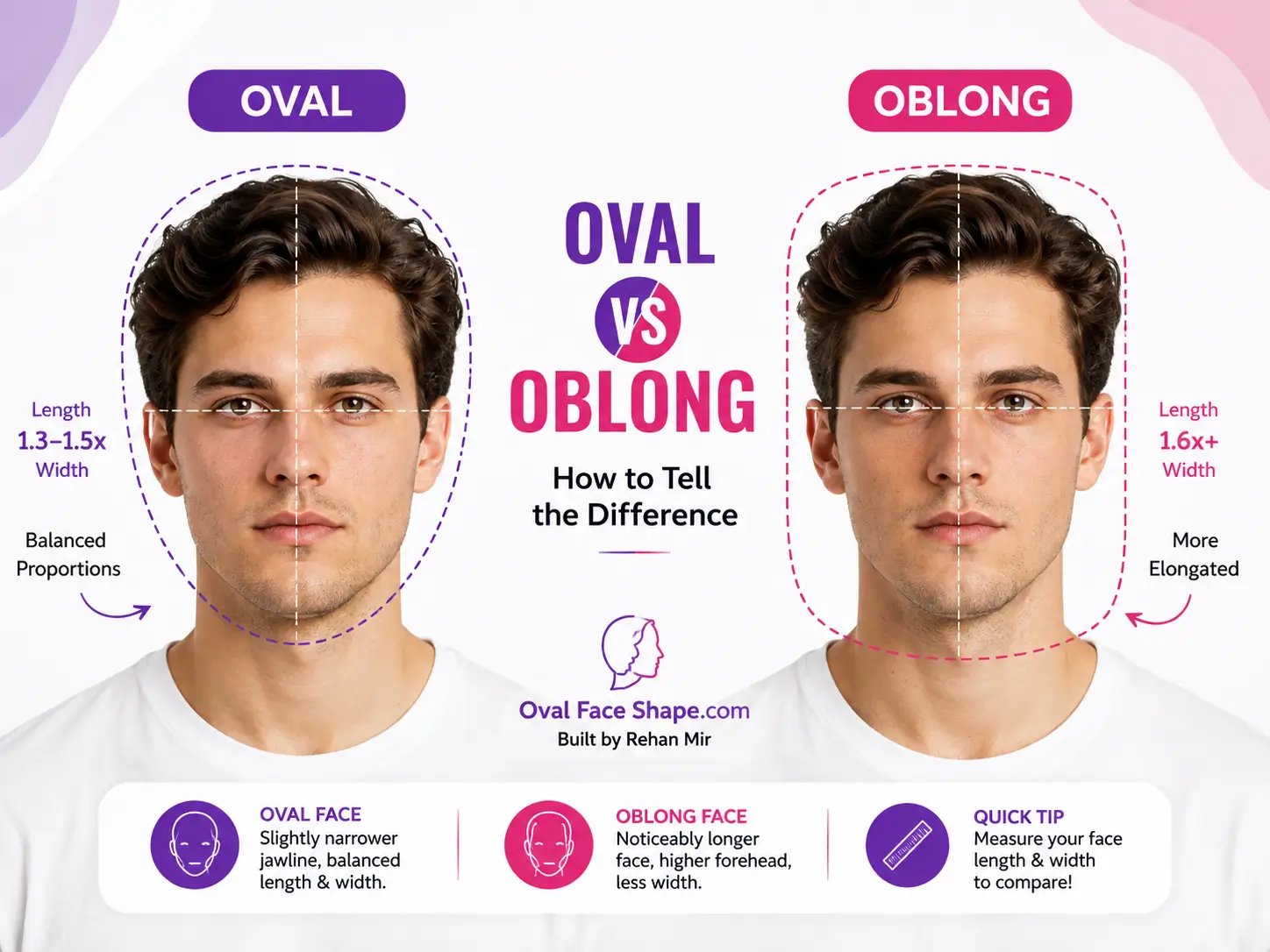
The key difference between oval and oblong face shapes is length relative to width. Oval faces typically measure 1.25–1.45, while oblong faces are 1.50+. Divide your face length by average face width: below 1.45 suggests oval, 1.50+ suggests oblong, and 1.45–1.50 is borderline.
If you’ve already ruled out round, square, and heart, and you’re stuck deciding between oval and oblong, you’re dealing with the two shapes people confuse most often — both are longer than they are wide, so the usual “look in the mirror” advice doesn’t settle it on its own.
Who Should Use This Face Shape Comparison?
This guide is built for one specific moment: you’ve measured or scanned your face, gotten “oval” from one quiz and “oblong” from another, and you need a clear answer before picking a hairstyle, glasses frame, or beard shape.
If you’re a stylist explaining the distinction to a client, the same logic below applies — it’s the same test either way. If you haven’t measured your face at all yet, OvalFaceShape.com’s own measuring guide walks through that step first; this article picks up from there.
The Core Difference: Length-to-Width Ratio
The single most reliable way to separate oval from oblong is a ratio, not an impression. Divide your face length (hairline to chin) by the average of three widths — forehead, cheekbone, and jaw.
| Ratio (length ÷ average width) | Likely shape |
|---|---|
| Roughly 1.3–1.45 | Oval |
| Roughly 1.45–1.5 | Borderline — see below |
| 1.5 or higher | Oblong |
This isn’t an arbitrary cutoff. Facial landmark measurement of this kind traces back to the anthropometric system developed by Leslie Farkas, whose landmark-based facial measurement atlas is still the reference point most facial-proportion research builds on today.
An oval face sits close to that lower ratio because its width holds up fairly well along its length. An oblong face sits higher because the face keeps extending in length well past where an oval face would already be tapering toward the chin.
Beyond the Ratio: Cheekbone, Jaw, and Chin
The ratio gets you most of the way there, but three visual traits confirm it.
Cheekbones:
On an oval face, the cheekbones are usually the widest single point, with a visible (if gentle) taper above and below them. On an oblong face, forehead, cheekbone, and jaw widths sit close enough to each other that no single point clearly stands out as widest.
Jawline:
An oval jawline curves inward smoothly toward the chin. An oblong jawline runs straighter for longer before it narrows, which is part of why oblong faces read as more angular even when the actual jaw angle is similar.
Chin:
Oval chins are consistently rounded. Oblong chins can be rounded or slightly squared — the chin shape alone doesn’t decide the category the way the ratio and the jawline do.
How to Measure Your Face Shape Accurately?
- Pull hair back fully and face a mirror or camera straight-on, not at an angle.
- Measure face length: hairline center to chin tip.
- Measure three widths: forehead (widest point), cheekbones (widest point), and jaw (widest point).
- Average the three widths, then divide your length by that average.
- Compare the result to the ratio table above.
A photo-based tool removes most of the measurement error that comes from a shaky tape or an angled phone.
OvalFaceShape.com’s Face Shape Detector reads these same landmark proportions from a single photo if you’d rather skip the manual math.
When You’re Right on the Border?
A ratio between roughly 1.45 and 1.5 is a real, common outcome — not a measurement failure. It usually means an elongated oval rather than a true oblong.
The practical takeaway is to lean on oval-friendly styling but avoid the one thing that pushes a borderline face toward looking longer: heavy volume at the crown.
If the manual measurement and a photo scan disagree, run both twice before trusting either — angle and hair placement are the most common sources of error at this specific range.
Why Getting This Right Matters for Styling?
Oval faces are the most forgiving shape to style — nearly every haircut, frame shape, and beard style works reasonably well because the proportions are already close to even.
Oblong faces work best with the opposite approach: styles that add visible width (waves, layers at cheek level, fuller beards on the sides, wider glasses frames) rather than styles that add height.
Confirming which shape you actually have — before choosing a style built for the other one — is the whole point of this comparison.
The full styling breakdown for each shape lives in the dedicated Oval Face Shape guide and Oblong Face Shape guide.
Key Takeaways
- The reliable test is a ratio (length ÷ average width), not a visual guess — round, square, and heart faces are ruled out first because oval and oblong are the two that most resemble each other.
- Oval: ratio roughly 1.3–1.45, curved cheek line, rounded chin, widest point usually the cheekbones.
- Oblong: ratio 1.5 or higher, straighter parallel sides, forehead/cheekbone/jaw widths close to equal.
- A ratio between 1.45–1.5 is a real borderline case — style as an elongated oval and avoid heavy crown volume.
- Getting the shape right first matters because oval and oblong take opposite styling approaches.
FAQs
What’s the fastest way to tell if I’m oval or oblong?
Measure your face length and your three widths (forehead, cheekbone, jaw), then divide length by the average width. Under roughly 1.45 points to oval; 1.5 or higher points to oblong.
Is “oblong” just a longer version of “oval”?
Not exactly — this is the most common misconception. Length alone doesn’t decide it; an oblong face also has straighter, more parallel sides, while an oval face keeps a visible taper even as it gets longer.
Is an oblong face shape still considered oval by some older style guides?
Yes. Older style guides sometimes grouped both under one “long face” category, or used the terms loosely as synonyms, which is part of why the two get confused today even though modern face-shape guidance treats them separately.
Which is more common, oval or oblong?
There isn’t a single independent, peer-reviewed dataset on face-shape prevalence that this article can point to with confidence — treat any specific percentage you see quoted online (including on other face-shape sites) as that site’s own self-reported figure, not an independently verified statistic.
Is an oblong face automatically closer to the “golden ratio” and therefore more attractive?
No — this claim shows up on other face-shape sites but isn’t well supported. Peer-reviewed research on the golden ratio and facial attractiveness has found mixed and often weak support for any single ratio predicting perceived attractiveness, so treat “closer to 1.618” as an interesting number, not a verdict on attractiveness.
Do oval and oblong faces suit the same hairstyles?
Mostly no. Oval faces have room to wear almost any style. Oblong faces do better with styles that add width and avoid extra height, since the goal is to visually shorten rather than lengthen the face further.