
Quick Answer:
No. Oval faces measure about 1.3–1.5 length-to-width, short of phi (1.618), so oblong sits closer. But phi isn’t a proven beauty standard, and oval’s strength is balance.
By Muhammad Rehan Iqbal, Founder and Developer of OvalFaceShape.com, specializing in face shape analysis and interactive facial assessment tools.
Who this guide is for:
Readers of OvalFaceShape.com who received an oval face shape result from the Face Shape Detector, or a golden ratio score from a calculator, and want to know how the two connect before using either for styling or self-assessment.
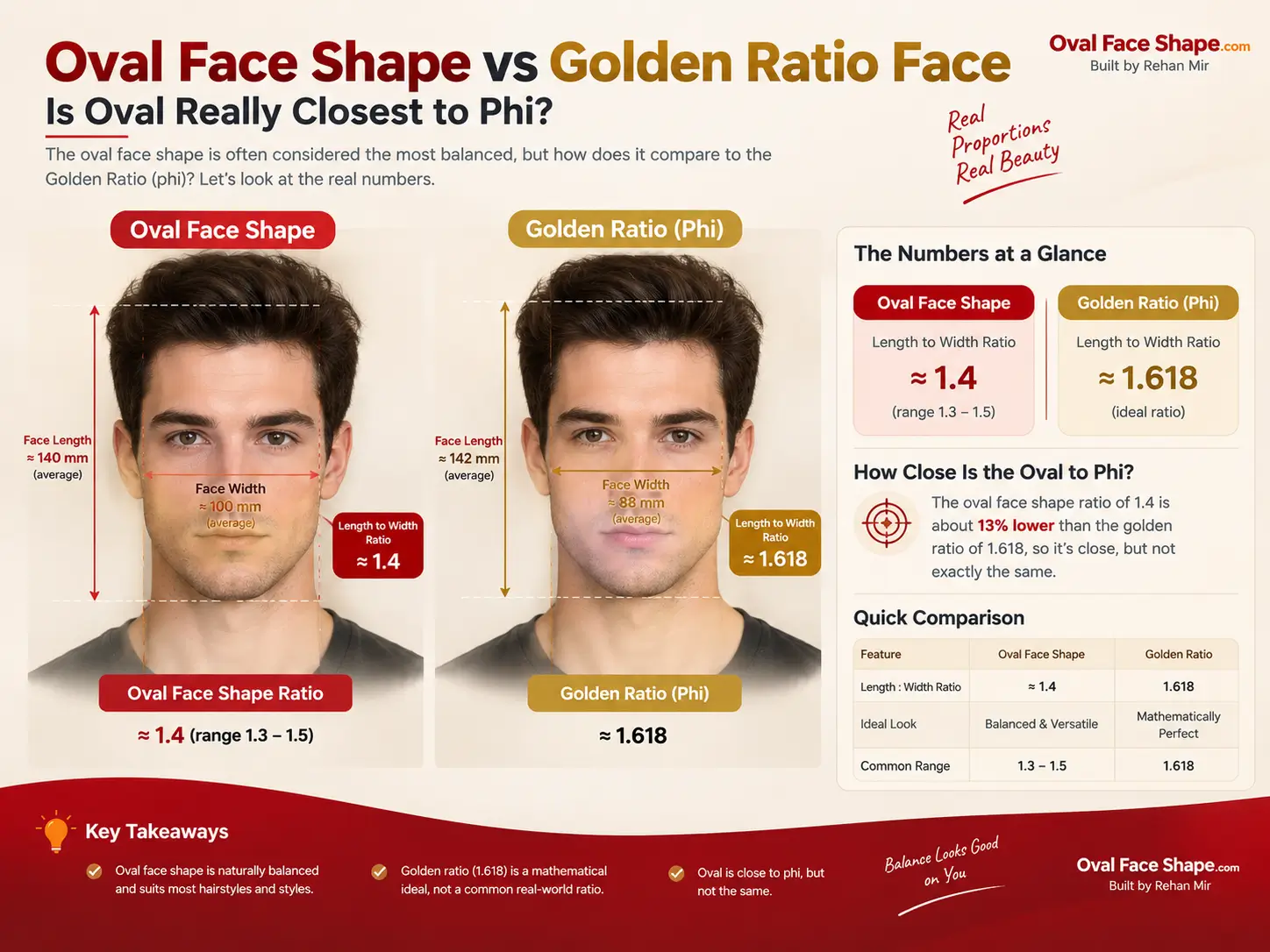
Oval face shape is not the shape closest to the golden ratio (phi, 1.618). Measured as face length divided by cheekbone width, oval faces fall around 1.3–1.5, so oblong faces (above 1.5) sit numerically nearer phi. Oval earns its “ideal” reputation through balance, not through arithmetic that matches 1.618.
What Does a “Golden Ratio Face” Actually Measure?
Golden face ratio, golden proportion face and face beauty ratio are all names for the same idea: comparing facial distances with phi. Tools apply it in three different ways, and each gives a different answer for oval face shape.
| Metric | What is compared | Oval face shape | Research support |
|---|---|---|---|
| Length-to-width | Hairline-to-chin ÷ cheekbone width; phi target 1.618 | About 1.3–1.5 | None found (Naini, 2024) |
| Eye spacing | Distance between eyes ÷ face width; optimum ≈46% | Independent of face outline | Pallett et al., 2010 (female faces) |
| Eye-to-mouth | Eyes-to-mouth distance ÷ face length; optimum ≈36% | Independent of face outline | Pallett et al., 2010 (female faces) |
Length-to-width is the metric most calculators headline, and it is the weakest. A 2024 review by Farhad Naini in Maxillofacial Plastic and Reconstructive Surgery found no convincing evidence linking the golden ratio to idealized human proportions or facial beauty, or to surgical planning.
Explore our guides to celebrities with oval face shapes and celebrities with golden ratio faces to discover famous examples and learn more about facial proportions.
Oval Face Shape vs Golden Ratio Face: The Actual Numbers
On length-to-width, oval faces sit roughly 7% to 20% below phi, while oblong faces sit within about 7% of it.
| Face shape | Length-to-width band | Gap from 1.618 |
|---|---|---|
| Oblong | Above 1.5 | Within ~7% |
| Oval | 1.3–1.5 | ~7–20% below |
| Square | 1.05–1.20 | ~26–35% below |
| Round | About 1.0 | ~38% below |
Bands are OvalFaceShape.com classification ranges, not population statistics. See all shapes in types of face shapes.
Several comparison pages already say oblong lands closest to phi, and on this single metric they are right. That doesn’t make oblong more attractive or oval less balanced. It only shows that closeness to 1.618 and attractiveness are separate questions. The oval vs oblong guide shows how to tell the two apart.
Why Is Length-to-Width an Unreliable Yardstick?
The ratio changes with where “length” starts. A study of 1,003 healthy Turkish adults measured face length from nasion to gnathion instead of from the hairline. Its prosopic index averaged 84.31 in men and 85.25 in women, so the face measured shorter than wide. The same face can read below 1 or near 1.4 depending on landmarks.
A hairline-based length also moves with hairstyle, a receding hairline or a fringe, and photo angle can shift the width. A “1.618” claim without named landmarks cannot be checked.
What Does Research Treat as the Real “Golden Ratios”?
In 2010, Pamela Pallett, Stephen Link and Kang Lee tested faces with identical features but altered eye spacing and eye-to-mouth distance.
Faces were judged most attractive when the eye-to-mouth distance was about 36% of face length and the distance between the eyes about 46% of face width. These ratios match an average face, not phi.
Those two numbers describe feature spacing, not outline. Oval, oblong and round faces can all match them, so oval face shape carries no built-in advantage.
Oval Face vs Golden Ratio Face: Male and Female
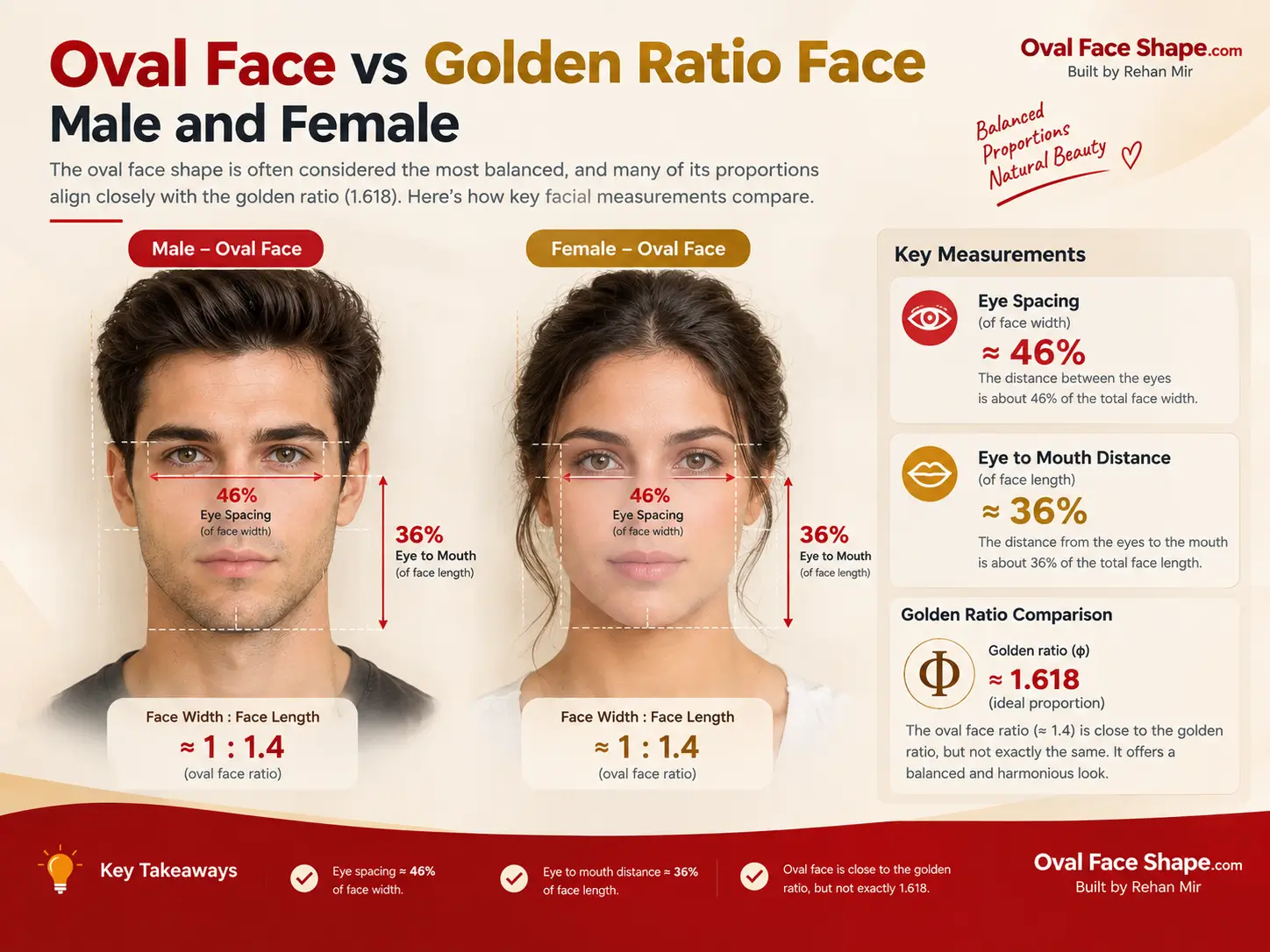
Female faces
Pallett’s experiments used female faces, and the researchers noted that male faces and other populations still needed testing.
Male faces
A preprint from Marburg University tested morphed male faces with 97 participants. It estimated the preferred eye-spacing ratio at roughly 0.457–0.464, close to the female 46%.
Explore our complete guide to the eye spacing ratio to learn how eye distance is measured, understand facial proportions, and interpret your results.
The authors name morphed composites and ethnicity as limits, so treat it as preliminary. Neither study supports a separate golden-ratio standard for oval faces by sex.
Is a Perfect Golden Ratio Face Real?
A perfect golden ratio face would need every measured ratio to equal phi at once, and Naini’s review found no evidence for treating that as an ideal.
Most consumer tools score against Marquardt’s phi mask, whose limits are covered in our golden ratio face guide. Treat any single score as one data point beside your face shape category.
Oval Face Shape vs Golden Ratio Face Test: How to Check Yours
- Take a front-facing, neutral photo at eye level with hair off the forehead.
- Measure hairline-to-chin and cheekbone-to-cheekbone width, then divide length by width.
- Read the result against the bands above: 1.3–1.5 is oval, above 1.5 is oblong. The Face Shape Detector finds landmarks automatically.
- Divide eye-to-eye distance by face width, and eye-to-mouth distance by face length, then compare with 46% and 36%.
- Treat results within a few points as typical, not as a grade.
A golden ratio face calculator or face rating app rolls these into one score. Each tool anchors to different landmarks and weights, so two tools can score one photo differently. An attractiveness face test measures geometry only; symmetry, averageness and culture also shape perceived attractiveness.
Hairstyles for an Oval Face and Golden-Ratio Balance
Hairstyle changes how long a face looks, not the underlying bone structure. For oval face shape, the practical choice is whether to expose or cover the forehead, since that alters apparent length. Browse hairstyles by face shape before treating any ratio as a reason to change your cut.
Key Takeaways
- Oval face shape (about 1.3–1.5) sits below the golden ratio (1.618); oblong sits closer on length-to-width.
- “Closest to phi” and “most balanced” are different claims.
- Naini’s 2024 review found no convincing evidence tying the golden ratio to facial beauty.
- Pallett et al.’s 36% and 46% ratios describe feature spacing and apply to any face outline.
- Scores depend on landmarks, hairline and photo angle. Use them as a guide, not a grade.
Next step:
See your own length-to-width, eye-spacing and eye-to-mouth ratios side by side in the Golden Ratio Face Detector.
FAQs
Is an oval face the “perfect” face shape?
No. Oval is the most balanced and versatile shape for styling, but “perfect” has no scientific definition. Naini’s 2024 review found no convincing evidence for an ideal golden-ratio face.
Is the golden ratio still a valid way to judge a face?
Only as a rough reference. Research points to averageness, symmetry and culture as stronger influences, and Pallett’s optimal ratios match average faces rather than phi.
Which scores higher on a golden ratio face calculator, oval or oblong?
Oblong, on length-to-width, because above 1.5 sits nearer 1.618. Oval and oblong faces can score equally on eye spacing and eye-to-mouth ratios, which don’t depend on face outline.
How do I calculate my golden ratio face score?
Divide face length by width and compare with 1.618, then compare eye spacing with 46% and eye-to-mouth distance with 36%. Use a front-facing photo and name your landmarks, because the result depends on them.
Why do golden ratio face tests give different results?
Tools anchor to different landmarks, weigh ratios differently and react to photo angle and hairline. The Turkish prosopic-index study shows how landmark choice alone can move a face’s ratio from above 1 to below 1.
Can a haircut change my golden ratio face ratio?
It changes measurements that use the hairline, and how long your face looks. It does not change bone-based landmarks such as cheekbone width or chin position.