
Quick Answer:
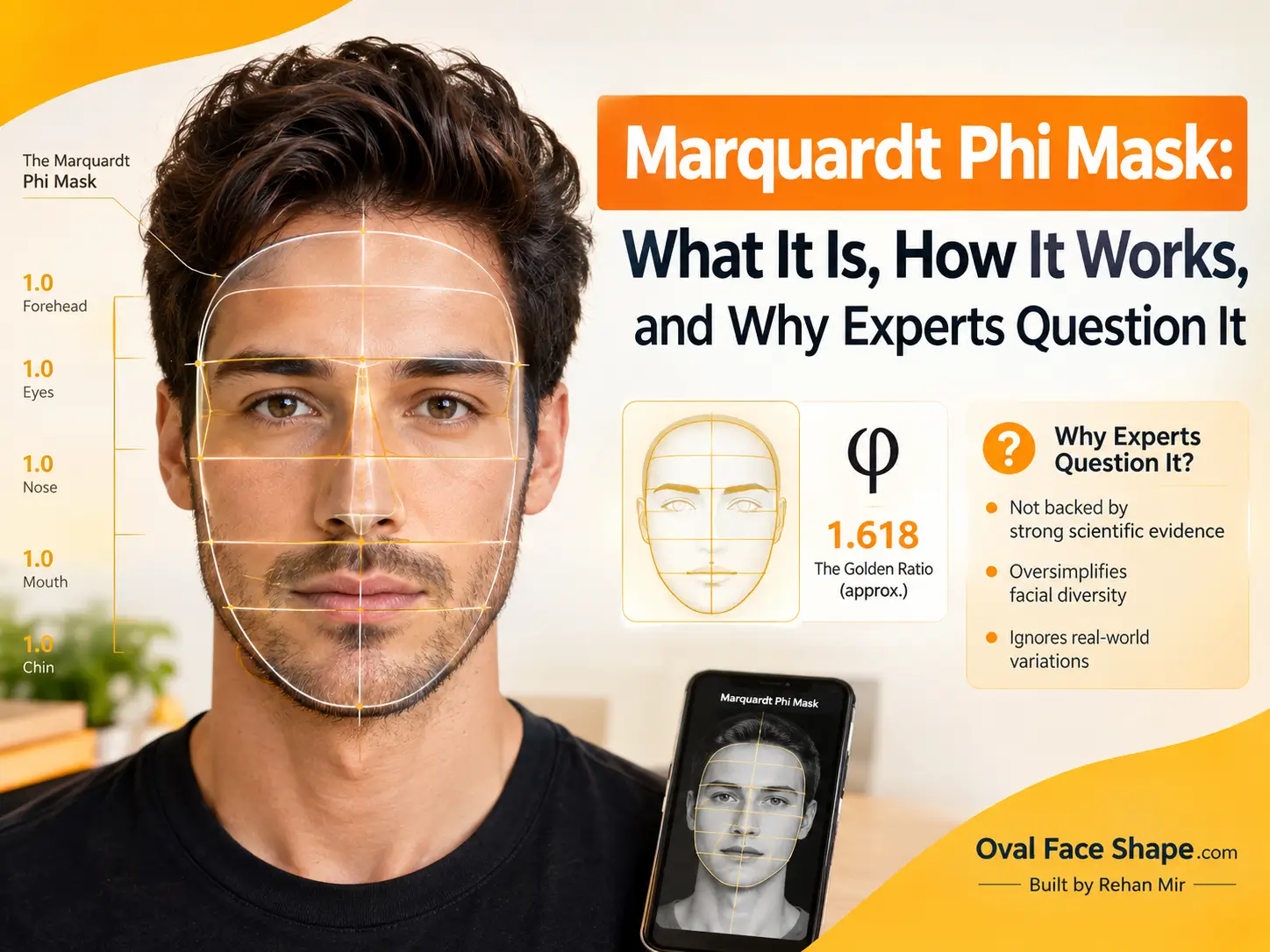
The Marquardt Phi Mask is a facial template built from the golden ratio (1.618), created by Dr. Stephen Marquardt to model an “ideal” face — but peer-reviewed research finds it best matches masculinized white fashion models, not a universal beauty standard.
Who this guide is for:
If you’ve landed on this page after seeing your photo run through a “golden ratio face test,” you’re looking at the Marquardt Phi Mask.
This guide explains where it came from, how the geometry actually works, and — just as important — what the published criticism of it actually says, so you can weigh it honestly against tools like OvalFaceShape.com’s own Face Shape Detector rather than treating it as a verdict on your face.
What Is the Marquardt Phi Mask?
The Marquardt phi mask is the most famous attempt to turn the golden ratio into a complete face template, created by American oral and maxillofacial surgeon Dr. Stephen Marquardt around 2002. It overlays a geometric grid built entirely from phi (1.618) onto a face photo.
The result was never published in a peer-reviewed journal by Marquardt himself — it was patented rather than academically peer-reviewed. The mask exists in frontal and lateral (side-profile) versions, and in both “repose” (neutral) and smiling expressions. Devils’ Lane, CA
Who Is Dr. Stephen Marquardt?
Stephen R. Marquardt is a retired oral and maxillofacial surgeon based in Orange County, California, known for the “Marquardt face mask” or “repose frontal mask” — a drawing said to represent the proportions of an ideal human face using the golden ratio.
He is CEO of Marquardt Aesthetic Imaging and has studied human beauty for decades, including cross-cultural surveys and historical facial analysis dating from ancient times to the present. In his own words, given in an interview published by the Journal of Clinical Orthodontics: The Golden Ratio is a ratio found in nature and design that measures 1:1.618, also called the Fibonacci Ratio, Phi Ratio, or divine ratio. Stephen R. Marquardt
How the Golden Ratio Mask Works?
The mask isn’t a single number applied to your face — it’s a full grid of proportions. Marquardt describes the mask as the two-dimensional expression of the Phi Ratio in the face, distinct from the older “Golden Divider” caliper method that only measured linear relationships. Key features of the method: Journal of Clinical Orthodontics
- Built from the golden decagon and pentagon, not freehand
- Separate masks exist for repose and smiling expressions
- Frontal and lateral (profile) versions are both defined
- Fit is assessed by overlaying the mask on a photo and checking alignment at landmark points (eyes, nose, jawline, cheekbones)
A closer photo-to-mask match is presented as a higher “golden ratio score” — the basis of most online “phi mask test” tools.
The Real Criticism, With Sources
This is where most explainer pages stop short. A peer-reviewed study published in Aesthetic Plastic Surgery directly tested the mask’s claims using statistical shape analysis. The authors found the method used to examine goodness of fit with the mask’s proportions was faulty, and that the mask is ill-suited for non-European populations, especially sub-Saharan African and East Asian faces.
Their conclusion, based on Generalized Procrustes and thin-plate spline analysis, was that Marquardt’s mask best describes the facial proportions of masculinized white women as seen in fashion models — not an “ideal” face shape for most people, particularly with regard to femininity. SpringerPubMed
That distinction matters:
The mask isn’t wrong because it’s mathematical, it’s limited because it was built from a narrow reference population, and later analysis found it approximates masculine European features rather than a cross-cultural ideal. ResearchGate
Wanna learn about the golden ratio in facial proportions and celebrities with golden-ratio faces? Read our detailed golden ratio face guide.
Should You Take a Phi Mask Score Seriously?
Treat it the same way you’d treat any single-model beauty metric: as one geometric perspective, not a diagnosis. It can be a fun way to see how your proportions compare to one historical template, but it isn’t a validated measure of attractiveness, and a low “score” says nothing about your actual face shape, symmetry, or how others perceive you.
If what you actually want is an accurate read on your face shape — as opposed to a golden-ratio novelty score — that’s a separate, better-supported question. OvalFaceShape.com’s Face Shape Detector uses live facial landmark analysis instead of a single fixed template, and is the tool to use if your goal is styling guidance (hairstyles, glasses, beard shape) rather than a beauty-ranking exercise.
Curious how facial fifths and facial thirds are measured and explained? Explore our detailed guide to facial proportions.
Mask vs. Masque: Quick Clarification
“Phi mask” and “phi masque” refer to the same golden-ratio face template — “masque” is simply an alternate spelling, not a different concept. It has no relation to skincare “masque” products (moisturizing or clay treatments); those are a completely different category.
Key Takeaways
- The Marquardt Phi Mask is a golden-ratio-based facial template created by Dr. Stephen Marquardt around 2002, patented rather than peer-reviewed.
- It’s built from golden decagon/pentagon geometry, with separate frontal/lateral and repose/smiling versions.
- Independent peer-reviewed analysis found it best fits masculinized white fashion models, not a universal beauty standard, and is a poor fit for non-European faces.
- A phi mask score is a geometric novelty, not a validated attractiveness or face-shape measurement.
- For actual face-shape identification and styling guidance, use a landmark-based tool like the Face Shape Detector instead.
Curious how your own proportions read? Run your photo through the Face Shape Detector for a landmark-based read on your face shape, rather than a single-template golden ratio score.
FAQs
Is the Marquardt Phi Mask scientifically accurate?
Not in the way it’s often marketed. Its own creator never published it in a peer-reviewed journal, and a study in Aesthetic Plastic Surgery found its fitting method flawed and its proportions specific to one demographic group, not a universal ideal.
Who created the Marquardt Phi Mask?
Dr. Stephen R. Marquardt, a retired American oral and maxillofacial surgeon, developed it around 2002 after decades of studying reconstructive facial surgery and cross-cultural beauty perception.
Does the Marquardt Phi Mask work for all ethnicities?
No. Peer-reviewed analysis found it is ill-suited for non-European populations, particularly sub-Saharan African and East Asian faces, since it was derived from a narrow reference sample.
Is “phi masque” different from “phi mask”?
No — “masque” is just an alternate spelling of “mask” in this context, referring to the same golden-ratio facial template. It’s unrelated to skincare masque products.
Is a golden ratio face test still worth trying in 2026?
As a curiosity, yes — it’s a quick way to see how your proportions compare to one historical template. As a measure of attractiveness or an accurate face-shape read, no; a landmark-based tool is more reliable for styling decisions.