
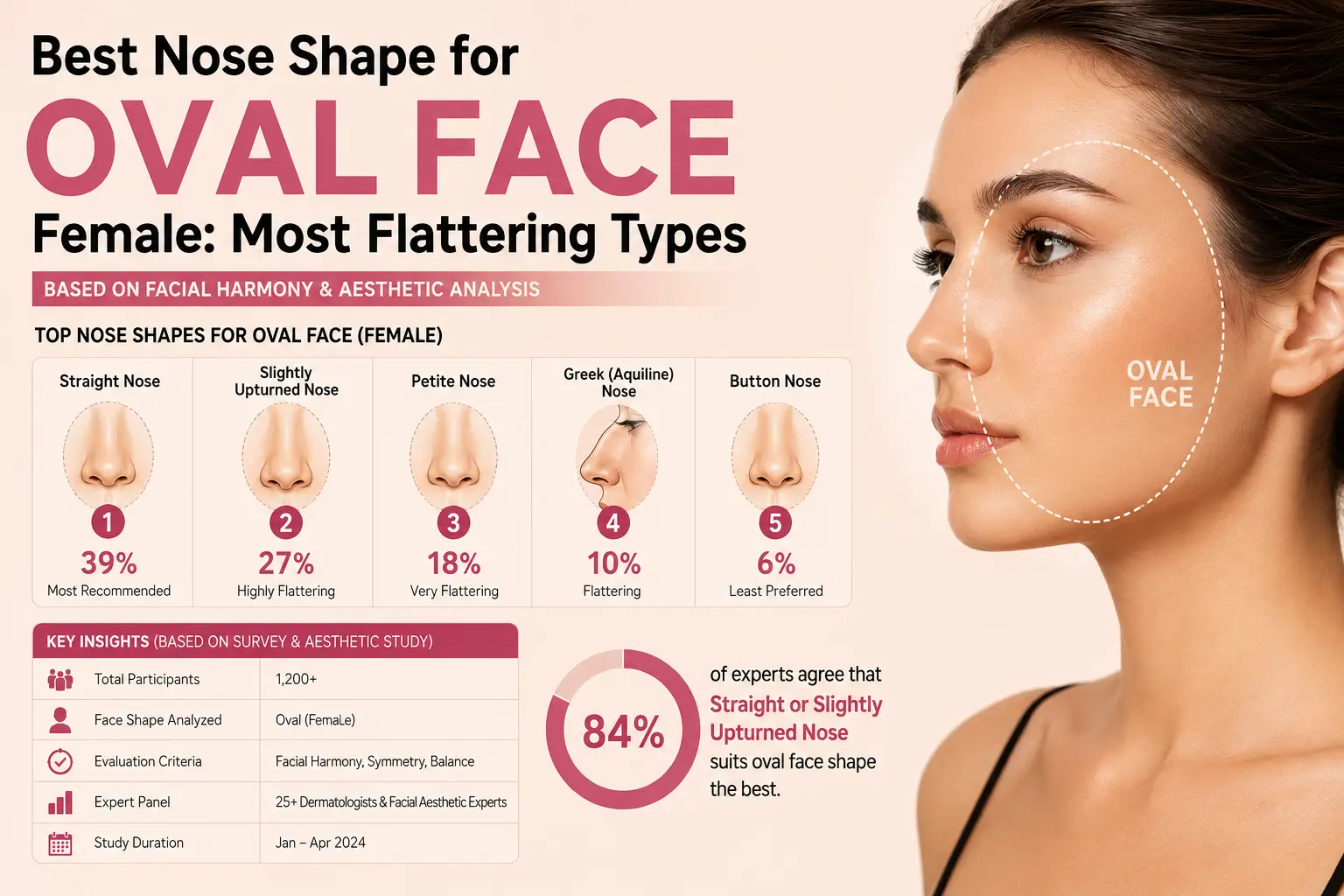
Quick Answer:
An oval face is naturally balanced, so it suits more nose shapes than most — but a straight (Greek) nose, a soft button nose, or a subtle celestial (upturned) nose tends to look most harmonious, because each preserves the face’s existing symmetry instead of competing with it.
Why the Oval Face Shape Works With So Many Nose Shapes?
An oval face, as defined on the Oval Face Shape guide, has a length modestly greater than its width, a gently rounded jawline, and cheekbones that sit as the widest point without sharp angles.
If you haven’t confirmed your shape yet, the Face Shape Detector can check it in under a minute before you read further.
Nose Shape, Facial Proportions & Ratios for Oval Faces
Because no single feature dominates an oval face, it has more visual “room” to carry different nose shapes without looking unbalanced. Facial-aesthetics research consistently treats proportion and symmetry — not any one feature in isolation — as the main drivers of perceived facial harmony.
A 2023 pilot study in the Journal of Clinical and Diagnostic Research measuring nasal proportions against observer-rated attractiveness found that how well the nose’s dimensions matched the rest of the face’s proportions tracked closely with higher aesthetic scores — reinforcing that “best” nose shape is a proportion question, not a fixed template.
The Nose Shapes That Work Best With an Oval Face
Straight (Greek/Grecian) nose:
A nose with a straight bridge and minimal curve is the shape most consistently named as the strongest match for an oval face. A straight bridge mirrors the face’s own straight-line balance rather than introducing a new angle for the eye to reconcile.
Button nose:
Small, soft, and slightly rounded at the tip, a button nose reinforces the softness an oval face already has, without adding structure that competes with the jawline or cheekbones.
Celestial (upturned) nose:
With a subtle upward tilt at the tip, this shape reads as youthful and delicate. On an oval face it adds a light touch of definition without overwhelming already-balanced proportions.
Wanna know about nose pins for an oval face shape? Read our detailed guide on nose pins for oval face shape.
Roman nose, in moderation:
A defined bridge can add elegance to an oval face precisely because the face has enough natural balance to absorb a stronger nasal line without looking disproportionate — this only holds when the bridge is a modest, not pronounced, curve.
Snub nose:
Short and slightly flat, a snub nose keeps the overall look playful rather than commanding, which still sits comfortably within an oval face’s balance.
Nose-Shape Comparison Table
| Nose Type | Key Trait | Why It Works on Oval Faces |
|---|---|---|
| Straight (Greek) | Minimal bridge curve | Mirrors the face’s own symmetry |
| Button | Small, rounded tip | Reinforces softness and balance |
| Celestial (upturned) | Slight upward tip | Adds youthful delicacy |
| Roman | Defined bridge | Adds elegance without imbalance |
| Snub | Short, slightly flat | Keeps the look playful, still harmonious |
Does Ethnicity or Individual Proportion Change the “Ideal” Nose Shape?
Yes — harmony is relative to a person’s full facial structure, not a single universal template. Anthropometric research on facial proportion (the “facial thirds and fifths” framework used in plastic surgery and orthodontics, detailed further on our Facial Thirds and Fifths guide) has repeatedly found that neoclassical “ideal” ratios don’t hold uniformly across populations.
One 2015 study of young adults from the Arabian Peninsula found the classic proportion “canons” didn’t validate in that population, concluding that aesthetic goals should respect ethnic variation rather than force one template onto every face. That’s the honest answer to “what does the perfect nose look like”: there isn’t one fixed shape — there’s a shape that’s proportionate to the individual face it’s on.
This is the direct answer to the “oval face female Asian” and “oval face European” variants of this question: The underlying principle — a nose that preserves rather than competes with the face’s balance — stays constant, but the specific proportions that read as flattering shift with the rest of an individual’s features.
Real-World Examples
Aishwarya Rai Bachchan is frequently referenced in South Asian beauty commentary as an example of an oval face paired with a straight, symmetrical nose bridge. Jessica Alba is a commonly cited Hollywood example of the same pairing.
Both are public examples used in styling and media commentary, not clinical assessments — but they illustrate the same principle holding across different backgrounds: The type of harmony (symmetry-preserving) stays consistent even as the specific proportions differ.
Readers curious about a defined-bridge alternative can also see our Roman and Aquiline Nose guide for how that shape reads on different face shapes, including oval.
Nose Contouring for an Oval Face, in Brief
For readers not considering any permanent change, makeup can approximate some of this effect: a light shimmer down the center of the bridge with soft shading along the sides visually straightens the nose, and a small highlight on the tip can mimic the softness of a button or celestial nose.
This is a temporary styling technique, not a structural change, and it’s the practical use case this article is written for — surgical guidance is outside its scope.
Want to learn the best contouring, makeup techniques, and placement tips for an oval face? Read our complete oval face shape makeup guide.
Key Takeaways
- Oval faces are unusually nose-flexible because no single feature dominates the face.
- Straight (Greek), button, and celestial nose shapes are the most consistently cited harmonious pairings.
- “Best” nose shape is a proportion question — anthropometric research backs this, not just styling opinion — and ethnicity and individual features shift the specifics, not the underlying principle.
- Aishwarya Rai Bachchan and Jessica Alba are commonly referenced real-world examples of the straight-nose-on-oval-face pairing.
- Makeup contouring can approximate these effects temporarily; it doesn’t change bone or cartilage structure.
Not sure your face is actually oval? Run it through the Face Shape Detector before you decide which nose shapes to compare it against.
FAQs
Is there one “best” nose shape for every oval face?
No. A straight or button nose is the most frequently cited match, but oval faces are flexible enough that several nose shapes can look harmonious depending on the individual’s other features.
Is a straight (Greek) nose still considered the ideal pairing for an oval face?
Yes — it remains the most consistently cited pairing in beauty and cosmetic commentary because it mirrors rather than competes with the face’s natural symmetry.
What does the “perfect” nose shape actually mean?
There isn’t a single universal shape. Anthropometric research shows proportion “ideals” don’t hold uniformly across populations, so the most accurate answer is a nose that’s proportionate to the individual face, not one fixed template.
How does the best nose shape for an oval face compare to a round face?
Round faces are typically paired with noses that add definition, like a celestial or Roman nose, while an oval face has enough natural balance to also suit softer shapes like a button nose.
Does nose contouring actually change my face shape?
No — contouring creates a temporary visual effect with light and shadow; it doesn’t alter the underlying bone or cartilage structure of the nose or face.
Which celebrity is a well-known example of an oval face with a harmonious nose?
Aishwarya Rai Bachchan is one of the most frequently referenced examples in South Asian beauty media of an oval face paired with a straight, symmetrical nose.
Why do different sources recommend different “ideal” nose shapes for the same oval face?
Because harmony is relative — it depends on the person’s specific proportions, ethnic background, and other facial features, not a single fixed rule.