
Quick Answer:
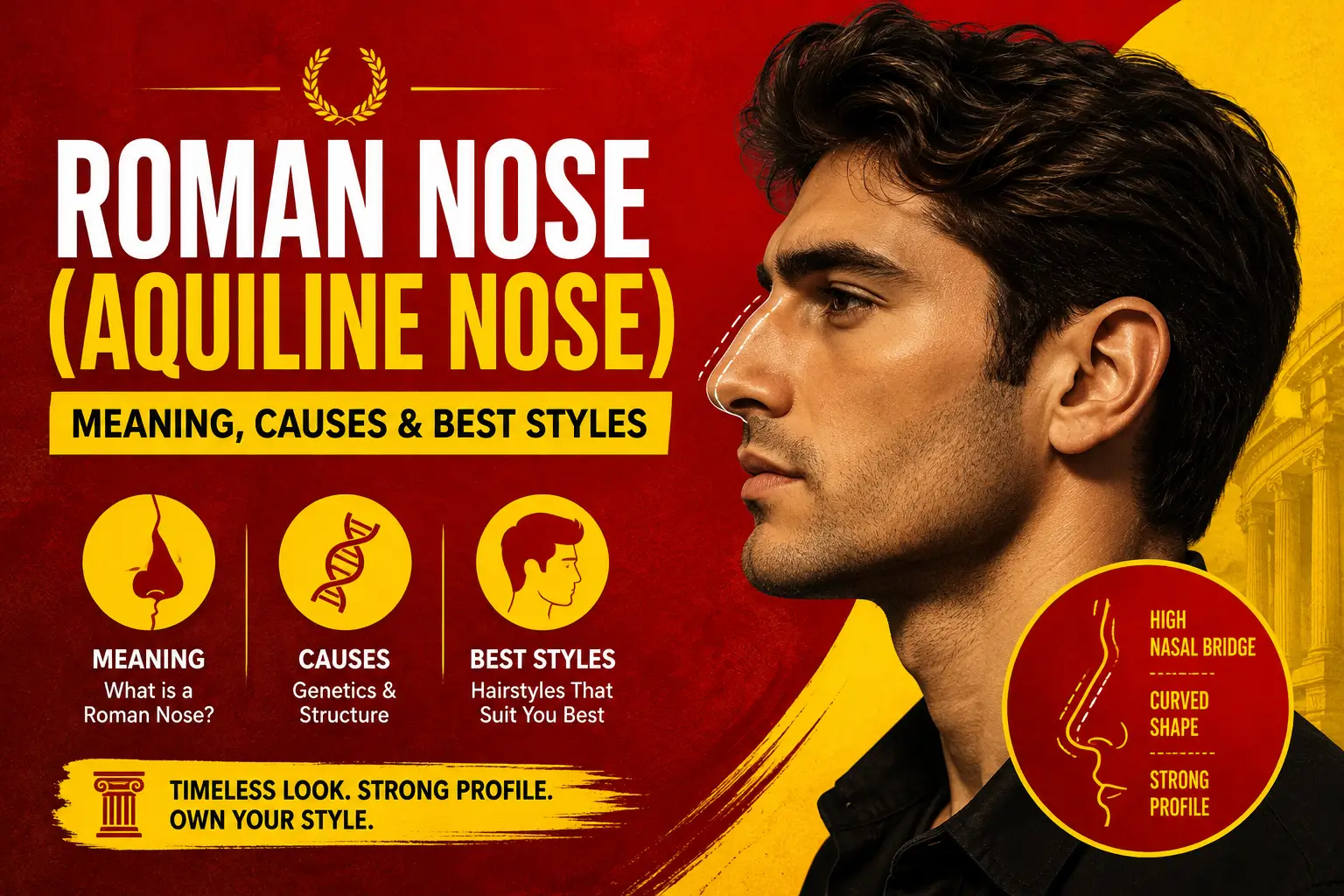
A Roman (aquiline) nose has a raised nasal bridge that curves or angles outward partway down, giving a hooked profile. It’s a structural nose shape, not a face shape, and appears across every population — it isn’t tied to ethnicity or personality.
What Is a Roman Nose (Aquiline Nose)?
A Roman nose — more formally an aquiline nose — is defined by a prominent, often convex nasal bridge that curves or bends partway down its length, producing a hooked side profile. The term describes a human nose with a prominent bridge that appears curved or slightly bent.
“Aquiline” comes from the Latin aquilinus, meaning eagle-like, a reference to the curved beak of an eagle. WikipediaWikipedia
This is a nose-shape term, not a face-shape category on OvalFaceShape.com — it describes one facial feature, distinct from the oval, round, or heart-shaped face categories the site covers elsewhere. If you’re trying to identify your overall face shape rather than just your nose profile, the Face Shape Detector handles that separately.
Why the Bridge Curves This Way?
The aquiline profile comes down to the underlying nasal bone and cartilage structure — specifically how the bony bridge (upper third) transitions into the cartilaginous lower two-thirds of the nose. When that transition point sits slightly higher or more prominent than the surrounding profile, the side view reads as convex rather than straight.
This is a matter of individual bone and cartilage growth, the same way jaw width or brow prominence varies — it isn’t caused by anything a person does, and it isn’t a defect.
Roman Nose vs. Other Nose Shapes
Nose profiles are generally grouped into three broad types by how the bridge line runs from root to tip:
| Nose type | Profile line | Common alternate name |
|---|---|---|
| Straight | Runs in a flat line from root to tip | Greek |
| Convex (Roman/Aquiline) | Curves or bends outward partway down | Roman, hooked |
| Concave | Dips inward along the profile | Snub, retroussé, infantine |
None of these is more “correct” than another — they’re simply different, common variations in nasal bone and cartilage structure.
The Race and Personality Myth — Corrected
A persistent claim, mostly traceable to Victorian-era physiognomy, links the Roman nose to ethnicity, social status, or intelligence. This has no scientific backing. No scientific studies support linking the aquiline nose to any specific ethnic, racial, or geographic group, or to non-physical traits like intelligence or status.
Like other physical traits such as a widow’s peak or a particular eye color, it appears across geographically diverse populations rather than belonging to any one group. Treat any content that presents nose shape as evidence of ancestry or character as outdated pseudoscience, not fact. Wikipedia
Styling: Hairstyles
The goal isn’t to hide a Roman nose — it’s to keep the rest of the face in visual balance with it. Styles with volume or texture near the crown (rather than heavy, blunt fringes that end right at the bridge line) tend to keep attention distributed across the whole face rather than concentrated on the profile.
Side-swept fringes and soft layering around the face work the same way, They add movement near the eyes and cheeks instead of framing the nose in isolation.
Styling: Glasses
Frame choice matters more here than for most nose shapes, because the bridge sits higher and more forward. Low-bridge-fit or adjustable-nose-pad frames tend to sit more evenly, since a standard low bridge can perch too high on a prominent bridge.
In terms of shape, frames with a straight or only slightly curved top bar (like a rectangular or browline silhouette) tend to complement a convex profile better than deeply rounded frames, which can echo and exaggerate the curve rather than balance it.
Styling: Makeup Contouring
Light contouring works with proportion, not correction. A thin, softly blended highlight down the center of the bridge combined with subtle shadow just below the curve’s high point can visually flatten the profile slightly for those who want that effect — but it’s an optional styling choice, not a “fix,” since there’s nothing to fix.
Key Takeaways
- A Roman/aquiline nose is defined by a convex, curved nasal bridge — a structural trait, not a face shape.
- It results from individual nasal bone and cartilage proportions, not ancestry, personality, or lifestyle.
- Claims linking it to race or intelligence come from debunked Victorian physiognomy, not science.
- Glasses with a straight or gently curved top bar and a proper bridge fit tend to sit and look best.
- Hair with volume near the crown and soft face-framing layers balances the profile without hiding it.
FAQs
Is a Roman nose the same as an aquiline nose?
Yes. “Roman nose” and “aquiline nose” describe the same feature — a nasal bridge that curves or bends outward partway down its length.
Is a Roman nose linked to a specific ethnicity?
No. It’s found across genetically and geographically diverse populations, and no scientific evidence ties it to any single ethnic group.
Does having a Roman nose mean anything about personality?
No. The idea that nose shape reflects intelligence or character comes from 19th-century physiognomy, a discredited pseudoscience, not from any real research.
What glasses work best with an aquiline nose?
Frames with a straight or gently curved top bar and a proper (often adjustable or low) bridge fit tend to sit evenly and complement the profile better than deeply rounded shapes.
Can a Roman nose change with age or weight change?
The underlying bone and cartilage structure stays largely fixed after facial growth completes; minor softening of surrounding skin and tissue can subtly change how prominent it appears, but the bridge shape itself doesn’t change.
Is a Roman nose considered attractive?
Beauty standards vary by culture and era — historically it’s been associated with strength and nobility in some traditions, while symmetrical, less pronounced profiles are favored in others. Neither is objectively correct.
Do I need surgery to change a Roman nose?
No — this article covers styling, not medical decisions. Rhinoplasty is a personal, surgical choice best discussed with a licensed surgeon, not something to decide from a styling guide.
1 thought on “Roman Nose (Aquiline Nose): Meaning, Causes & Best Styles”