
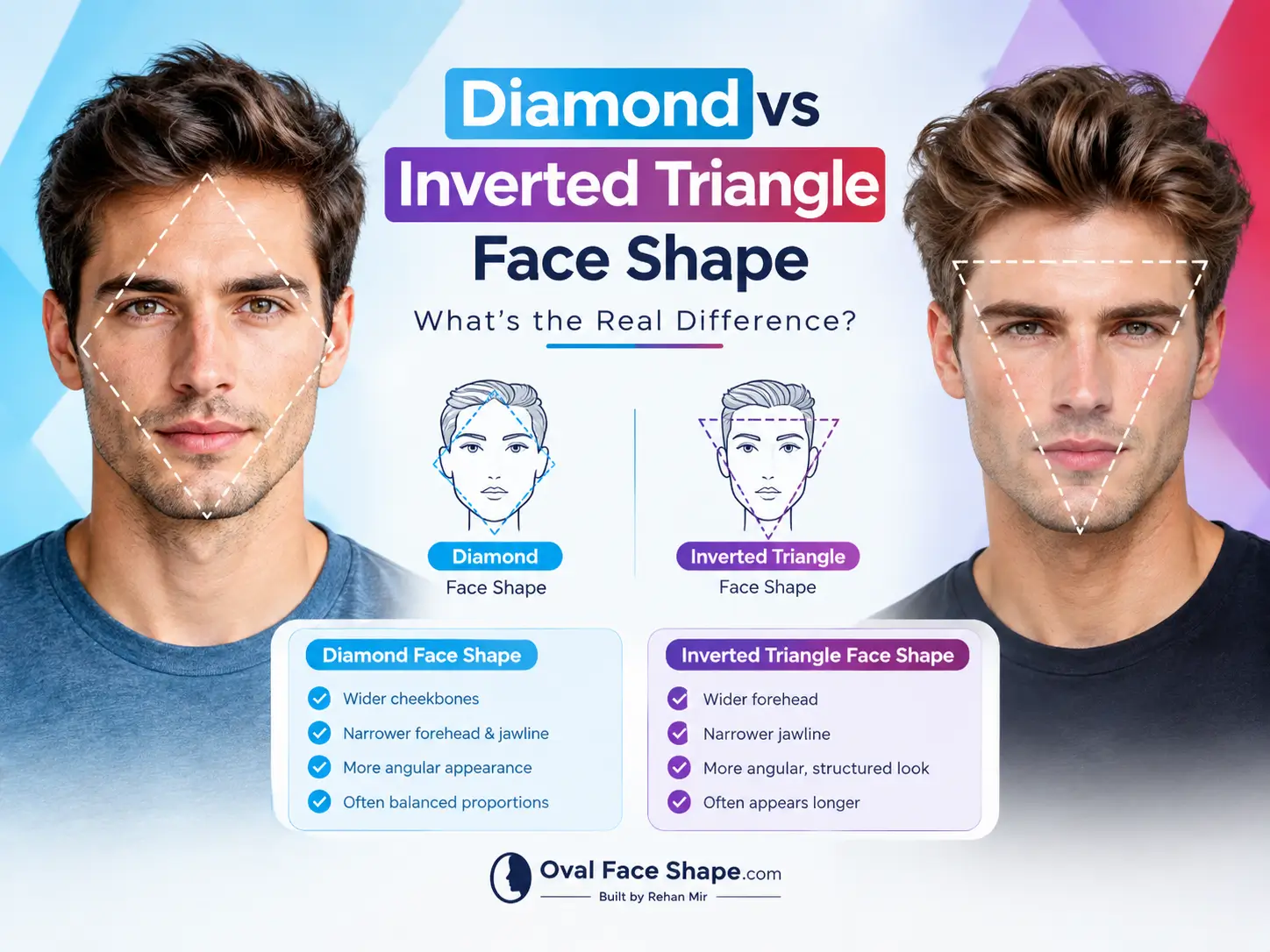
Quick Answer:
A diamond face narrows at both the forehead and chin, widest at the cheekbones. An inverted triangle stays wide at the forehead and narrows only toward the jaw and chin.
Two face shapes get confused with each other more than almost any pairing on OvalFaceShape.com: Diamond and inverted triangle. Both taper to a narrow, pointed chin, both read as “angular” in a photo, and both regularly get flipped by quiz-style detectors that only measure overall face length and width instead of forehead, cheekbone, and jaw width separately.
Who This Comparison Is For?
This is written for someone who has already taken a face-shape quiz — or run the Face Shape Detector — and gotten “diamond” from one source and “inverted triangle” from another.
It’s equally useful for a hairstylist deciding between the two before recommending a cut, or for anyone comparing the male and female versions of an inverted triangle face before choosing a style.
If you haven’t identified your face shape at all yet, start with the Face Shape Detector rather than this comparison.
Diamond Face Shape at a Glance
A diamond face shape is narrowest at the forehead, widens sharply at the cheekbones, and narrows again to a pointed chin. The cheekbones are the widest point on the entire face — not the forehead, not the jaw. That single trait is what defines diamond over every other shape.
Named examples of this shape are collected on OvalFaceShape.com’s Celebrities With a Diamond Face Shape guide — worth a look, since celebrity attributions for “diamond” vary noticeably between sources, and comparing several examples side by side is more reliable than trusting any single one.
Inverted Triangle Face Shape at a Glance
An inverted triangle face shape is widest at the forehead and temples, then narrows steadily down to a slim jaw and pointed chin. Unlike diamond, the cheekbones aren’t a separate wide point — the forehead itself is the widest measurement on the face. Reese Witherspoon and Ryan Gosling are commonly cited real-world examples of this shape.
The One Measurement That Tells Them Apart
Facial anthropometry — the formal measurement of head and face proportions documented in Leon Farkas’s reference text Anthropometry of the Head and Face (2nd ed., Raven Press, 1994) — compares three widths: the forehead (temporal width), the cheekbones (bizygomatic width), and the jaw (bigonial width). That comparison is what actually separates diamond from inverted triangle:
- Diamond: cheekbones > forehead, and cheekbones > jaw. Narrowest at the top and bottom, widest in the middle.
- Inverted triangle: forehead > cheekbones, and forehead > jaw. Widest at the top, narrowing the rest of the way down.
If your cheekbones stick out further than your forehead when you frame your face with your hands, that’s diamond. If your forehead is clearly the broadest part before your cheekbones even register, that’s inverted triangle.
Want to compare oval vs. oblong and oval vs. heart face shapes? Explore our detailed guides to discover the key differences.
Diamond vs Inverted Triangle: Side-by-Side
| Feature | Diamond | Inverted Triangle |
|---|---|---|
| Widest point | Cheekbones | Forehead / temples |
| Forehead | Narrow | Wide, often flat |
| Cheekbones | Prominent, angular | Present, but not the widest point |
| Jaw | Narrow, angular | Narrow, tapering |
| Chin | Pointed | Pointed |
| Overall outline | Wide middle, narrow top and bottom | Wide top, narrow bottom |
Quick Test: Which One Do You Have?
- Pull your hair back and face a mirror in even light.
- Compare your forehead width, cheekbone width, and jaw width.
- Cheekbones widest → diamond. Forehead widest → inverted triangle.
- Still unsure? Run the Face Shape Detector, which measures these widths from 468 facial landmarks instead of a visual guess.
Styling Differences by face shapes
Hairstyles for Diamond Face Shape
The goal for a diamond face shape is to soften the cheekbones and add width at the forehead and jaw. Side-parted styles, chin-length cuts, and a brow-grazing fringe all work in that direction; styles that add extra width right at cheekbone level tend to fight the shape rather than flatter it.
Hairstyles for Inverted Triangle Face Shape
The goal reverses: balance a wider forehead by adding volume to the lower half of the face. Layered cuts with volume at the jaw, textured crops, and chin-length bobs are the standard recommendations for an inverted triangle face shape — for inverted triangle face shape female and upside down triangle face shape hairstyles male alike. Styles that add further height or width at the crown work against this shape rather than for it.
This comparison only covers the basics. For the full range of cuts, lengths, and texture options, see the dedicated Inverted Triangle Face Shape Hairstyles guide.
Glasses for Each Shape
Frame choice follows the same logic as hair. According to All About Vision, rectangle, oval, and cat-eye frames in bold colors work well for a diamond face shape, since soft angles draw attention to the eyes rather than the cheekbones. For an inverted triangle, frames with more width or detail along the bottom edge help balance a wider forehead.
See Glasses by Face Shape for the full frame-by-frame breakdown.
Key Takeaways
- Diamond = narrow forehead, wide cheekbones, narrow jaw.
- Inverted triangle = wide forehead, narrower cheekbones and jaw.
- The forehead-vs-cheekbone comparison is the one measurement that actually distinguishes them.
- Hairstyle and glasses goals run close to opposite: diamond softens the cheekbones, inverted triangle balances the forehead.
Still not sure which one is yours? Run the Face Shape Detector — it measures your forehead, cheekbone, and jaw width directly instead of relying on a visual guess.
About the author: Muhammad Rehan Iqbal is the founder and developer of OvalFaceShape.com, specializing in face shape analysis, interactive facial assessment tools, and educational styling guides.
FAQs
Is a diamond face shape the same as an inverted triangle?
No. Both narrow toward the chin, but a diamond face is also narrow at the forehead, while an inverted triangle keeps a wide forehead. Cheekbones are the widest point on a diamond face; the forehead is the widest point on an inverted triangle.
Which is rarer, diamond or inverted triangle face shape?
Prevalence estimates vary widely between sources and detection methods, so treat any specific percentage with caution — this is genuinely one of the less standardized figures in the face-shape space.
What’s consistent is that celebrity examples cited for “diamond” specifically differ a lot from source to source, which reflects that same measurement ambiguity.
Is it still worth telling diamond and inverted triangle apart now that AI face-shape detectors exist?
Yes. AI landmark detection is generally more consistent than a visual guess, but it still needs to measure forehead, cheekbone, and jaw width separately to tell these two apart reliably — a detector that only compares overall face length and width can still return the wrong one of the two.
What’s the best haircut if I’m between diamond and inverted triangle?
Chin-length layered cuts with soft volume at the jaw work reasonably well for both, since they add width low on the face without adding more at the cheekbones or forehead. From there, fine-tune using whichever shape your forehead-to-cheekbone measurement confirms.
Can my face look like diamond in one photo and inverted triangle in another?
Yes. Camera angle, hairstyle, and lighting all shift how wide the forehead or cheekbones appear. A straight-on photo with hair pulled back and even lighting gives the most reliable read; side-lit or tilted photos are the most common cause of a shape flipping between the two.
What hairstyle works best for an inverted triangle face shape on a woman?
Chin-length bobs, textured lobs, and layered cuts with deliberate volume at jaw level are the most consistently recommended options for an inverted triangle face shape female, since they add visual width exactly where the face needs it.
Is a diamond or inverted triangle face shape considered attractive?
Both are widely described in styling guides as flattering, angular shapes — the difference is simply where the face is widest. Attractiveness is subjective and depends on styling choices as much as the underlying shape.