
Quick Answer:
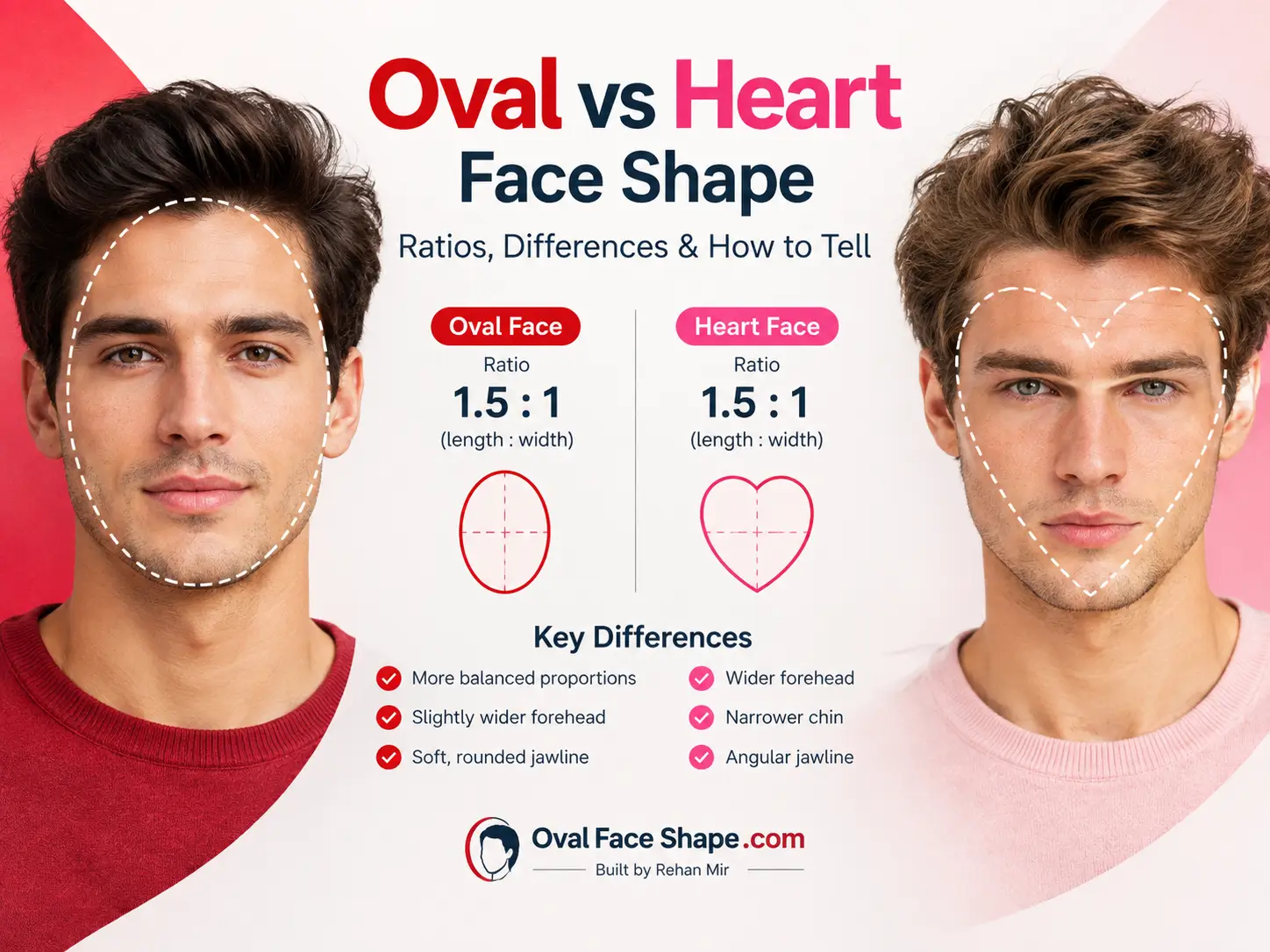
An oval face has a rounded chin and roughly even forehead-to-jaw width. A heart face has a forehead noticeably wider than the jaw, tapering to a narrow, pointed chin.
Oval vs Heart Face Shape: How to Tell the Difference
If you’re trying to figure out whether your face is oval or heart-shaped before choosing a haircut or glasses, This guide is for you — especially if you’re comparing the two because your forehead looks wide but your face doesn’t feel “boxy” enough to call square.
OvalFaceShape.com built this comparison around one measurement, so you don’t have to guess from a mirror.
What Is an Oval Face Shape?
An oval face is longer than it is wide, with a forehead slightly wider than the chin and a smoothly rounded jawline — no sharp corners anywhere.
Forehead, cheekbones, and jaw are close in width, and the chin curves rather than comes to a point. This is the shape most style guides call the most versatile, because there’s no single feature that needs balancing out.
What Is a Heart-Shaped Face?
A heart-shaped face has a forehead and cheekbones that are clearly the widest part of the face, narrowing down to a slim, pointed chin.
Viewed straight on, the outline resembles an inverted triangle — wide at the top, narrow at the bottom. A widow’s peak often makes the forehead look even wider.
Curious about the differences between oval and oblong face shapes? Explore our detailed Oval vs Oblong Face Shape guide to compare their proportions, features, and key differences.
Oval vs Heart Face Shape: Key Differences
| Feature | Oval | Heart |
|---|---|---|
| Forehead width | Slightly wider than chin | Clearly the widest point |
| Chin shape | Rounded, soft | Narrow, pointed |
| Forehead-to-jaw ratio | Roughly even | Forehead noticeably wider than jaw |
| Face outline | Smooth curve | Inverted triangle |
A 2026 review of aesthetic surgery literature on facial contouring found that when physicians describe reshaping a heart-shaped face toward oval, the two features they flag most consistently are a narrower chin and a jaw and zygoma (cheekbone) brought closer in width to the forehead — the same two landmarks that separate the shapes here.
How to Tell Which One You Have?
- Measure your forehead at its widest point, about a finger above the brows.
- Measure your jaw straight across, corner to corner.
- Compare the two. If they’re close in width and your chin is rounded, you’re looking at oval. If your forehead is noticeably wider than your jaw and your chin comes to a visible point, that’s heart.
- Check the chin last if the forehead-to-jaw numbers are close — chin shape is the tiebreaker Quora users and stylists both point to most often.
For a faster check that also flags blended shapes (common for “oval-leaning heart” faces), OvalFaceShape.com’s Face Shape Detector runs the same measurements from a photo.
Best Hairstyles for Oval vs Heart Face Shapes
Oval faces can wear almost any length or part without correction. Heart faces — including the oval-leaning heart shapes many men search for — do better with styles that add width at the jaw and reduce it at the forehead: Side parts, textured crops with length left at the sides, and fringe or curtain bangs that break up forehead width instead of exposing all of it.
Best Haircuts for a Heart-Shaped Face
Chin-length bobs, jaw-length lobs, and layered cuts that build volume from the ears down all work with a heart face’s natural taper instead of against it. Avoid slicked-back styles or blunt center-parted bangs — both expose the full forehead width and sharpen the point of the chin rather than softening it.
For glasses, round or bottom-heavy frames balance a heart face better than top-heavy cat-eye shapes, which add width exactly where a heart face already has the most.
Discover hairstyles and glasses that suit your face shape — explore our hairstyles by face shape and glasses by face shape guides.
Key Takeaways
- Oval = even forehead-to-jaw width + rounded chin.
- Heart = forehead clearly wider than jaw + pointed chin.
- Chin shape is the fastest tiebreaker when the widths look close.
- Heart-face styling adds jaw width and reduces forehead width; oval needs no correction.
Reviewed by Muhammad Rehan Iqbal, Founder and Developer of OvalFaceShape.com, specializing in face shape analysis, interactive facial assessment tools, and educational styling guides.
FAQs
What is a heart shaped face?
A heart-shaped face has a wide forehead and cheekbones that taper down to a narrow, pointed chin, giving the outline an inverted-triangle look. It’s one of the seven core face shapes alongside oval, round, and square.
Can an oval face have a widow’s peak?
Yes — a widow’s peak alone doesn’t make a face heart-shaped. The deciding factor is the forehead-to-jaw width and whether the chin is rounded (oval) or pointed (heart).
Are oval and heart face shapes basically the same?
No. They’re often confused because both can look balanced and elongated, but the chin and forehead-to-jaw ratio are genuinely different measurements, not a matter of degree.
What haircut is best for a heart-shaped face?
Chin-length bobs and layered cuts with volume at jaw level work best, since they widen the lower face to balance a wider forehead — the opposite of what an oval face needs.
Is oval or heart face shape more common?
Neither is rare, but face-shape prevalence varies by dataset and measurement method, so treat any specific percentage with caution — self-reported and AI-detected results can differ.
How accurate is an AI face shape detector for telling oval and heart apart?
Detectors that measure forehead, cheekbone, and jaw width directly are generally more consistent than a visual guess, though bangs, hairline, and head tilt can shift results — which is why manual measurement is worth cross-checking.