
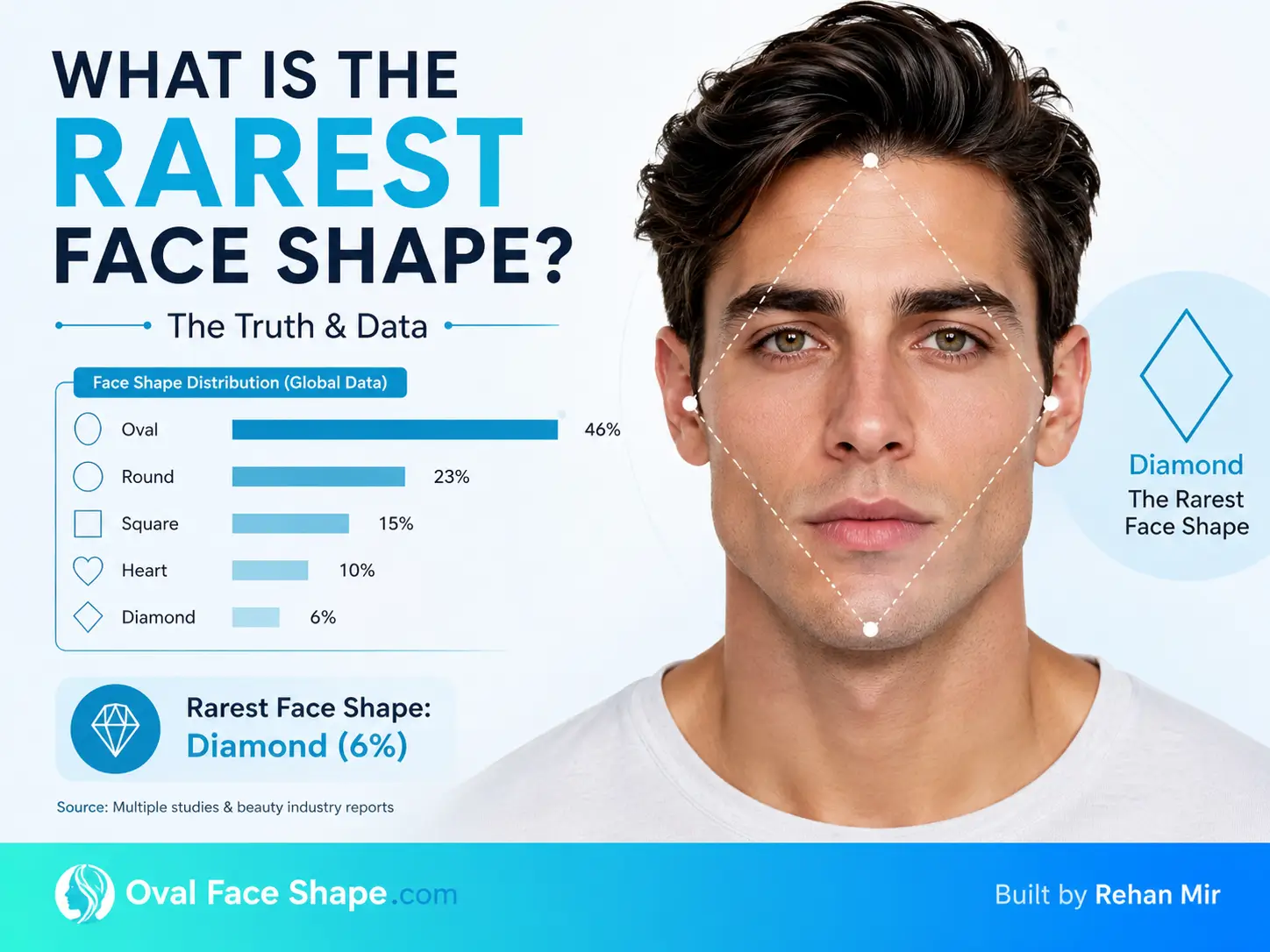
Quick Answer:
Diamond is the face shape most experts and datasets call rarest — narrow forehead, dominant cheekbones, narrow chin. But one large AI dataset ranks triangle rarest instead, so treat any single percentage with caution.
Most sources agree on one thing: diamond is the rarest of the seven recognized face shapes. It requires three things to line up at once — a forehead narrower than the cheekbones, cheekbones that are clearly the widest point of the face, and a chin that tapers to a point — and that specific combination doesn’t occur often.
Who this guide is for:
This guide is for you if you’ve been told (by a quiz, an AI tool, or a comment section) that you have a rare face shape and want to know whether that’s actually rare, or just a label.
It’s also for anyone who’s noticed that two “rarest face shape” articles give completely different answers and wants to understand why, before trusting either one.
Why Diamond Gets Called the Rarest?
Beverly Hills facial plastic surgeon Dr. Patrick Davis has identified diamond as the rarest face shape, ( Face Shape Statistics ) describing it by its narrow forehead, wide cheekbones, and narrow chin.
That combination of traits is echoed across eyewear guides, beauty-clinic blogs, and face-shape tools alike — diamond shows up as the rarest shape far more consistently than any other candidate.The anatomical logic is straightforward.
Most human faces keep a fairly even width from forehead to jaw. For the cheekbones to project noticeably past both the forehead and the jaw, a specific skeletal pattern has to occur — narrow temporal width, a prominent zygomatic arch, and a narrowing mandible, all together.
Each condition on its own isn’t unusual. Needing all three at once is what makes the shape uncommon.
Where the Numbers Actually Come From — and Why They Disagree?
Here’s the part most rarity articles skip:
The specific percentages you’ll see quoted (5%, 8.6%, 0.05%, and so on) rarely come from population research. They come from the scan logs of individual face-shape tools — meaning the “data” is really a record of who chose to upload a photo to that one site, not a random sample of the population.
That’s exactly why two prominent tool-based sources contradict each other. One large dataset (over 51,000 scans, drawn from a competing face-shape site) ranks diamond as rarest at roughly 5%. A separate dataset of over 18,000 AI scans ranks triangle as rarest instead, at a fraction of a percent, with diamond appearing far more often in that sample.
Both datasets are real. Neither is a scientific population survey. The likely explanation is sampling: each tool draws from a different visitor base, uses its own thresholds for where “diamond” ends and “heart” or “oval” begins, and neither has been peer-reviewed or checked against a broader demographic sample.
When a tool’s classification rule requires cheekbones to be 10% wider than the forehead, versus another tool requiring 15%, the same face can get sorted into different categories — and the reported rarity shifts accordingly.
The honest takeaway:
Treat “X% of people have this shape” claims — including the ones in this article — as directional, not precise. The consistent part across nearly every source is the ranking logic, not the exact number: shapes needing more simultaneous conditions (diamond, triangle, true square) are less common than shapes with more forgiving criteria (oval, round).
The Second Rarest: Triangle and Square
After diamond, triangle is the next shape most sources agree is uncommon. It’s defined by a jawline wider than the cheekbones — the reverse of the more familiar heart-shape pattern — and it needs its own unusual skeletal setup to occur.
Square faces are also rarer than beauty media suggests. A true geometric square needs forehead, cheekbones, and jaw to be nearly equal in width, plus visibly angular jaw corners — not just “a strong jaw,” which is the loosest, most overused version of the claim.
Many people who self-identify as square turn out to be oval or diamond once cheekbone and jaw width are actually compared.
Is a Rare Face Shape More Attractive?
No — rarity and attractiveness are separate questions. Rarity is about how often a geometric pattern occurs; attractiveness research generally points to facial symmetry and proportional balance, which can exist in a face shape of any frequency.
A common oval face with strong symmetry can be rated more attractive than a rare diamond face without it. If you’re chasing a “rare” label for its own sake, that’s the gap worth knowing about upfront.
How to Actually Check Your Own Shape?
Given how much tool-to-tool disagreement exists, a single online quiz result is a starting point, not a verdict. The most reliable approach:
- Use the Face Shape Detector for an instant, landmark-based read
- Cross-check against the Diamond, Triangle, and Square guides to compare your specific proportions against each shape’s defining criteria
- If your result sits between two shapes, that’s common — many real faces blend traits from two categories rather than fitting one perfectly
Key Takeaways
- Diamond is the most consistently cited rarest face shape, per expert sources and most rarity rankings
- Percentages vary widely between sites because they’re drawn from each tool’s own user base, not population studies — treat exact figures as estimates
- Triangle and true square are also genuinely uncommon, more so than casual “I have a square face” self-labeling suggests
- Rarity has no bearing on attractiveness — symmetry and proportion matter more than how common a shape is
- One quiz result isn’t final; cross-checking against a defined shape guide gives a more reliable answer
FAQs
What is the rarest face shape?
Diamond is most consistently named the rarest, defined by cheekbones clearly wider than both the forehead and jaw, with a narrow, pointed chin. Some tool-based datasets rank a different shape as rarest, which is why the exact percentage varies by source.
What is the second rarest face shape?
Triangle is widely considered the second rarest, followed closely by true square — both require an uncommon combination of jaw, cheekbone, and forehead proportions.
Is diamond really the rarest face shape, or just the least talked about?
It’s genuinely uncommon by anatomical logic, not just underrepresented in styling content. Needing narrow-forehead, wide-cheekbone, and narrow-chin conditions simultaneously is a stricter requirement than most other shape classifications.
Why do different sites give different rarity percentages?
Because most published numbers come from an individual tool’s own scan or quiz logs — a self-selected sample, not a scientific population survey. Different classification thresholds between tools also shift how many people land in each category.
Is a rare face shape more attractive than a common one?
No. Research on attractiveness points to facial symmetry and proportional balance rather than how frequently a shape occurs.
A well-proportioned oval or round face can be rated more attractive than a rare diamond face without those qualities.
What is the most common face shape?
Oval is the most frequently cited common shape across most sources, largely because its proportions require the fewest simultaneous conditions to match.
Can two people with different quiz results actually have the same face shape?
Yes — because thresholds differ between tools, borderline faces can get classified differently depending on which detector or quiz is used. Comparing your result against a defined shape guide, rather than trusting one quiz alone, gives a clearer answer.