
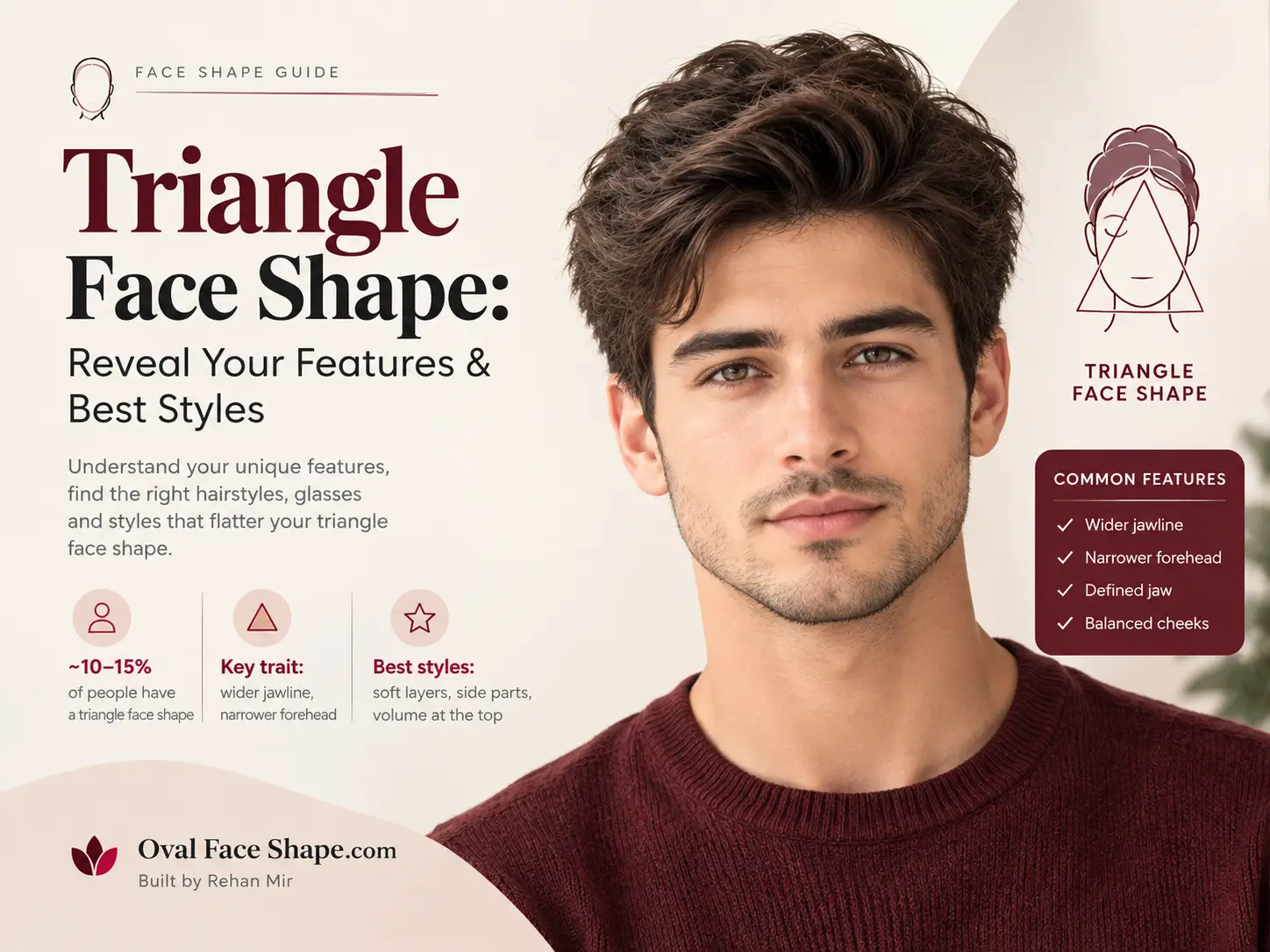
Quick Answer:
A triangle face shape has a jaw wider than the cheekbones, and cheekbones wider than the forehead — the face widens as it goes down. It’s sometimes called a pear face shape.
Triangle Face Shape: How to Tell + What Actually Works?
If your jawline feels like the widest, most defined part of your face — wider than your forehead, wider even than your cheekbones — you likely have a triangle face shape.
Who this guide is for:
This guide is built for anyone trying to confirm that shape before choosing a haircut, glasses, or beard style, using OvalFaceShape.com’s Face Shape Detector or a simple tape-measure check. Hairstylists comparing client face shapes will find the same reference useful.
What Is a Triangle Face Shape?
A triangle face shape widens from top to bottom: the forehead is the narrowest of the three widths, the cheekbones sit in the middle, and the jaw is the widest point on the face.
The jaw is often square-cornered and clearly defined rather than soft or rounded. Face length isn’t the deciding factor here — a triangle face can be short or long — what matters is that top-to-bottom widening pattern.
Triangle vs. Pear vs. Inverted Triangle — Don’t Confuse These
This is the most common mix-up in face-shape content, so it’s worth stating plainly. Triangle and pear face shape describe the same widening pattern — jaw widest, forehead narrowest — and different sites simply use different names for it.
Inverted triangle is the opposite shape: Forehead widest, jaw narrowest, tapering to a point at the chin (closer to what a heart face shape looks like). If a guide tells you your forehead is your widest feature, you’re reading about inverted triangle, not triangle.
How Rare Is a Triangle Face Shape?
Across large-scale face-shape analyses, triangle is consistently one of the less common shapes, sitting around 8–9% of faces — roughly on par with diamond as one of the rarer categories, well behind oval, oblong, and round.
Facial anthropometry research (Farkas, 1994) supports the underlying width-ratio method used to classify it, though any single percentage should be read as a population average, not a fixed rule: real faces often blend two shapes, and self-selected samples from online tools skew the exact number slightly.
Want to know the rarest face shape? Discover its key features and how to identify it in our detailed guide.
How to Tell If You Have a Triangle Face Shape?
Three measurements settle it. Pull hair back from your hairline and, using a soft tape measure:
- Forehead — widest point, roughly eyebrow to hairline.
- Cheekbones — widest point, just below the outer eye corners.
- Jaw — straight across from corner to corner.
Decision check:
If jaw > cheekbones > forehead, you have a triangle (pear) face shape. If it’s reversed, you have an inverted triangle. If all three are close, check oval or square instead.
OvalFaceShape.com’s Face Shape Detector runs this same comparison automatically from a photo, using on-device facial landmark mapping so nothing is uploaded.
Triangle Face Shape at a Glance
| Face shape | Widest area | Jaw | Typical length |
|---|---|---|---|
| Triangle (pear) | Jaw | Wide, defined corners | Short or long |
| Inverted triangle | Forehead | Narrow, tapered | Often medium |
| Diamond | Cheekbones | Narrow | Medium to long |
| Oval | Cheekbones | Gently tapered | Longer than wide |
Celebrities With a Triangle Face Shape
Timothée Chalamet is one of the most frequently cited examples of a triangle face shape, styled with volume at the temples and crown to balance the wider jaw. Minnie Driver is a commonly cited female example of the same jaw-widest pattern.
Best Hairstyles for a Triangle Face Shape
The rule stylists repeat most often:
Add volume near the top of the head, keep things tighter near the jaw. Soft layers starting at the cheekbones, side-swept bangs, and waves that create width at the temples all pull visual weight upward.
Middle parts tend to emphasize jaw width, so a deep side part usually reads better. For shorter styles, textured crops with lift at the crown do the same job for men.
Discover the best hairstyles for every face shape with our complete face shape hairstyles guide.
Glasses, Beards, and Makeup — Quick Notes!
Glasses:
Frames with detail concentrated in the upper half — cat-eye or browline shapes — draw attention away from the jaw.
Beards:
Shorter, tapered styles that don’t add further width at the jawline tend to work better than full boxed beards.
Makeup:
Contour lightly at the jaw’s outer edges and add a touch of highlight at the temples to soften the top-to-bottom widening.
Key Takeaways
- Triangle = jaw widest, forehead narrowest; also called pear face shape.
- Inverted triangle is the opposite pattern — don’t confuse the two.
- Roughly 8–9% of faces measure as triangle, making it one of the rarer shapes.
- The fix for styling is consistent: build volume up top, keep it tighter at the jaw.
- A photo-based detector confirms the shape faster and more consistently than eyeballing it.
FAQs
Is a triangle face shape attractive?
Yes — attractiveness isn’t tied to a single face shape, and a defined jawline is widely considered a strong feature. Styling advice for triangle faces is about balance and personal preference, not correcting a flaw.
How rare is a triangle face shape?
It’s one of the less common face shapes, typically measured around 8–9% of people, putting it in similar rarity territory to diamond and well behind oval or round.
Which celebrity has a triangle face shape?
Timothée Chalamet is one of the most commonly cited examples, with his jaw as the widest point of his face and styling that adds volume at the temples to balance it.
What does a triangle face shape mean?
It describes a face that widens from top to bottom: narrowest at the forehead, wider at the cheekbones, and widest at the jaw. It carries no meaning beyond bone structure — it’s a proportion description, not a personality trait.
What hairstyles look best on someone with a triangle face shape?
Styles that add volume near the crown and temples — soft layers, side-swept bangs, waves, or a textured crop for shorter cuts — while avoiding extra bulk right at jaw level.
Is triangle the same as pear face shape?
Yes. Different sites use different names for the identical jaw-widest, forehead-narrowest pattern — triangle and pear are interchangeable terms for the same shape.
How do I know if I have a triangle or an inverted triangle face shape?
Check which is widest. If your jaw is widest, it’s triangle (pear). If your forehead is widest and the face narrows toward the chin, it’s inverted triangle — the reverse pattern.
2 thoughts on “Triangle Face Shape: Reveal Your Features & Best Styles”