
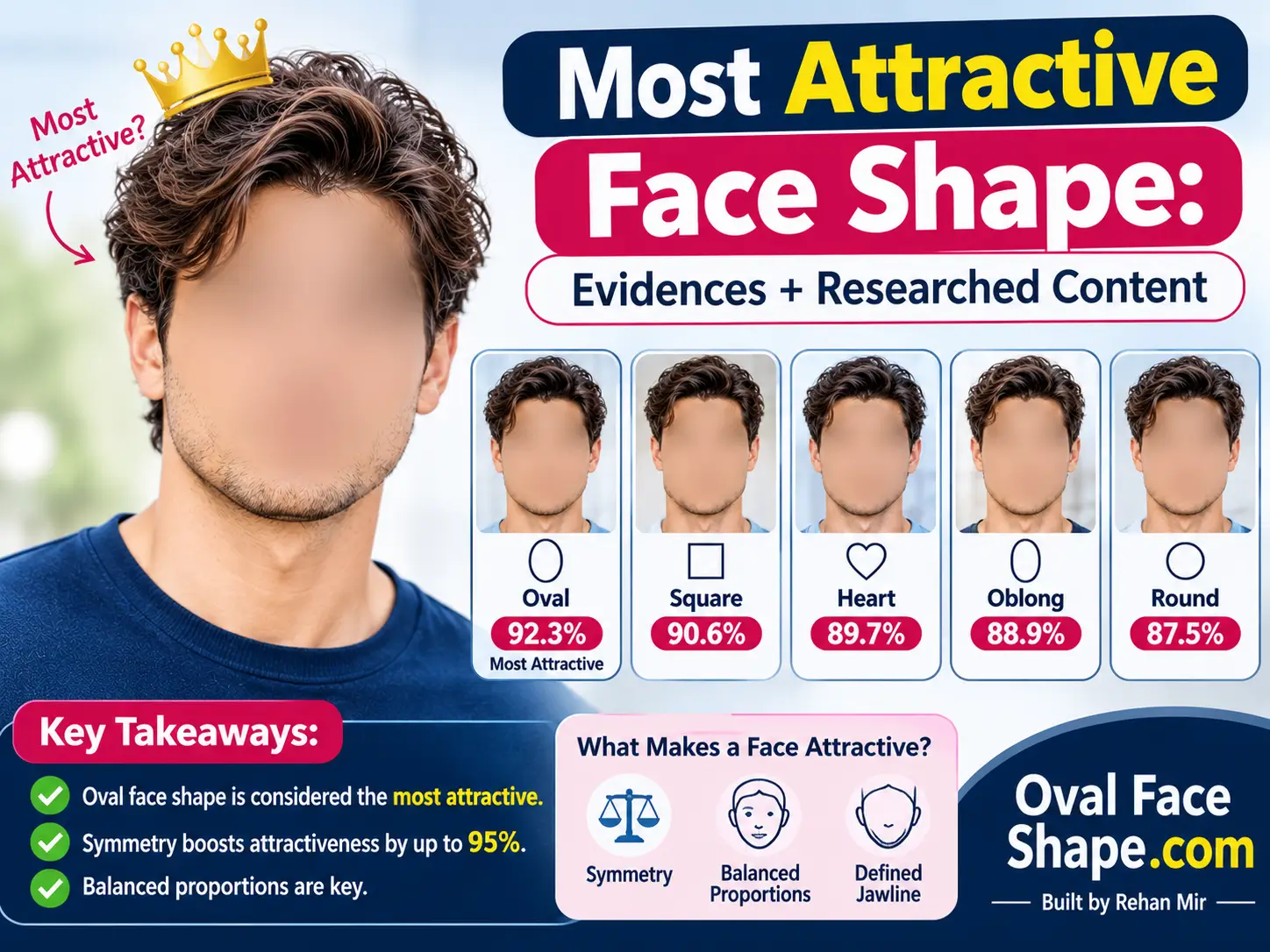
Quick Answer:
No face shape is proven to be the most attractive. Studies link attractiveness to averageness and, in women, to femininity, not to oval, square, or heart categories.
By Muhammad Rehan Iqbal, Founder and Developer of OvalFaceShape.com, specializing in face shape analysis and interactive facial assessment tools.
There is no research-proven most attractive face shape. Oval is called the most ideal face shape because 1930s Hollywood styling used it as the reference, not because studies ranked it first. Measured research points to averageness, plus femininity in women’s faces, and finds no reliable advantage for any single shape category.
Who this guide is for:
Readers who found a “top 10 most attractive face shapes” list and want to know what is real before choosing hair, glasses or a beard. OvalFaceShape.com uses face shape for styling, never for scoring anyone.
Face Shape Labels vs. What Studies Measure?
Style labels (oval, round, square, heart, diamond, oblong, triangle) describe broad width-to-length proportions. Attractiveness studies measure dozens of facial landmarks and test averageness, symmetry and sex-typical features. Most ranked lists mix the two, which is why they contradict each other.
Our face shapes guide explains each label.
Why Oval Is Called the Most Ideal Face Shape?
In the 1930s, Ern and Perc Westmore built the first systematic face-shape styling system for hair and makeup, on the premise that the ideal face shape was oval. Max Factor’s film makeup work shaped that view, and screen actors with oval, well-proportioned, symmetrical faces were considered easiest to film from any angle.
Other shapes were then described by how far they sat from oval. So when a list calls the oval face shape the most attractive, it is usually repeating a styling convention, not reporting a finding.
What Research Finds Instead of a Winning Shape?
| Factor | Finding | Source | Limit |
|---|---|---|---|
| Averageness | Predicted higher ratings for male and female faces | Lee et al., 2025 | White faces |
| Distinctiveness | Lowered ratings in all 10 populations (1,550 faces) | Kleisner et al., 2024 | Standardized frontal photos |
| Symmetry | No independent effect in either study | Lee 2025; Kleisner 2024 | Earlier findings were mixed |
| Femininity | Predicted higher ratings in female faces | Lee 2025; Kleisner 2024 | n/a |
| Masculinity | No significant effect on male-face ratings | Lee 2025; Kleisner 2024 | n/a |
| Feature spacing | Eyes-to-mouth near 36% of face length and eye gap near 46% of width rated best, matching an average face | Pallett et al., 2010 | Caucasian female faces only |
| Beyond average | Faces built from attractive faces beat the average, and exaggerating them raised ratings | Perrett et al., 1994 | Composite faces |
Averageness is the most replicated result, but it describes how well proportions fit a population, not a style label. Oval and square categories each contain faces near and far from average.
The golden ratio does not rescue the ranking: A 2024 review argues the claim does not hold up (Naini, 2024). See how those claims are applied in celebrities with golden ratio faces.
Most Attractive Face Shape for Men
No category is proven most attractive for men. In the 2025 study, averageness predicted ratings of male faces while masculine face shape did not. The 10-population study likewise found a null or weak effect of masculinity when women rated men. That challenges the claim that a square face shape with an angular jaw wins.
Men can still change how the face is framed. Beard shape alters how long or wide the lower face reads, and haircut height and side volume change the forehead and temples.
Start with beard styles by face shape or hairstyles by face shape.
Most Attractive Face Shape for Women
For women, the best-supported finding concerns proportions and femininity, not oval. Both the 2025 and 2024 studies tied higher ratings to femininity in female faces. Neither measured style categories, and the trait can appear in any shape, so neither supports ranking oval above heart, diamond, round or square.
Treat the 36%/46% spacing result with care. It came from Caucasian female faces only, so it cannot be applied to every face.
Top 3, Top 10 and “Least to Most Attractive” Lists: Claims vs. Evidence
Ranked lists, including top 3, top 5, top 10 and least-to-most versions, do not come from a study scoring these style categories against each other. None turned up in the sources reviewed for this guide.
| Shape | Common claim | What the evidence supports |
|---|---|---|
| Oval | Most ideal | A styling reference shape since the 1930s, not a ranking finding |
| Heart | “Proven” most attractive | No category ranking found; femininity, not the label, predicts women’s ratings |
| Diamond | Most desirable for women | No category-level study found |
| Square | Most attractive for men | Masculinity did not predict male ratings (2025, 2024) |
| Round | Youthful or cute | A styling-guide association; no ranking study found |
| Oblong, triangle | Least attractive | No study found ranking either last |
Some lists also call receding or protruding jaws unattractive without naming a study. Treat that as opinion.
Most Attractive Face Shape in the World: Do Cultures Agree?
Partly. A study of 1,550 faces from 10 populations, including Brazil, India and Vietnam, found distinctive faces were rated less attractive in every population, and symmetry had no effect. Japanese and Caucasian observers also favored the same direction of face-shape change in Perrett’s 1994 experiments.
A 2000 meta-analysis (Langlois et al.) found raters agree on who is attractive within and across cultures. That agreement concerns individual faces and proportions, not an eight-shape ranking.
What Actually Changes How Your Face Comes Across?
Face shape category is a styling tool and the least changeable part of your look. What you can change:
- Hair: height, width and parting shift forehead and cheek balance.
- Brows and glasses: frames add lines and width at eye level.
- Beard and grooming: these change the outline of the lower face.
For a quick check, divide face length (hairline to chin) by cheekbone width. On OvalFaceShape.com, about 1.3 to 1.5 reads as oval. That is a styling label, not a score.
Next step: Find your own shape with the Face Shape Detector, then use it to choose hair, glasses or a beard.
Key Takeaways
- No study shows any face shape category is the most attractive.
- Oval’s “ideal” status comes from 1930s Hollywood styling.
- Averageness is the best-replicated predictor, and femininity in women’s faces.
- Symmetry and male masculinity did not predict ratings in the 2024 and 2025 studies.
- Use face shape to choose hair, glasses and beards, not to rank faces.
FAQs
Which face shape is the most handsome?
No shape is proven most handsome. In recent studies, averageness predicted ratings of male faces while masculine face shape did not. Square, oval, diamond and other faces all include men rated highly.
Which face shape is rarest?
No reliable population data exist for style categories, so claims vary by classifier. Guides often name diamond or triangle, but no study confirms it, and rare does not mean more attractive.
Curious about which face shape is the rarest? Explore our complete guide to discover the rarest face shapes, their defining features, and what makes them uncommon.
What is the luckiest face shape?
Luck by face shape comes from physiognomy, a traditional face-reading belief, not tested science. No study links any face shape to luck, and traditions disagree on which shape qualifies.
What’s the cutest face shape?
No study ranks face shapes for cuteness. Styling guides associate round faces with a soft, youthful look, but that is a convention, not a measured result.
Is the oval face really the most attractive?
No study shows it. Oval became the ideal through 1930s Hollywood styling, and research links ratings to averageness, not the oval label.
Is a heart or diamond face more attractive than oval?
No evidence ranks them. Heart and diamond top some lists for women, but studies tie ratings to averageness and femininity, which occur in every shape. Compare them for styling instead.
Has research on attractive faces changed recently?
Yes. Studies in 2024 and 2025 found averageness and femininity predicted ratings, while symmetry and male masculinity did not. Samples are limited, so treat results as evidence, not rules.