
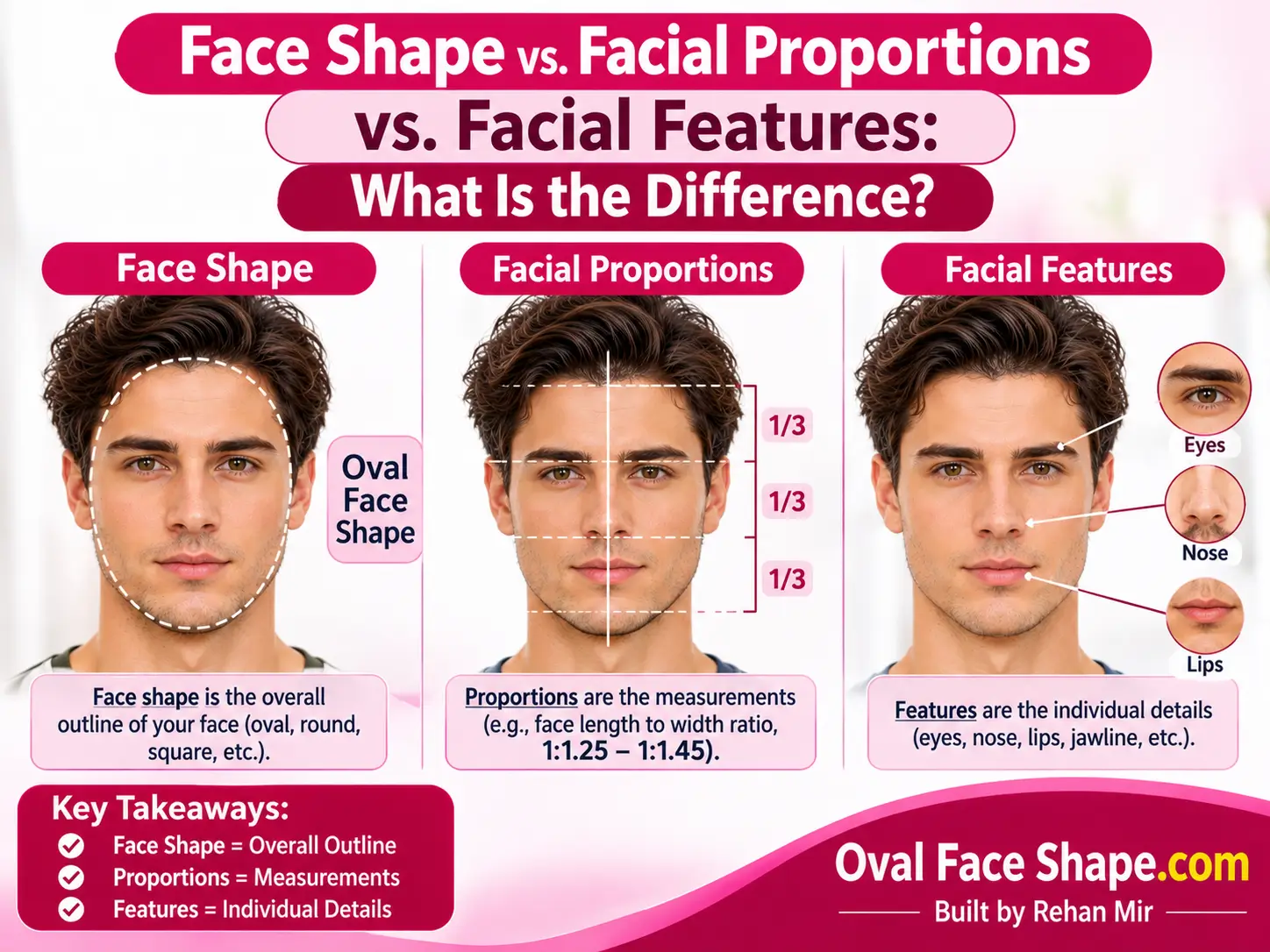
Quick Answer:
Face shape is the outline label, facial proportions are the measured ratios behind it, and facial features are the individual parts. Measure first, label second.
Face shape is the category name for your facial outline. Facial proportions are the measured ratios between distances such as face length and cheekbone width. Facial features are the individual parts (eyes, nose, jaw) inside the outline. The face shape vs facial proportions vs facial features confusion is why styling advice so often contradicts itself, because each term answers a different question.
Who this guide is for:
Anyone who took a face shape test, got a label, and then found advice written in measurements or in individual features. Use it to decide which term should drive a haircut, a glasses frame or a beard.
The Three Terms Side by Side
| Term | The question it answers | What it is made of | Example |
|---|---|---|---|
| Face shape | “Which category is my outline?” | One label from a fixed set | Oval |
| Facial proportions | “How do my measurements relate?” | Ratios between distances | Face length 1.35× cheekbone width |
| Facial features | “What are my individual parts like?” | Eyes, brows, nose, lips, cheekbones, jaw, chin | A wide jaw, close-set eyes |
The three connect in one direction. Proportions are measured, the shape label summarises them, and features are judged separately. A tool that reports only the label discards the numbers you would need to check it, which is why OvalFaceShape.com’s tools show the proportions next to the shape.
Face Shape: A Label for the Outline
A face shape is a category for the overall outline, judged from face length, widest width, jaw direction and chin shape. OvalFaceShape.com uses ten: oval, round, square, rectangle, oblong, heart, diamond, triangle, pear and inverted triangle. For the full set, see Types of Face Shapes.
The label is a convention, not a biological group. Abraham Tamir’s study “Not all faces are alike” (Journal of Craniofacial Surgery, 2014) sorted 108 front-view photographs into five shapes, and the author acknowledged the analysis was qualitative and that different observers may classify the same face differently.
Round was the most common shape in that sample (38.9%) and oval only 12%. Frequencies depend on who is classified and which categories are used.
Measurement vs. Classification: Where Proportions Become a Label
Measurement answers “how much.” Classification answers “which box.” They are separate steps, and most face shape disagreements happen in the second one.
| Stage | What happens | Reproducible? | Example |
|---|---|---|---|
| 1. Landmarks | Points are placed on the face | Yes, with a fixed protocol | Outer cheekbone points |
| 2. Measurements | Distances are taken | Yes | Face length 21.0 cm |
| 3. Ratios | One distance is divided by another | Yes | 21.0 ÷ 14.5 = 1.45 |
| 4. Thresholds | A cutoff assigns a ratio to a category | No, it is a convention | Oval = roughly 1.3–1.5 here |
| 5. Label | The category is reported | Only as reliable as stage 4 | Oval |
Two points follow from this.
The same measurements can produce different labels. A study of 1,003 Turkish adults (Ozsahin et al., International Journal of Morphology, 2016) measured face length from nasion to gnathion and face width at the cheekbones.
It reported a prosopic index of 84.31 in men and 85.25 in women, then sorted people into five Banister types. About a third of each sex was mesoprosopic (33.2% of men, 34.3% of women). Run the same numbers through a ten-shape system and you get a different set of boxes.
Landmarks must be defined before ratios can be compared. That study’s face length starts at the nasion, not the hairline, so its index of about 0.85 is not comparable to a hairline-to-chin ratio such as 1.35.
Boundaries are narrow. In an illustrative case with a 14.5 cm cheekbone width, a ratio of 1.50 is a 21.75 cm face length and 1.52 is 22.04 cm. About 3 mm of tape-measure error can move a face across a cutoff. Near a boundary, trust the ratio and read the label as “between two shapes.”
Facial Proportions: What Gets Measured?
Facial proportions are relationships between distances: face length to width, forehead to jaw width, eye spacing, and the upper, middle and lower thirds. A proportion is a number, so it can be checked. Proportions also explain why two faces with the same label can need different styling.
See Eye Spacing Ratio and How Facial Landmarks Work for the measurement side.
Why photos distort proportions?
- Perspective. A Rutgers–Stanford model (Ward et al., JAMA Facial Plastic Surgery, 2018) estimated that a selfie at about 12 inches makes the nasal base look about 30% wider in men and 29% in women, and the nasal tip about 7% wider, compared with a 5-foot portrait. The figures are modelled and specific to the nose. The same principle (parts closer to the lens look larger) is why shape guidance recommends shooting from a distance.
- Photo vs. direct measurement. In a 2024 Annals of Human Biology study of 74 adults aged 18–21 (Stukaite-Ruibiene et al.), 14 of 25 male and 10 of 25 female facial indices matched direct measurement when professional photos were used. With non-professional photos only 8 of 25 male and 7 of 25 female indices matched, mostly those built from vertical dimensions and eye measurements.
- Cheekbone width. A separate conference abstract from the same research group, covering 1,376 adolescents, reported that every index involving bizygomatic (cheekbone) width differed between photos and direct measurement. This is a conference abstract, not a full paper, so treat it as an early signal. It matters because cheekbone width underlies most shape calls.
A tape measurement entered into the Face Shape Calculator never passes through a camera.
Facial Features: The Parts Inside the Outline
A facial feature is one identifiable part, described by its size, shape, spacing and angle. Features do not add up to a face shape: One person can have an oval outline, a strong jaw and close-set eyes at once.
| Feature | What varies | What it mainly affects |
|---|---|---|
| Eyebrows | Position, thickness, angle | Brow shaping; how frames sit against the brow line |
| Eyes | Size, spacing, eyelid shape | Frame width and bridge fit; eye makeup |
| Nose | Width, length, bridge height | Glasses bridge fit |
| Cheekbones | Height, prominence | Blush and contour placement |
| Jaw | Width, angle, curve | Beard edges, neckline, side volume |
| Chin | Length, projection, curve | Beard length, centre-part and fringe decisions |
Classifying features is hard even for trained observers. Fuentes-Hurtado et al. (PLoS ONE, 2019) note that classifying isolated features is difficult for human observers and cite low inter- and intra-observer agreement.
Features suit fit and detail decisions. They are a weak basis for an overall label, which is why shape classification is built on proportions.
How Face Shape Tests, Calculators and Quizzes Differ
| Tool type | You provide | How it measures | Main error source | Best for |
|---|---|---|---|---|
| Photo-based detector (Face Shape Detector) | A front-facing photo | Landmarks located in the photo, ratios computed, matched to shape profiles | Camera distance, head tilt, hair covering the jawline | A fast result with the ratios shown |
| Proportions calculator (Face Shape Calculator) | Four tape measurements | None needed; you enter the numbers | Careless tape work or inconsistent landmarks | Borderline cases or photo-distortion concerns |
| Quiz (Face Shape Quiz) | Your own judgments in words | None; one person’s qualitative reading | The observer problem described above | A quick photo-free first pass |
| General AI chatbot | An uploaded photo | No dedicated landmark pipeline; a verbal impression | The answer can change with the photo or the prompt | A rough opinion, not a measurement |
| Funnel-style analysis service | Photo, often an email | Varies; check what it reports | Some withhold full results behind a paywall | Only if it shows its measurements |
On privacy and cost, the Face Shape Detector is free, needs no sign-up or email, and analyses the photo in your browser rather than uploading it. For a borderline result, run the detector, then confirm with the calculator and compare the ratios rather than the labels.
Female and Male Faces: Same Terms, Different Averages
The method is identical for female and male faces. Only the average numbers differ. In the Turkish study above, mean face length (nasion–gnathion) was 12.07 cm in men and 11.30 cm in women, and mean face width was 14.34 cm and 13.28 cm.
Classification should compare each face by its own proportions, not against one sex’s averages. Preferences such as how much jaw emphasis to aim for vary far more than the method does.
Which Term Should Guide Which Decision?
| Decision | Start with | Then refine with |
|---|---|---|
| Haircut | Face shape (which outline you are balancing) | Proportions (where volume or height is needed) |
| Glasses style | Face shape and proportions | Features (brow line against the frame top) |
| Glasses fit | Features (bridge, pupil position, temple width) | Nothing; fit overrides style |
| Beard shape | Lower-face proportions and the jaw feature | Chin length and growth pattern |
Shape and proportions guide anything that changes how the outline looks. Features guide anything that must fit a specific part.
See Hairstyles for Every Face Shape, Beard Styles for Every Face Shape and Oval vs. Oblong Face Shape for applications.
Measure it yourself in four steps
- Set up. Stand in front of a mirror, hair pulled back, head level, neutral expression. For a photo, shoot at eye level from roughly 5 feet (1.5 m) with a zoomed-in lens rather than a close selfie.
- Measure four widths and lengths. Face length (hairline to chin tip), forehead width, cheekbone width at the widest point, and jaw width.
- Divide. Face length ÷ cheekbone width gives the main ratio. Compare forehead and jaw to the cheekbone width.
- Match, then check the runner-up. If two shapes score closely, your face sits between them.
Illustrative example: Two Ovals, Different Styling
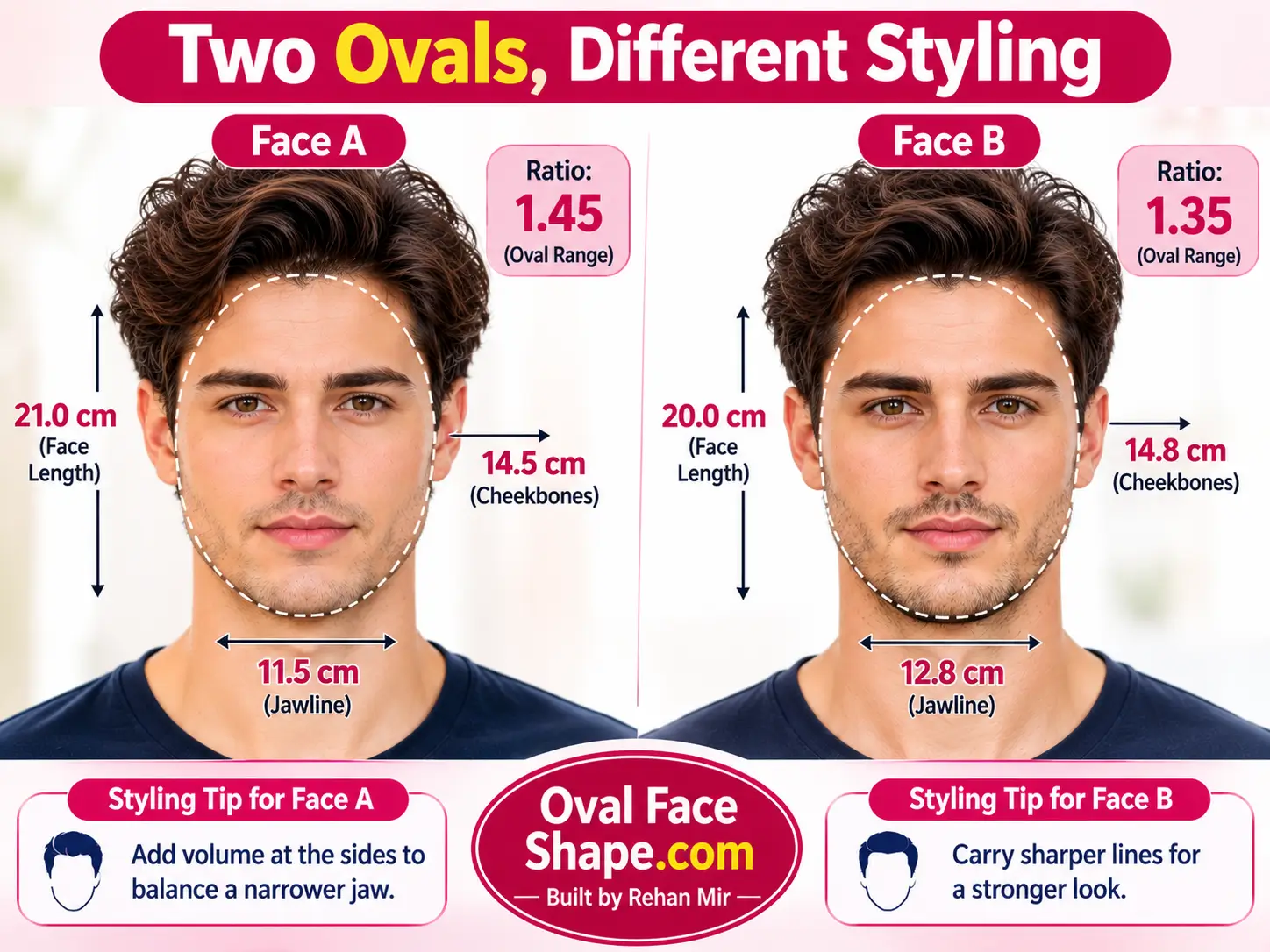
Take two hypothetical faces. A has a 21.0 cm face length, 14.5 cm cheekbones and an 11.5 cm jaw (ratio 1.45, narrower jaw).
B has 20.0 cm, 14.8 cm and 12.8 cm (ratio 1.35, wider jaw). Both fall in an oval ratio range, but A may want volume at the sides to balance a narrower jaw, while B can carry sharper lines.
Common mistakes
- Choosing glasses by nose shape alone, or a haircut by one feature.
- Trusting a label from a close-range selfie.
- Comparing ratios from tools that define “face length” differently.
- Treating the label as fixed when two shapes score nearly the same.
Key Takeaways
- Face shape is a label, facial proportions are measurements, and facial features are individual parts.
- The order runs one way: measure proportions, summarise as a shape, assess features separately.
- Classification is a convention layered on measurement, and thresholds differ between systems. Near a boundary, trust the ratios.
- Photos distort widths, and agreement with direct measurement is limited, so tape measurements are the most reliable input.
- Use shape and proportions for outline decisions, and features for fit decisions.
Get the Measurements, Not Just the Label
Run the Face Shape Detector and read two things: the shape it names and the measurements behind it.
FAQ’s
What is a face feature?
A face feature is one identifiable part of the face, such as the eyes, nose, cheekbones, jaw or chin. Features are not the same as face shape, which describes the whole outline.
Can ChatGPT analyze my face shape?
It can describe an impression from a photo, but it doesn’t run a landmark-measurement process, so results can change with the photo or wording. For a measured result, use a detector or calculator. On OvalFaceShape.com the photo stays in your browser.
How do I identify my face type?
“Face type” usually means face shape. Take four tape measurements (face length, forehead, cheekbone and jaw width), compare the length-to-cheekbone ratio against the shape profiles, and treat close scores as “between two shapes.”
Is one face shape or set of proportions more attractive than the others?
No. Research doesn’t rank face shapes, and a 2024 systematic review (Londono et al., Journal of Prosthetic Dentistry) found no significant link between golden-ratio proportions and facial evaluation scores across ethnicities.
What is the difference between a face shape test and a facial proportions calculator?
A test measures proportions from a photo and returns a label plus ratios. A calculator takes your own tape measurements and returns the ratios, which avoids camera distortion.
Why did two face shape tests give me different results?
The tests likely use different categories or cutoffs, or your proportions sit near a boundary where about 3 mm can flip the label. Compare the reported ratios, not the labels.
Are AI face shape tests accurate in 2026?
They are consistent, not clinically validated: the same photo gives the same result, but the cutoffs are styling conventions. Cross-check borderline results with a tape measurement.