
Quick Answer:
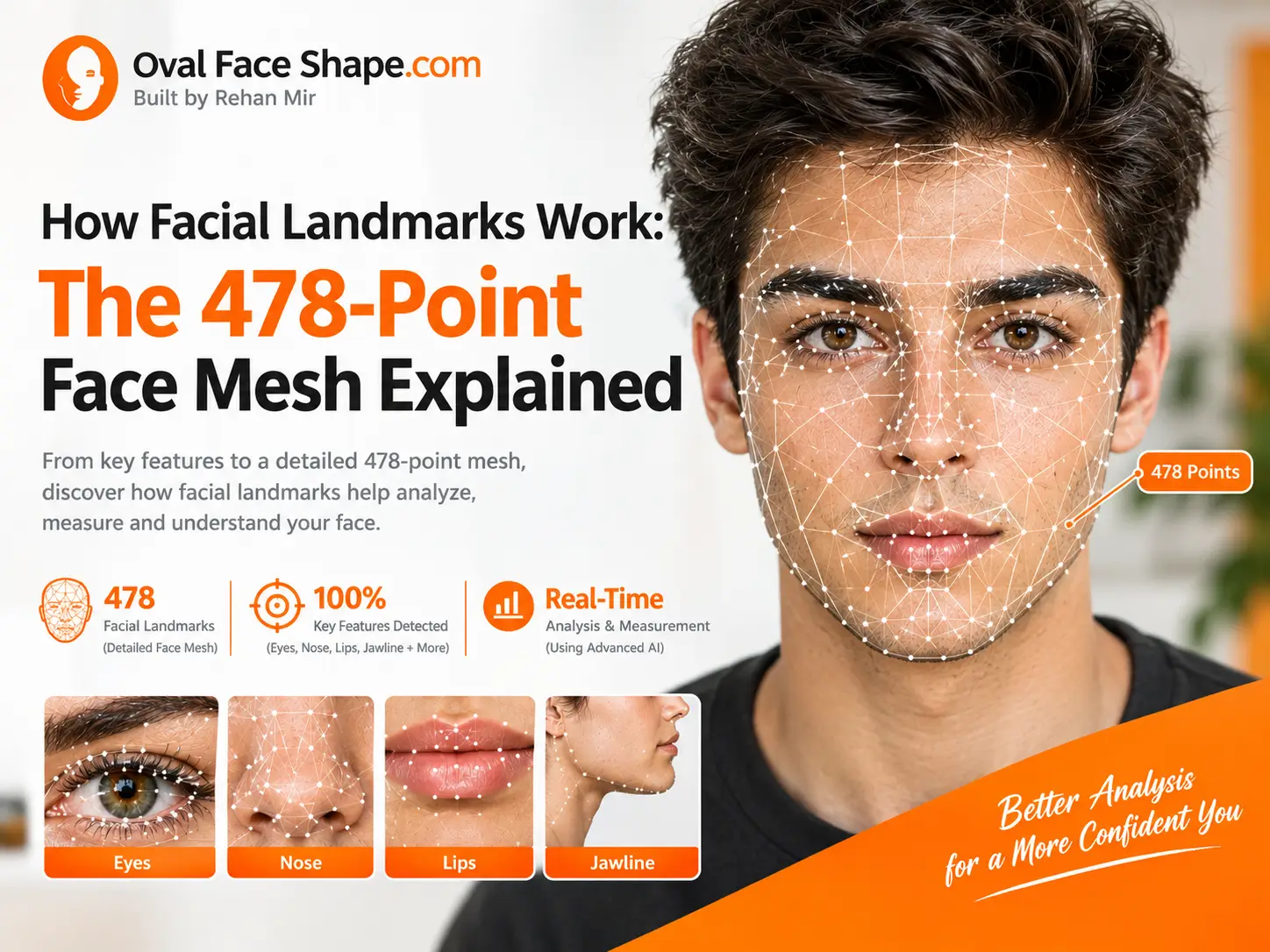
Facial landmarks are fixed points on a face that software finds automatically. Google’s MediaPipe locates 478 of them in 3D, then measures the distances between them to calculate face proportions.
By Muhammad Rehan Iqbal, Founder and Developer of OvalFaceShape.com, specializing in face shape analysis, interactive facial assessment tools, and educational styling guides.
Who this is for:
If you have used a face shape detector and wondered how it reached its answer, this guide explains the process step by step. Hairstylists, makeup artists and eyewear consultants will find the reliability section useful.
Developers searching for MediaPipe landmark indexes will find the index section. It does not cover which hairstyle or glasses to choose; the styling guides linked below do that.
What Are Facial Landmarks?
Facial landmarks are specific, repeatable points on the face, such as the corner of an eye, the tip of the nose or a point on the jawline. In anatomy they are called face anatomical landmarks. Anthropometry, the science of measuring the head and face, has used them for decades; Farkas’s Anthropometry of the Head and Face is the standard reference.
In computer vision, each landmark is a coordinate: an x and y position, plus a z value for depth in 3D systems. A landmark detector finds those coordinates automatically on any face.
How MediaPipe Face Landmarker Finds 478 Landmarks?
Google’s MediaPipe Face Landmarker works in stages. A face detection model finds the face first (the BlazeFace short-range model), a face mesh model then outputs an estimate of 478 3D landmarks, and a blendshape model predicts 52 expression scores. google
The detector only finds where the face is. The mesh model does the landmark work. The blendshape scores describe expressions, not shape, so they play no part in face shape analysis.
The 478 Points Explained
The 478 figure is two layers stacked together:
| Layer | Points | What it covers | Used for face shape? |
|---|---|---|---|
| Face mesh surface | 468 | Face contour, jaw, cheeks, brows, eyelids, nose, lips, forehead | Yes, all four key measurements |
| Iris refinement | 10 (5 per eye) | Iris center and edge points | Rarely; useful for eye-spacing and gaze work |
| Total landmarks | 478 | Full face plus both irises | |
| Blendshapes (not landmarks) | 52 scores | Expressions such as smile or brow raise | No |
The original Google Research mesh model used 468 vertices arranged in a fixed topology. The later Attention Mesh work predicts all 478 landmarks in 3D, with the iris handled as a separate output from the eye contour.
In MediaPipe’s iris-enabled output, the 10 iris points are appended after the 468 mesh points, at indices 468 through 477. Real-time Facial Surface Geometry from Monocular Video on Mobile GPUs
That explains why you still see “468” in older tutorials. They describe the original Face Mesh. Current Face Landmarker output is 478.
MediaPipe Face Mesh Landmarks Index: Points Used for Face Shape
Every landmark has a fixed index number, so the same index lands on the same anatomical spot on every face. Google publishes a full-size landmark map for the complete list. These indexes are commonly used for face shape measurements:
| Index | Location | Used for |
|---|---|---|
| 10 | Top of the forehead | Face length |
| 152 | Chin | Face length |
| 234 and 454 | Outer cheek edges | Face width |
| 1 | Nose tip | Alignment and symmetry checks |
Forehead width and jaw width use additional points along the contour, chosen per tool. A developer’s code decides which indexes count as “the jaw angle,” so two tools can disagree on the same photo.
How 478 Points Become a Face Shape?
The points are not the answer; the distances between them are. Four measurements matter most, all drawn from long-standing craniofacial anthropometry:
- Forehead width, across the temples
- Cheekbone width, usually the widest span
- Jaw width, at the angle of the jaw
- Face length, hairline to chin
The tool converts these into ratios, such as face length to cheekbone width and forehead to jaw, and compares them with the pattern for each shape (oval, round, square, heart, diamond, oblong, triangle). Some tools use a trained classifier.
Others, including the OvalFaceShape.com Face Shape Detector, apply ratio thresholds to the landmark measurements. Either way, the same math runs on every face, which a mirror check cannot guarantee.
Facial Landmark Detection vs Face Recognition
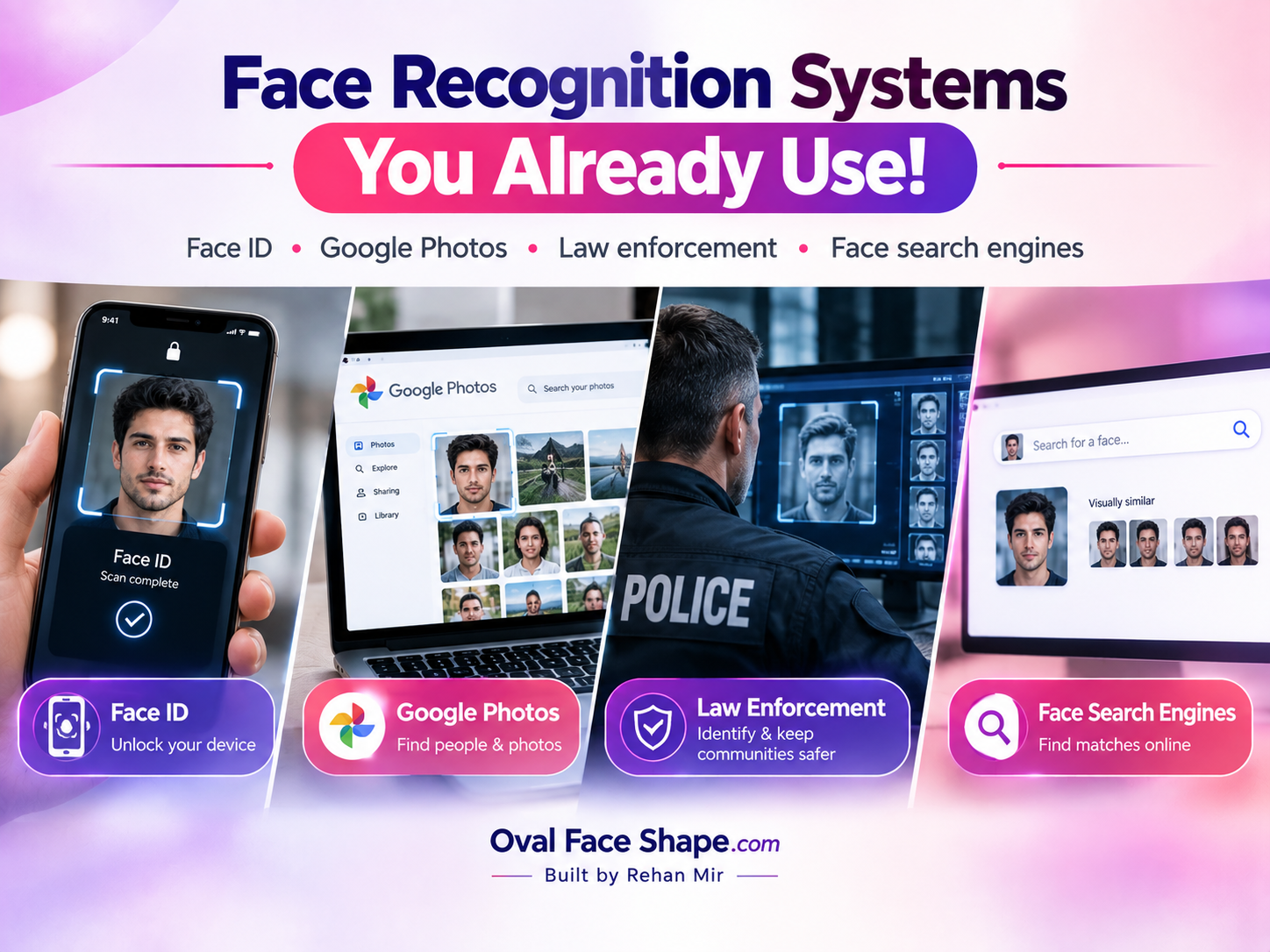
Landmark detection answers “where are the features?” Face recognition answers “who is this?” They are separate tasks. Recognition converts a face into a numeric template and compares it with stored templates. Landmarks are often only a preprocessing step that aligns the face first.
Curious about face recognition and face detection? Read our complete guide to understand how both technologies work and how they differ.
Recognition is not 100% accurate. NIST’s demographic study found that false positive rates often vary by factors of 10 to beyond 100 across demographic groups, depending on the algorithm. The tool in your browser measures proportions; it does not identify you. nist
What Are the Limitations of Facial Landmark Detection?
Accuracy drops with poor lighting, extreme head angles, heavy makeup that hides contours, and hair covering the forehead or jawline. A dense mesh helps on imperfect photos because each measurement draws on many converging points, but a blurry photo is still a blurry photo.
Google’s published research reports how accurately landmarks are placed, not how accurately a face shape label is assigned. For the original mesh, the authors describe prediction quality as comparable to the variance between human annotators. Treat any single “accuracy percentage” for face shape detection with caution, and read the result as a data-backed starting point, not a fixed label.arxiv
Faces between two categories, such as oval and oblong, can tip either way depending on a tool’s cutoffs.
Key Takeaways
- A facial landmark is a fixed, indexed coordinate on the face.
- Google’s current MediaPipe Face Landmarker outputs 478 3D landmarks: 468 face-mesh points plus 10 iris points.
- The 52 blendshape scores describe expressions, not landmarks.
- Face shape comes from the distances between landmarks: forehead, cheekbone, jaw and face length.
- Landmark detection locates features; face recognition identifies people.
- Results are a starting point for styling decisions, not a rigid label.
Next Step
Ready to see your own landmarks and ratios? Run the Face Shape Detector on a front-facing, evenly lit photo.
FAQs
What are facial landmarks?
Facial landmarks are fixed reference points on the face, such as eye corners, nose tip and jaw contour, that software locates as coordinates. Measuring the distances between them gives a repeatable way to calculate face proportions.
How do you identify a landmark?
A landmark detector first finds the face, then a trained model predicts each point’s coordinates. In MediaPipe, every landmark has an index number, so index 152 is always the chin. Anatomists identify landmarks by hand using bone and tissue references instead.
Is face recognition 100% accurate?
No. Accuracy depends on the algorithm, image quality and the population tested. NIST found false positive rates varying by factors of 10 to beyond 100 across demographic groups for many algorithms.
How does facial recognition identify a person?
It detects the face, aligns it (often using landmarks), converts it into a numeric template and compares that template with stored ones to find a match above a set threshold. A face shape detector does none of this; it only measures proportions.
Is it 468 or 478 landmarks?
Both numbers are correct for different versions. The original Face Mesh outputs 468 points. Current Face Landmarker output is 478: those 468 plus 10 iris landmarks.
How is 478-point detection different from the 68-point model?
A 68-point model places a few anchors around the eyes, brows, nose, mouth and jaw. The 478-point mesh covers the whole surface, including cheeks, forehead and eyelids, as continuous curves. The extra coverage helps measure jaw and cheek width on imperfect photos.
Does a landmark-based face shape detector upload my photo?
It depends on the tool. Browser-based MediaPipe tools can run the model on your device. The OvalFaceShape.com detector processes the photo in your browser and does not upload it.
1 thought on “How Facial Landmarks Work: The 478-Point Face Mesh Explained”