
Quick Answer:
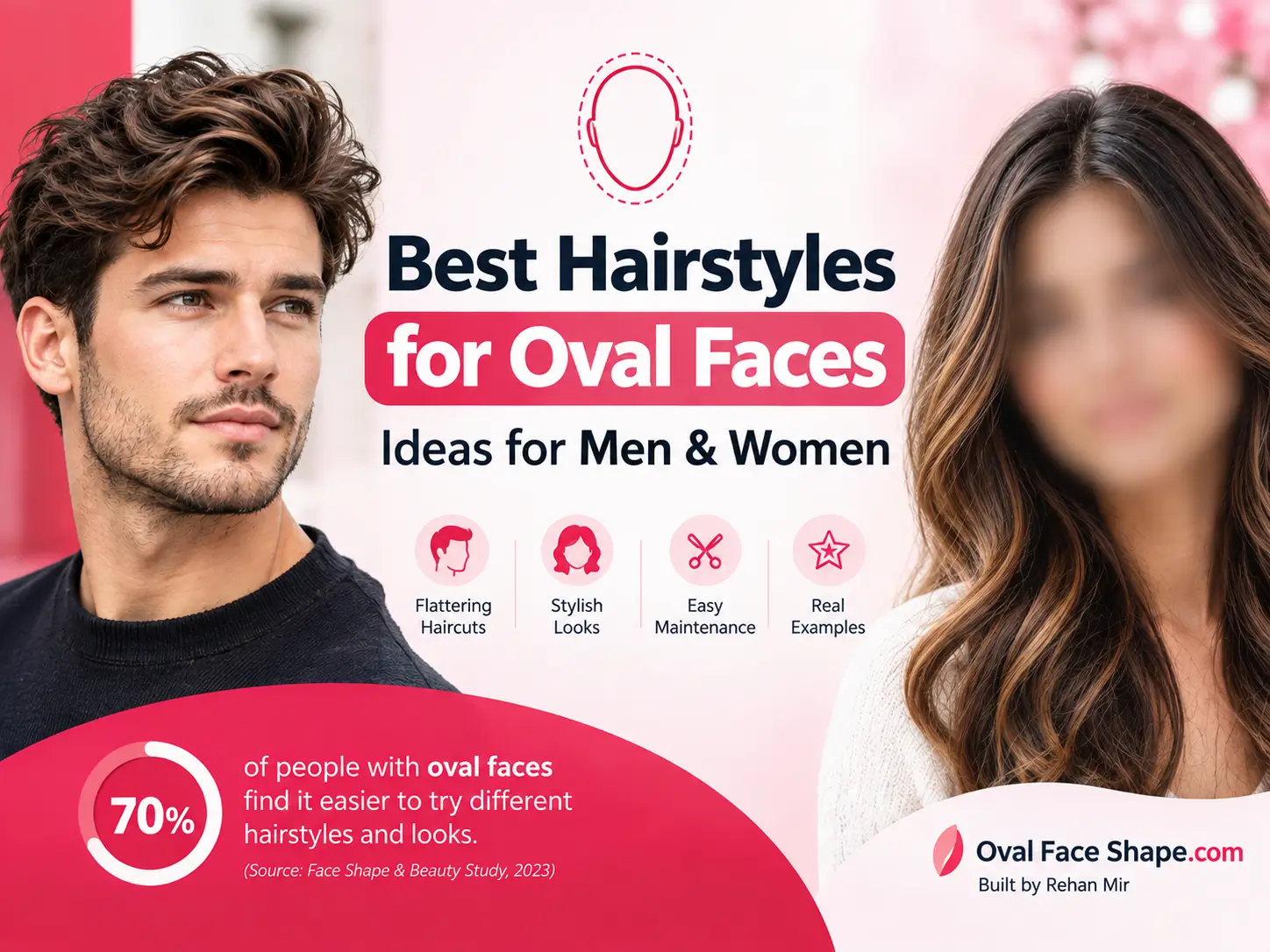
Almost any hairstyle suits an oval face. Top picks: textured crops and tapers for men, shoulder-length bobs and soft layers for women — both styled with a center or side part.
Best Hairstyles for an Oval Face Shape (Men & Women)
Who this guide is for:
Anyone who has confirmed an oval face shape — via a mirror check or OvalFaceShape.com’s Face Shape Detector — and wants a shortlist to bring into a salon or barber appointment, or is deciding whether to grow out or cut off a current style.
Given how many people searching this topic specifically want men’s options, this guide gives that side genuinely equal depth rather than a token mention.
Key Takeaways
- Oval faces run roughly 1.5:1, length to width, with cheekbones wider than the forehead and jaw — the baseline cosmetology styles against.
- Because there’s no width or angle to correct, the job of a cut is to showcase the face, not balance it.
- For men, textured crops, tapers, and classic side parts consistently top barber recommendations; for women, shoulder-length bobs, soft layers, and center parts do the same.
- The real risks are self-inflicted: excess crown volume, one-sided heavy length, or flat styling can distort proportions the oval shape already has working in its favor.
- This is styling guidance, not a rule book — hair texture, density, and lifestyle matter as much as face shape.
What Makes a Face Oval, Exactly?
Craniofacial anthropometry has long used the oval as its reference shape. Facial-proportion standards from Leslie Farkas’s anthropometric research put the oval face’s length-to-width ratio near 1.5:1, with curved rather than angular transitions at the forehead and jaw, and cheekbones as the widest point.
That’s distinct from an oblong face, which shares the length but keeps a more uniform width top to bottom instead of curving in.
Researchers measuring the related facial width-to-height ratio — bizygomatic width divided by upper facial height — across 2D photographs, 3D scans, and direct anthropometry in the same individuals found high agreement across all three methods, a 2012 study in PLOS ONE reported.
That consistency is part of why oval has held up as a stable styling category even as face-mapping has gone digital.
Why Stylists Treat Oval as the “No-Correction” Shape?
Gregory Patterson, Hair Care & Styling Expert for Sally Beauty, has said an oval-friendly cut’s success comes down to geometry — the shape carries only soft round lines, unlike a square, diamond, or triangle.
Hairstylist Samantha Cusick, describing a jaw-skimming bob on an oval face, called the effect sharp and intentional — proof that structured, blunt cuts read as clean rather than harsh here, something that isn’t true for angular shapes.
Best Hairstyles for Women with an Oval Face
- Shoulder-length crop — lifts the cheekbones and draws the eye upward; works on straight or wavy hair.
- Textured pixie — keeps attention on the eyes and lips; suits straight and curly textures alike.
- Soft curls or beachy waves — adds volume without needing to correct width or angles.
- Face-framing layers, starting at the cheekbone or jaw, add dimension without shortening the visible face length.
- Center part — one of the few partings cosmetology texts specifically recommend for oval faces, since it echoes the face’s natural symmetry.
Best Hairstyles for Men with an Oval Face Shape
Because so much of the search demand behind this topic comes specifically from men looking for haircut direction, this section covers three real categories rather than one generic list.
Short, textured cuts:
The textured crop — short sides with length and texture on top — is the most consistently recommended oval-face men’s cut for its low maintenance and built-in dimension. A buzz cut or Caesar works for the same reason: it exposes the face’s natural symmetry without fighting it.
Men’s Health Australia’s stylist Clark has pointed to Michael B. Jordan’s undercut-plus-beard pairing as an example of how an undercut lends height and contrast while a full beard adds balance.
Find the best curly haircuts and perms for an oval face shape in our detailed guides.
Classic, low-maintenance cuts:
A slicked-back taper or a classic side part is a safe, sharp option that won’t fight the face’s proportions — Jacob Elordi’s slicked-back taper is a frequently cited reference for this look, particularly on fine or thinning hair.
Longer, textured styles:
Mid-length waves with faded sides, or a longer taper worn messy or slicked back, add volume and work whether the hair is straight, wavy, or coily — an afro taper with a beard fade follows the same principle for textured hair types.
Cuts and Styling Mistakes to Avoid
- Excess crown volume can visually stretch an already-balanced face longer than it is.
- Heavy length on one side only pulls the eye and can read as wider or asymmetrical.
- Flat, product-starved styling dulls the definition an oval face already has.
- Overly heavy layering throughout can widen the visual silhouette unnecessarily.
Explore our complete guide to hairstyles for every face shape,haircuts for oval face shape.
Oval vs. Other Face Shapes at a Glance
| Face Shape | Widest Point | Length-to-Width Ratio | Jawline |
|---|---|---|---|
| Oval | Cheekbones | ~1.5:1 | Softly rounded, tapered |
| Oblong | Roughly even top to bottom | >1.5:1 | Straight sides, minimal taper |
| Round | Cheeks | ~1:1 | Soft, no defined angle |
| Square | Jaw and forehead roughly equal | ~1:1 | Strong, angular |
A Note on This Guidance!
This is styling guidance based on proportion and stylist convention, not a fixed rule book or a medical assessment.
Oval is a spectrum — many faces sit close to the oval/oblong or oval/round boundary — and a stylist’s in-person read of your hairline, density, and growth pattern will always outweigh a general guide like this one.
If you haven’t confirmed your shape yet, the Face Shape Detector is a faster starting point than a mirror guess.
Once your haircut is set, the next natural step for a lot of readers is coordinating facial hair with it — see our Beard Styles by Face Shape guide for pairings that work with the same oval proportions.
FAQs
Is oval considered the most attractive face shape?
There’s no scientific consensus that any single face shape is objectively “most attractive.” Cosmetology treats oval as the most versatile for styling, not the most attractive, since it’s the shape other proportions are measured against.
Are oval face hairstyles still relevant in 2026?
Yes — the underlying proportions haven’t changed, though the specific cuts in rotation have. Textured crops for men and soft, undone layers for women are the current expression of the same long-standing “no-correction” principle.
How is an oval face different from an oblong or round face?
Oval and oblong are both longer than wide, but oval curves in at the forehead and chin while oblong keeps a straighter, more even width throughout. Round faces are roughly as wide as long, with no elongation.
Read our complete guide on oval vs oblong face shape.
Do I need to see a stylist to confirm I have an oval face, or can I check myself?
A mirror check or a tool like the Face Shape Detector gets you a reasonable starting point; a stylist consultation is still worth it since hair density and growth pattern affect the final call.
Does hair texture change which of these cuts will actually work?
Yes — the shape principle stays the same, but curly or coily hair reads layers and volume differently than straight hair, so bring texture into the conversation with your stylist alongside face shape.
What’s the best men’s haircut for an oval face if I want something low-maintenance?
A textured crop or a buzz cut needs the least daily styling while still working with the shape’s natural symmetry — both hold up well between barber visits.