
Quick Answer:
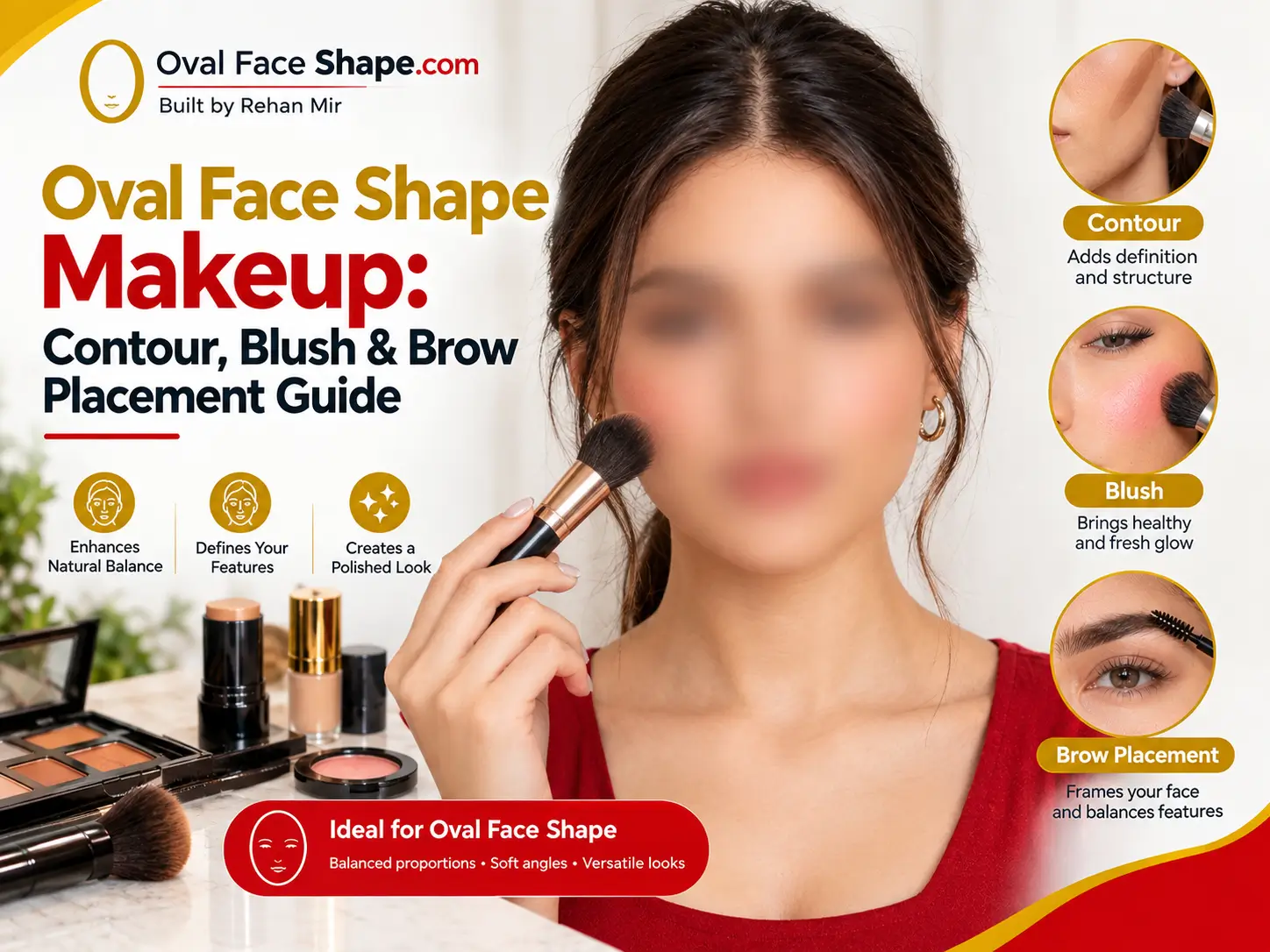
An oval face is typically about 1.5× as long as it is wide, creating balanced proportions. For oval face makeup, use light cheekbone contour, upward-swept blush, and a soft brow arch to enhance your natural features without heavy correction.
Oval face shape makeup is less about correcting proportions and more about maintaining them — the oval is already the most balanced shape on OvalFaceShape.com’s Oval Face Shape guide, with a gently tapered jaw and a forehead close in width to the cheekbones.
That balance changes the goal of every product on your face: contour, highlighter, blush, and brows are there to add dimension, not to reshape a jawline or narrow a forehead the way they would on a square or round face.
Who this guide is for:
This guide is written for someone who has already confirmed an oval face — through OvalFaceShape.com’s Face Shape Detector or by eye — and wants a practical, zone-by-zone answer for everyday or event makeup. If you haven’t confirmed your shape yet, the main Oval Face Shape guide walks through identification first; This article picks up where that one leaves off.
Why Oval Face Makeup Skips Heavy Correction?
Most face-shape makeup guides exist to disguise something — a wide jaw, a short forehead, a strong angle. An oval face doesn’t have a dominant feature to disguise, which is why over-applying correction techniques built for other shapes is the single most common mistake on this shape.
The forehead, cheekbones, and jaw curve gradually into one another with no sharp break, so any contour heavy enough to be seen at a glance usually reads as muddy rather than sculpted. Jane Iredale
How Contour and Highlighter Enhance an Oval Face?
Contour and highlighter work at all because of how the eye reads shading as depth. The extraction of three-dimensional shape from patterns of light and shadow is one of the most reliable cues the visual system uses to perceive surface curvature — that’s the actual mechanism behind “sculpting.”
On an oval face, that mechanism only needs a light touch, because the underlying bone structure is already doing the work. Springer
Contour Placement for an Oval Face
Apply contour just beneath the cheekbones, starting near the top of the ear and blending diagonally toward the corner of the mouth — stop at the midpoint of the cheek rather than dragging it all the way to the nose.
A very light sweep along the temples and hairline adds depth without narrowing the forehead.
Keep the product one to two shades deeper than your natural skin tone, and blend until there’s no visible line. The goal is a faint shadow, not a new jaw.
Highlighter Placement
Highlight the high points: cheekbones, brow bone, the bridge of the nose, and the center of the chin. Because an oval face already has balanced proportions, it can carry more highlighter than a round or square face without looking uneven — This is one of the few places where an oval face genuinely has more room to experiment.
Discover the makeup tricks that flatter a heart face shape in our heart face shape makeup guide.
Blush Placement
Smile slightly and apply blush to the apples of the cheeks, blending it upward and outward toward the temples. This placement works with the oval’s natural taper rather than against it.
Unlike a round face, where blush needs to stay high to avoid adding width, an oval face has enough length to tolerate blush placed slightly lower and closer to the apples for a softer, more natural flush.
Eyebrow Shaping
A soft, gently rounded arch complements an oval face better than a sharply angled one, since it echoes the face’s existing curves rather than cutting against them.
Facial symmetry is one of the more consistent predictors of how balanced a face is perceived to be, and brows are one of the fastest ways to either reinforce or disrupt that symmetry — keep the arch proportional rather than dramatically peaked. AMS
Eye Makeup Placement
Oval faces have flexibility here that other shapes don’t: winged liner, rounded smoky eyes, and horizontally elongated shadow all read well, because there’s no forehead-to-jaw imbalance to correct for. I
f you want a specific effect, extend liner slightly past the outer corner for a lifted look, or keep shadow centered on the lid for a rounder, softer eye — both work on this shape.
Lip Shape and Colour
Almost any lip shape and colour sits well on an oval face, from a natural nude to a bold, fully lined red. Slight over lining is optional rather than corrective here, since there’s no narrow chin or wide jaw to balance out with lip volume the way there would be on a heart or diamond face.
Oval vs. Other Face Shapes: How Contouring Differs?
| Face shape | Main contour goal | Blush placement | Brow shape |
|---|---|---|---|
| Oval | Maintain, not reshape | Apples, blended up | Soft, gentle arch |
| Round | Add length, narrow width | High on cheekbones only | Higher arch for lift |
| Square | Soften angular jaw | Apples, rounded blend | Rounded, low arch |
| Diamond | Soften cheekbone width | Below apples | Curved, gentle arch |
Common Oval-Face Makeup Mistakes
- Over-contouring the jaw: there’s rarely a jawline issue to fix on this shape, and heavy jaw contour just muddies a feature that’s already balanced.
- Copying a tutorial built for another shape: a technique demonstrated on a square or heart face will not translate directly.
- Skipping highlighter out of caution: an oval face can usually take more highlight than the wearer expects.
Discover the contouring secrets that make diamond face shapes shine in our diamond face shape makeup guide.
Key Takeaways
- Oval face makeup is about enhancement, not correction — the shape has no dominant feature to disguise.
- Contour goes lightly under the cheekbones and temples; stop well short of the nose.
- Blush blends from the apples up toward the temples.
- Brows should follow a soft arch; eyes and lips have the most flexibility of any face shape.
- The biggest mistake is applying another shape’s correction technique to an already-balanced face.
Article by Muhammad Rehan Iqbal, Founder and Developer of OvalFaceShape.com, specializing in face shape analysis, interactive facial assessment tools, and educational styling guides.
FAQs
Do oval faces actually need contour?
Not for correction — an oval face has no dominant imbalance to fix. Light contour still adds dimension for photos or evening looks, but it’s optional rather than necessary.
Is contouring still worth doing for an oval face in 2026, with “skin-first” and no-makeup trends popular?
Yes, in a lighter form. The trend has shifted toward soft, blended definition rather than heavy sculpting, which actually suits an oval face’s already-balanced structure better than the harder contour styles of a few years ago.
How is oval-face contour different from round or square face contour?
Round and square faces use contour to add length or soften angles; an oval face uses it only to add subtle depth, since the underlying proportions don’t need reshaping.
What’s the biggest makeup mistake people with oval faces make?
Applying a heavy, corrective technique built for a different face shape — most often over-contouring the jaw or forehead when neither needs narrowing.
What eyebrow shape works best on an oval face?
A soft, gently rounded arch that follows the face’s natural curves, rather than a sharply angled or overly straight brow.
Can bold lip colors work on an oval face?
Yes — because there’s no narrow chin or wide jaw to balance, an oval face can carry almost any lip shape or color, from natural nudes to fully overlined bold reds.