
Quick Answer:
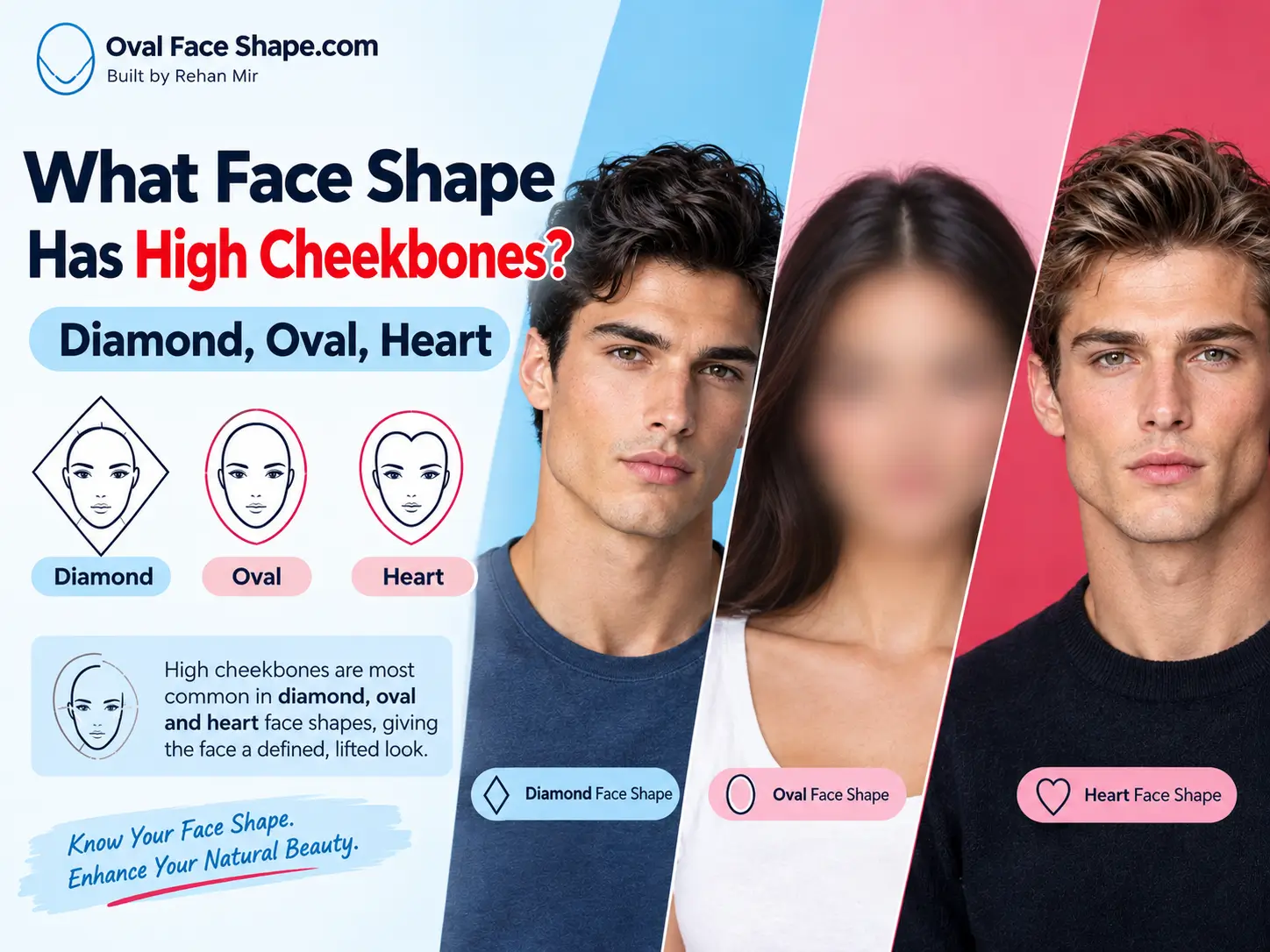
Diamond, heart, and oval face shapes commonly have high cheekbones. Diamond faces have the widest, most prominent cheekbones. Oval faces have gently prominent cheekbones, while heart faces have prominent cheekbones and a wider forehead.
High cheekbones happen when the zygomatic bones — the cheekbones — sit close to the eyes rather than the nose, creating a sculpted midface.
On OvalFaceShape.com, that trait shows up most strongly in diamond face shapes, moderately in oval face shapes, and is often visually present but not structurally defining in heart face shapes.
Who this guide is for:
If you’re trying to self-identify before picking a hairstyle, glasses, or makeup approach, which of these three you land in depends less on how “high” your cheekbones feel and more on how they compare in width to your forehead and jaw.
High vs. Prominent vs. Wide: Why This Gets Confusing?
“High” describes vertical position — how close the cheekbone sits to your eyes versus your nose. “Prominent” describes projection — how much the bone stands out, which can look softer or sharper depending on the fat layer over it. “Wide” describes proportion — how your cheekbone width compares to your forehead and jaw.
Face shape is decided by width, not height or projection. A cheekbone can be high and narrow, or lower and wide. That’s the distinction that actually sorts diamond from oval from heart.
Diamond Face Shape: Cheekbones as the Defining Feature
The diamond face shape is the one where high cheekbones aren’t just present — they’re the whole story. A diamond face has a narrow forehead and narrow jaw, with cheekbones sitting clearly wider than both, creating a sharp V-taper above and below.
If your cheekbone width measures meaningfully more than your forehead and jaw width — not a close call, a real gap — diamond is the shape you’re looking at.
This is the shape OvalFaceShape.com’s diamond face guide and hairstyle recommendations are built around, and it’s worth checking those once cheekbone dominance is confirmed.
Oval Face Shape: Cheekbones as the Widest Balanced Point
Oval face shapes also have cheekbones as the widest measurement — this site’s namesake shape is a cheekbone-led shape too. The difference from diamond is degree: An oval face’s cheekbones lead by a modest margin, with the forehead close behind and a gently rounded jaw beneath, rather than a dramatic V-taper.
If your cheekbones are your widest point but the gap to your forehead and jaw feels moderate rather than dramatic, that points to oval rather than diamond.
The Oval Face Shape guide and Face Shape Detector can confirm the exact proportions rather than leaving it to a visual guess.
Heart Face Shape: Prominent Cheekbones, Without Being the Widest Point
Heart faces often look cheekbone-forward because the cheekbones sit high and full. But on a true heart face shape, the forehead — not the cheekbones — is the widest single measurement, with the face narrowing steadily down to the chin.
So if your forehead reads wider than your cheekbones even though the cheekbones themselves look prominent, heart is the more accurate call than diamond or oval.
Which Shapes Don’t Have High Cheekbones?
Round and square faces keep their three widths (forehead, cheekbone, jaw) close to even — no one measurement dominates, which is part of what defines those shapes.
Oblong and rectangle faces are defined by length, not width dominance, so cheekbones aren’t the deciding factor there either. Triangle faces are widest at the jaw, the opposite pattern from diamond.
Low Cheekbones: The Opposite Pattern
Low cheekbones sit closer to the nose than the eyes — the reverse vertical position from high cheekbones. This is a separate property from face shape itself: Someone can have low-set cheekbones on an oval, round, or square face, since low describes height, not width proportion.
Low cheekbones don’t rule out any particular shape, and they aren’t something contouring changes structurally — makeup can create the visual illusion of lift, but the underlying bone position stays the same.
Does This Differ for Men vs. Women?
The geometry doesn’t change by gender — cheekbone width relative to forehead and jaw decides diamond, oval, or heart the same way for men and women.
Anthropometric research on the zygomatic bone has found real average differences in bone size and contour height between sexes, though these are population averages, not a predictor for any one face.
A 108-skull anthropometric study of a Chinese Han population found the relative position of zygomatic bone contour height was significantly greater in males than females — a size difference, not a difference in which face shape category the trait belongs to.
What changes by gender is usually the styling response: see the oval face shape hairstyles for men or diamond-specific guides for the practical side of this. Lippincott Williams & Wilkins
The 10-Second Self-Test
- Pull hair back and face a mirror straight-on, neutral expression.
- Hold two fingers at your temples, then slide them down to your cheekbones, then to your jaw below your ears — note which position has the widest gap.
- Cheekbones clearly widest, by a large margin → diamond.
- Cheekbones widest, by a small margin → oval.
- Forehead widest, cheekbones close behind → heart.
- All three widths close → round or square (check jaw angularity to tell those apart).
For an exact reading instead of a visual guess, the Face Shape Detector measures all three widths from a photo.
Genetics and Why Cheekbone Structure Varies?
Zygomatic bone size, contour, and projection vary across individuals and, on average, across populations — this is population-level variation, not something that predicts any one person’s face.
Zygomatic projection has been used in studies of inter-population variation, and osteometric standards for the bone are considered population-specific.
Sexual dimorphism and ancestral variation in the zygomatic bone occur as a result of both environmental and genetic factors that differ between population groups.
In practical terms:
Cheekbone height and width are inherited traits, not something diet or exercise reshapes, though weight loss can reveal cheekbone structure that was there all along but obscured by soft tissue. Wiley Online LibraryScienceDirect
Key Takeaways
- Diamond = cheekbones clearly the widest point, narrow forehead and jaw.
- Oval = cheekbones the widest point, but only moderately.
- Heart = cheekbones look prominent, but the forehead measures wider.
- Low cheekbones is a height question, separate from face shape entirely.
- The geometry is the same for men and women; only the styling advice differs.
- Cheekbone structure is genetic and doesn’t change with weight, though visibility can.
FAQs
What face shape has the highest cheekbones?
Diamond face shapes have the most clearly cheekbone-dominant structure — cheekbones sit wider than both forehead and jaw by a real margin, not a marginal one.
Do oval faces have high cheekbones?
Yes, in the sense that cheekbones are typically an oval face’s widest measurement. Whether they’re also vertically “high” (close to the eyes) is a separate, individual trait rather than something the oval shape itself guarantees.
What’s the difference between high, prominent, and low cheekbones?
High and low describe vertical position relative to your eyes and nose. Prominent describes projection — how much the bone stands out. Face shape, though, is decided by width proportion between forehead, cheekbones, and jaw, not by height or projection.
Can you have high cheekbones with a round face?
Structurally, yes — but round faces carry more soft-tissue volume across the midface, which can make cheekbone structure less visible even when the underlying bone sits high. Losing weight sometimes reveals cheekbone definition that was there but obscured.
Do low cheekbones mean a specific face shape?
No. Low cheekbones describe vertical bone position and can occur on any face shape — oval, round, square, or otherwise. It isn’t tied to one particular shape category.