
Quick Answer:
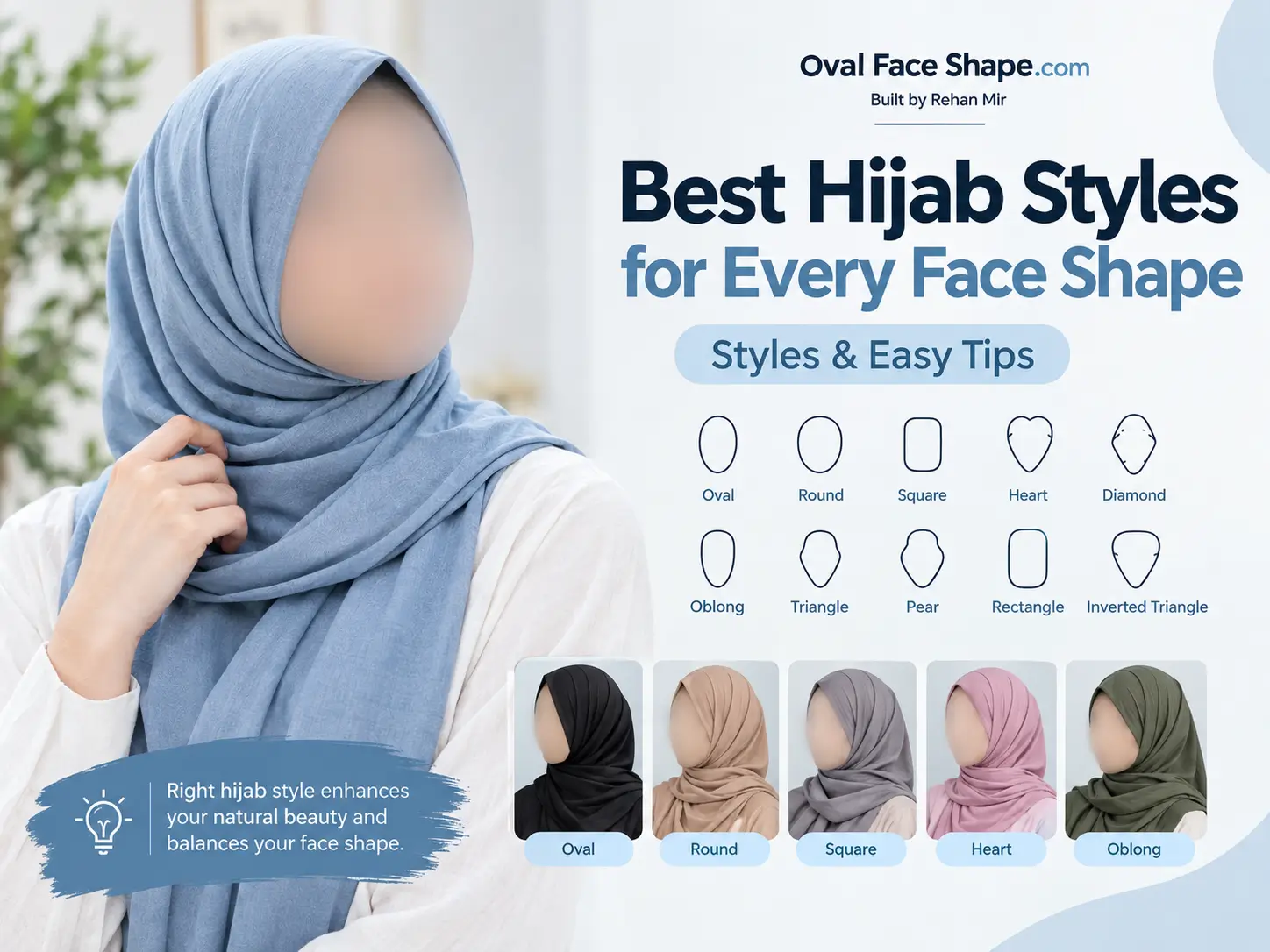
The best hijab style depends on your face shape: round faces benefit from loose drape and a higher fold, long faces from width and lower folds, square jaws from soft side-swept layers, and heart/diamond faces from fuller fabric at the jawline.
A hijab style doesn’t change your face shape — it changes what the eye notices first. Matching drape, fold height, and fabric to your specific shape adds definition where you want it, instead of by accident.
Not Sure of Your Face Shape?
This guide assumes you already know your shape. If you don’t, OvalFaceShape.com’s Face Shape Detector and per-shape guides can confirm it in a few seconds before you style around it — that identification step is covered there, not repeated here.
Why Drape Changes How a Face Reads?
A hijab pulled tight and horizontal across the face emphasizes width; one draped with more vertical line reads as longer and narrower.
This isn’t just styling folklore — a study of the Helmholtz illusion shows that vertical found that shapes framed by vertical lines are consistently perceived as taller and narrower than identical shapes framed by horizontal ones, reporting that a vertical-striped rectangle needs to be extended by roughly 7% to visually match the height of a horizontally framed square.
Every recommendation below is a version of that same principle, adjusted for what each face shape actually needs — more vertical line, more width, or more softness.
Round Face Shape
Round faces are close to equal in width and length, with full cheeks and a soft, curved jaw. The goal is vertical line, not width.
- Loosely draped styles — let a layer fall past the jaw instead of pinning fabric snugly against the cheeks.
- Higher front fold — positioned slightly higher on the forehead opens the face and adds lift.
- Side-swept or asymmetric drapes — an uneven line breaks up the circular shape.
- Best fabrics: chiffon or modal, worn over a smooth undercap so fabric doesn’t puff outward at the sides.
Oval Face Shape
Oval faces are naturally balanced — slightly wider foreheads, gently curved jaws, close to a 1.3–1.5:1 length-to-width ratio. Most styles suit this shape without adjustment, so it’s the easiest face shape to experiment on, from structured pre-shaped hijabs to loose draped shawls.
Square Face Shape
A square face has a broad forehead and a strong, angular jaw, with width close to equal at the forehead, cheeks, and jaw. The goal is softening the angles, not hiding them.
- Side-swept layers — wrap one end higher and let the other drape longer to break the boxy symmetry.
- Soft, fluid fabrics — chiffon or jersey smooth out sharp jaw lines better than stiff, structured fabric.
- Avoid tight, straight-edged wraps that echo the jaw’s own angularity.
Long or Oblong Face Shape
A long face has more vertical length than width already, so the goal flips: add width, not length.
- Wider scarves wrapped with more fullness at the sides add horizontal balance.
- Lower front fold — starting the wrap lower on the forehead shortens the visual length of the face.
- Fuller, structured fabric (like a soft jersey) holds width better than fabric that collapses flat.
Heart-Shaped Face
A heart face is wider at the forehead and narrows to a pointed chin. Balance comes from adding fullness lower on the face.
- Fuller drape at the jawline widens the narrower lower half to match the forehead.
- Wider scarves wrapped loosely around the chin soften the taper instead of emphasizing it.
Diamond Face
A diamond face is narrow at the forehead and chin, with the cheekbones as the widest point.
- Wider scarves wrapped fuller near the jaw and forehead balance the prominent cheekbones.
- Soft fabrics like chiffon or jersey smooth the transition between the narrow and wide points of the face.
Triangle Face
A triangle face has a narrower forehead widening toward a fuller jawline.
- Higher folds and more volume near the crown draw visual weight upward, balancing the wider jaw below.
- Avoid styles that add bulk low at the sides, which can emphasize the jaw’s width further.
Fabric Quick Reference
| Fabric | Effect | Works especially well for |
|---|---|---|
| Chiffon | Light, holds a soft defined edge | Round, square, diamond |
| Modal | Fluid drape, minimal bulk | Round, oval |
| Jersey (structured) | Adds width and fullness | Long/oblong, heart, diamond |
| Heavy/stiff fabric | Adds bulk near the face | Best avoided for round and square |
Key Takeaways
- No face shape is limited to one “correct” hijab style — these are starting points, not rules.
- Round and square faces generally benefit from softer, looser drape; long and heart-shaped faces benefit from added width and fullness.
- The vertical-versus-horizontal effect behind this advice is grounded in real visual-perception research, not just styling tradition.
- Fabric choice (chiffon, modal, jersey) changes the effect of the same wrap style.
- Confirming your face shape first makes every other choice here more useful.
Muhammad Rehan Iqbal, Founder and Developer of OvalFaceShape.com, builds the site’s face-shape analysis tools and styling guides, combining web development and facial-analysis work with practical style research.
FAQs
Does hijab style actually change how a face shape looks, or is that just a trend?
It’s grounded in real visual perception. Research on the Helmholtz illusion shows that vertical framing is consistently perceived as taller and narrower than horizontal framing of the same size — the mechanism behind advice like “loose drape for round faces” and “wider wraps for long faces.”
What’s the best hijab style for a round face specifically?
A loosely draped style with a higher front fold, in a light fabric like chiffon or modal, worn over an undercap to prevent fabric from adding width at the sides.
Is a tudung style for round faces different from a hijab style?
No — tudung is a regional term (common in Southeast Asia) for the same head covering, and the same styling principles apply regardless of the term used.
Can any hijab style suit any face shape, or are some genuinely off-limits?
No style is off-limits for any shape. The recommendations here are about which styles create the most flattering effect for a given shape — not restrictions on what’s wearable.
Which face shape is easiest to style for?
Oval, since it’s naturally balanced in width and length — most drape and fold styles suit it without adjustment.
How do I find out my actual face shape before choosing a style?
Face shape is generally read from the width and length relationship across the forehead, cheekbones, and jaw. OvalFaceShape.com’s Face Shape Detector can confirm this in a few seconds.