
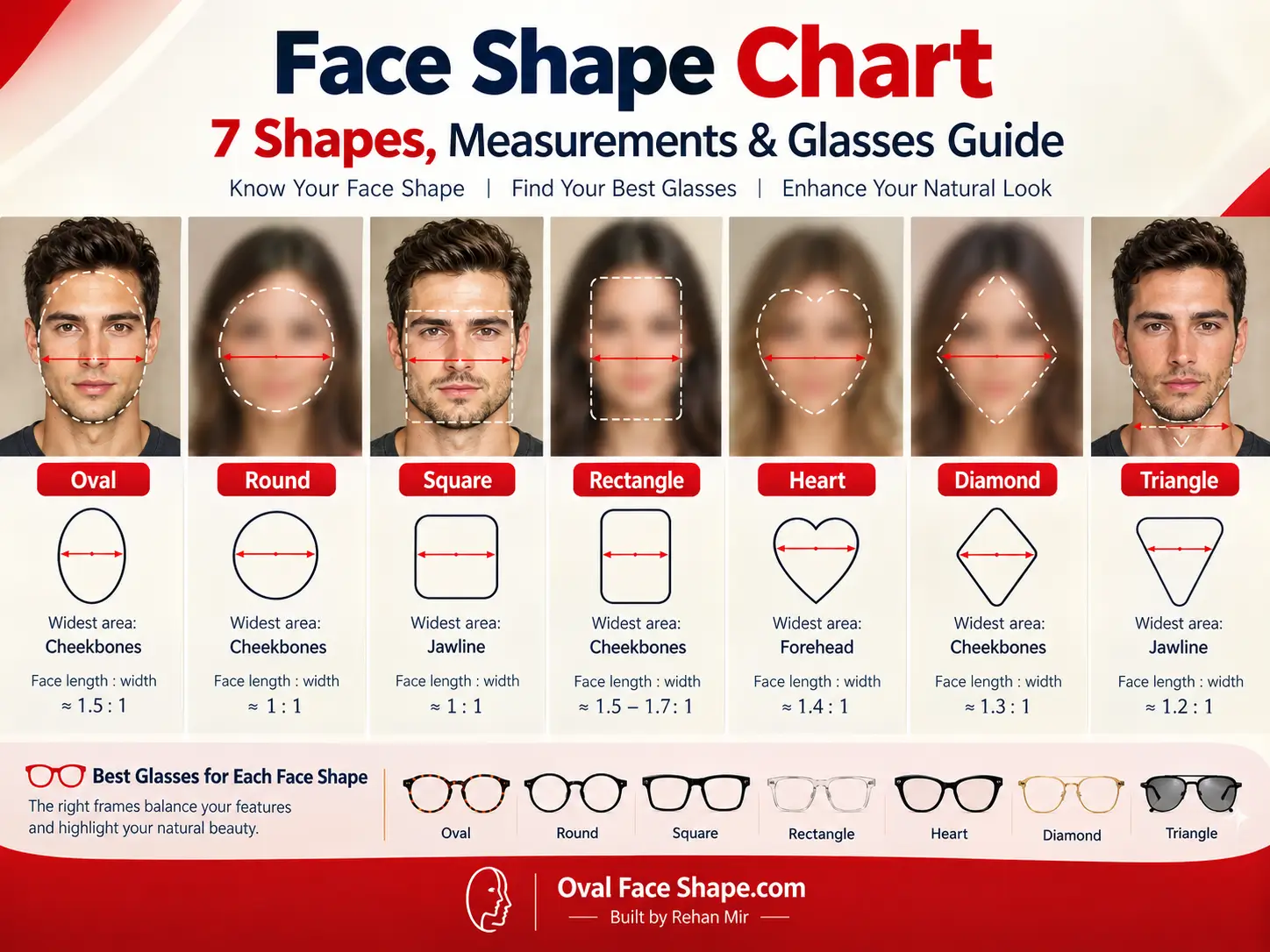
Quick Answer:
A face shape chart matches your face to 7 outlines (oval, round, square, rectangle, heart, diamond, triangle) by comparing length-to-width ratio with forehead, cheekbone and jaw widths.
By Muhammad Rehan Iqbal, Founder and Developer of OvalFaceShape.com, specializing in face shape analysis, interactive facial assessment tools, and educational styling guides.
A face shape chart sorts faces into seven common outlines. You compare face length with width, find the widest area, then check how the jaw and chin finish. Measure once, pick your closest match, and treat it as a styling starting point rather than a verdict.
Who this guide is for:
Anyone matching their own face to a diagram before buying glasses, choosing a haircut or planning makeup. It works the same way for men, women and boys. Each shape’s own guide covers full styling, so this page stays focused on identification.
Face Shape Chart: The 7 Shapes at a Glance
| Shape | Length ÷ width* | Widest area | Jaw and chin |
|---|---|---|---|
| Oval | 1.3–1.5 | Cheekbones | Rounded, gentle taper |
| Round | Under 1.3 | Cheeks | Soft, no corners |
| Square | Under 1.3 | Forehead, cheeks, jaw about equal | Defined corners |
| Rectangle / Oblong | Over 1.5 | Even from forehead to jaw | Angular (rectangle) or softer (oblong) |
| Heart | Any | Forehead (about 95% of cheekbone width or more) | Jaw about 80% of forehead or less; small chin |
| Diamond | Any | Cheekbones; forehead and jaw about 90% of cheekbone width or less | Narrow forehead and chin |
| Triangle | Any | Jaw; forehead about 90% of jaw width or less | Broad jaw |
Length runs from hairline to chin; Width is across the cheekbones. These are OvalFaceShape.com’s working ranges, not an anatomical standard.
Face Shape Chart Measurements: How to Measure?
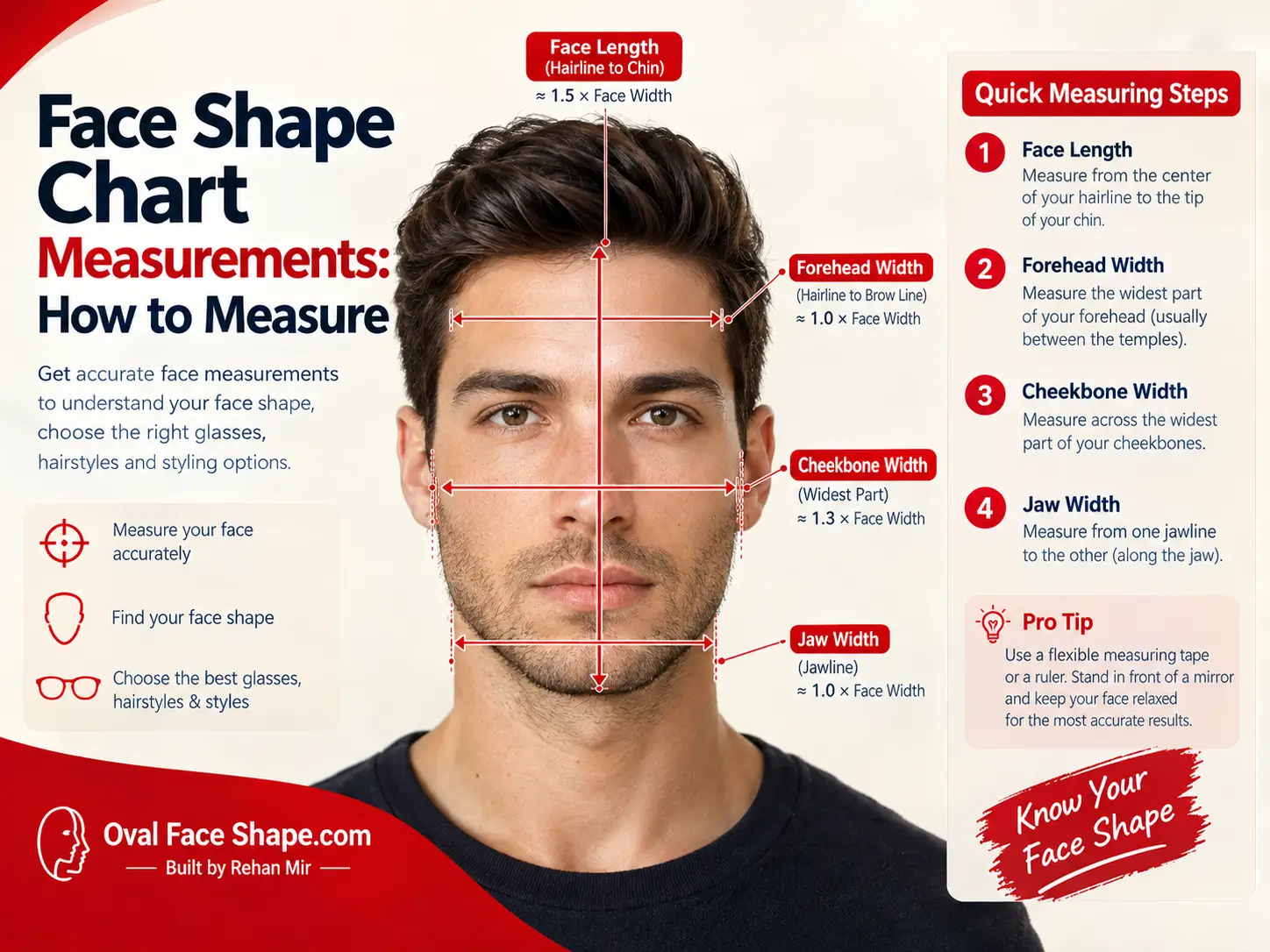 Take four straight-line measurements, then divide length by cheekbone width. The result is a clue, not a diagnosis.
- Length: center of the hairline to the tip of the chin.
- Cheekbone width: the widest point across the cheekbones.
- Forehead width: across the forehead at its widest, usually above the brows.
- Jaw width: between the two jaw angles below the ears.
Use a ruler on a printed front-facing photo, or measure in a mirror with a straight edge. A tape wrapped over the curve of the face adds distance and skews the ratio. For heart, diamond and triangle faces, compare the three widths instead of the length ratio.
Widths within about 5% of each other count as even. If the widths are even, use the length-to-width ratio alone (round, square, oval or rectangle). If one area clearly leads, apply the matching rule in the table. If two shapes still fit, keep both as starting points. These are OvalFaceShape.com’s working ranges, not an anatomical standard.
Why Sources Disagree on Face Shape Classifications?
Warby Parker describes an oval face as roughly twice as long as it is wide, while other glasses guides use 1:1.5. OvalFaceShape.com uses 1.3–1.5 for oval and treats anything above about 1.5 as rectangle or oblong. Check which ratio a chart assumes before comparing results.
The Face Shape Detector uses ratio and width comparisons like these. It estimates the measurements from facial landmarks in a photo, so you don’t have to take them by hand.
Face Shape Chart for Men, Women and Boys
The seven outlines are identical for everyone. What changes is how easily your measurements can be read.
- Men: a beard hides the jaw. Measure clean-shaven, or use a photo where the jawline is visible.
- Women: hair over the forehead and temples hides the upper face. Pull it back before measuring.
- Boys: faces keep growing through adolescence. Treat a boy’s result as a snapshot and re-check after growth spurts.
The sources reviewed publish no separate male or female cutoffs. The working ranges above apply to both.
Glasses Face Shape Chart (Frames and Sunglasses)
Frames that contrast with your jaw and match your widest zone are the usual starting point. The same chart applies to sunglasses.
| Shape | Frames Warby Parker suggests |
|---|---|
| Round | Rectangle, square, geometric, cat-eye, browline |
| Oval | Almost any style; go wide to balance length |
| Square | Round, oval, wire, semi-rimless |
| Heart | Oval, round, aviator, semi-rimless |
| Triangle | Rectangle, browline, cat-eye |
| Diamond | Browline, cat-eye, round, oval, semi-rimless |
| Rectangle / Oblong | Not listed by Warby; wide frames that add width are the common approach |
Warby Parker itself calls face shape a tiebreaker, with fit and comfort mattering more.
For get more details see the full glasses by face shape guide for each shape in depth.
Face Shape Chart for Haircuts, Makeup and Eyebrows
These are widely repeated styling conventions, not tested findings. Use them to narrow options, then adjust for hair texture and preference.
| Shape | Haircut cue | Makeup and eyebrow cue |
|---|---|---|
| Oval | Most cuts work | Soft arch, light contour |
| Round | Add height, avoid width at the cheeks | Angled arch to lengthen |
| Square | Softer texture at the jaw | Softly rounded brows |
| Rectangle / Oblong | Fringe or side volume to shorten | Flatter brows, blush across the cheeks |
| Heart | Volume at jaw level | Soft, rounded brows |
| Diamond | Width at forehead and jaw | Gentle arch |
| Triangle | Volume at the crown | Defined brows to lift the upper face |
For cuts in detail, see hairstyles by face shape and beard styles by face shape.
Between Two Shapes? Compare the Close Pairs
- Oval vs oblong: the length ratio separates them. Oblong runs above about 1.5. See oval vs oblong face shape.
- Oblong vs rectangle: both are long. Rectangle has angular jaw corners and oblong has a softer lower outline. Many charts merge them.
- Heart vs diamond: heart is widest at the forehead, with the jaw about 80% of forehead width or less. Diamond is widest at the cheekbones, with both forehead and jaw about 90% of cheekbone width or less.
- 6, 7 or 8 shapes: Warby Parker uses six, many guides use seven, and some use eight. The difference is mostly naming.
As the developer of the Face Shape Detector, Muhammad Rehan Iqbal built its classification on this same logic. Length ratio comes first, then forehead, cheekbone and jaw widths.
Key Takeaways
- A face shape chart compares length-to-width ratio and where the face is widest.
- Oval is roughly 1.3–1.5 on OvalFaceShape.com’s working scale. Sources vary, so check the ratio any chart assumes.
- The same chart serves men, women and boys. Beards and hair can hide the outline, and boys’ faces keep changing.
- Glasses and haircut guidance is a tiebreaker. Fit, comfort and preference matter more.
- Two shapes can fit one face. Keep both as starting points.
Next step:
Upload a front-facing photo to the Face Shape Detector to compare your result with this chart.
FAQs
What are the 7 basic face shapes?
The seven basic face shapes are oval, round, square, rectangle (also called oblong), heart, diamond and triangle (also called pear). Charts vary: Warby Parker uses six and some sites use eight, mostly through naming differences.
Explore our complete guide to the different types of face shapes to learn how to identify each shape and understand their key characteristics.
Which face shape looks the best?
No face shape is objectively best. Oval is often called the most versatile, but attractiveness depends on proportions, features and style, and glasses guides treat face shape as only an optional tiebreaker.
What is the rarest face shape to have?
No reliable population data ranks face shapes by rarity. Warby Parker describes triangle and diamond faces as relatively rare, but that is a descriptive claim rather than a measured prevalence.
Discover the rarest face shape in our complete guide, featuring different face shapes, their defining characteristics, and what research reveals about their rarity.
Is a rectangle face the same as an oblong face?
Often, yes. Some charts use the words interchangeably. This page treats rectangle as the angular version and oblong as the softer one, so check the description, not just the name.
Is a face shape chart or a detector more reliable?
Neither gives a definitive classification. A chart lets you inspect the criteria yourself, while a detector applies the same measurements consistently. Photo angle, hair and expression affect both.
Is a face shape chart still worth using in 2026?
Yes, as a starting point for glasses, haircuts and makeup. Its value is narrowing choices, not dictating them.
Can boys use the same face shape chart?
Yes, the outlines are the same. Boys’ faces are still growing, so re-check after growth spurts.