
Quick Answer:
Choose a cut that balances your face shape: height for round faces, softer lines for square, width for long, jaw volume for heart. Oval suits most styles. Hair type still matters.
By Muhammad Rehan Iqbal, Founder and Developer of OvalFaceShape.com, specializing in face shape analysis, interactive facial assessment tools, and educational styling guides.
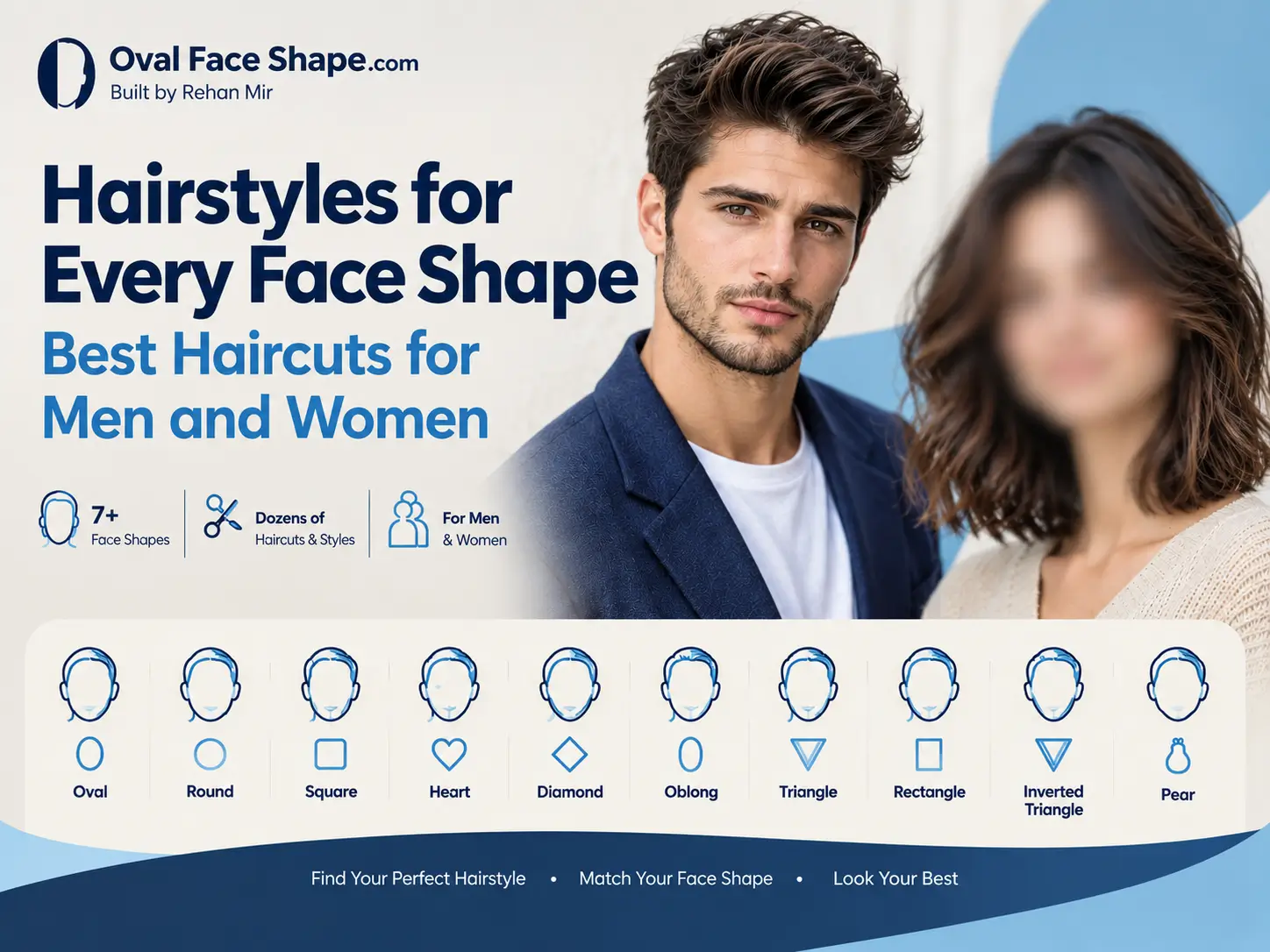
Hairstyles for every face shape are haircuts matched to the proportions of your forehead, cheekbones, jaw, and face length. They are a visual-balance guide, not a rule: hair texture, density, and personal taste change the result.
Who this is for:
Men and women choosing a new cut, and anyone briefing a barber or stylist. This OvalFaceShape.com guide covers haircut choice only; the Face Shape Detector handles identification in more depth.
How to Find Your Face Shape Before Choosing a Haircut?
Pull your hair back and measure four points: Forehead width, cheekbone width (the widest part), jaw width, and face length from hairline to chin. These are standard craniofacial landmarks, catalogued in Farkas’s Anthropometry of the Head and Face.
Then work through this order, which avoids the common mistake of sending every oval face to “oblong”:
- Find the widest point. Forehead = heart. Cheekbones, with a narrow forehead and jaw = diamond. Jaw = triangle (pear).
- If none of those fits, divide face length by cheekbone width. Above 1.5 = oblong. Between 1.3 and 1.5 = oval.
- Under 1.3, check the jaw. Angular = square. Soft and curved = round.
These cut-offs are OvalFaceShape.com’s working standard, not a universal scientific threshold. Real faces blend categories: A 2015 PLOS ONE study of 286 Malaysian university students found 54.5% had a short, wide face, 28.3% a long face, and only 17.1% matched the “ideal” ratio. Expect to sit between two shapes.
Best Haircuts for Men by Face Shape
For men, the goal is height on round faces, softer lines on square jaws, and width on long faces, using cut length and fade placement.
| Face shape | Best men’s cuts | Avoid |
|---|---|---|
| Oval | Quiff, side part, French crop, textured crop | Long, flat, center-parted hair that lengthens the face |
| Round | Textured crop with height and skin fade, quiff, side-swept styles | Buzz cuts, bulky sides |
| Square | Crew cut, low taper, classic side part | Very short sides with heavy top volume |
| Oblong | Textured fringe, medium side-swept styles | Tall pompadours and high quiffs |
| Heart | Medium length with texture and a fringe | Short sides with big top volume |
| Diamond | Side part with medium volume, textured fringe | Slicked-back styles that expose a narrow forehead |
| Triangle (pear) | Volume and height on top, tapered sides | Heavy weight at jaw level |
Want to complete your look? Explore our guides to the best beard styles for every face shape and glasses for every face shape to find options that complement your features.
Oval Face Haircuts for Men
An oval face has balanced proportions, so most men’s hairstyles for an oval face shape work. Short options such as a crew cut, French crop, or textured crop show the structure cleanly. The main rule is to avoid anything that adds extra length, such as flat, long, center-parted hair.
Long Face Haircuts for Men
A long (oblong) face needs width, not more height. A textured fringe shortens the forehead, and medium side-swept lengths add horizontal movement. If you are unsure whether you are oval or oblong, compare the two in our oval vs oblong face shape guide.
Best Hairstyles for Women by Face Shape
For women, the same logic applies through layers, bangs, and bob length.
| Face shape | Best women’s styles | Avoid |
|---|---|---|
| Oval | Long layers, lob, curtain bangs, pixie | Heavy blunt bangs |
| Round | Long layers, deep side part, side-swept bangs, bob longer in front | One-length bobs ending at the jaw |
| Square | Soft waves, side-swept layers, wispy or curtain bangs | Blunt cuts ending at the jawline |
| Oblong | Bangs, chin-length bob, waves at cheek level | Very long, straight, center-parted hair |
| Heart | Layers with volume at the chin, side part, curtain bangs | Short blunt bangs |
| Diamond | Chin-length bob, side-swept bangs, face-framing layers | Styles that flatten the forehead and jaw |
| Triangle (pear) | Crown volume, textured layers, lob with soft top layers | Chin-length blunt bobs |
For more on the pear and triangle shape, see the pear face shape guide. Looking for the best hairstyles for your face shape? Explore our guides to oval face shape hairstyles and round face shape hairstyles to find styles that complement each face shape.
Haircuts That Suit Most Face Shapes
No single cut suits every shape identically, but adaptable ones come close. For men, a textured crop or a side part with a medium-length top works across shapes; adjust the fade and top length.
For women, long layers with face-framing pieces and curtain bangs are the most flexible, with one exception: curtain bangs can make a very narrow forehead look smaller.
When Face Shape and Hair Type Disagree?
Hair type can outweigh face shape. Curly hair expands sideways, so volume placement matters more than cut length. Fine hair holds shorter shapes better. A strong hairline or cowlick can rule out a fringe.
If you fall between two shapes, balance your most prominent feature first, such as a high forehead or a strong jaw. A barber or stylist can judge this in person.
Hairstyle Apps vs Face Shape Detectors
A hairstyle app previews cuts on your photo. A face shape detector classifies your proportions. They answer different questions. OvalFaceShape.com’s Face Shape Detector identifies your shape from facial landmarks and does not preview haircuts, so use it first, then try your shortlist in a try-on app if you like.
Common Mistakes
- Copying a celebrity cut without checking your hair type
- Treating these pairings as rules rather than starting points
- Fixing one feature (like the forehead) and ignoring the rest of the face
- Skipping the consultation: bring a photo to your barber
Key Takeaways
- Face shape is one input; hair texture, density, and hairline matter equally.
- Work out your widest point first, then use the length-to-width ratio.
- Round faces need height, square faces need softening, long faces need width.
- Oval faces suit most cuts; avoid styles that add length.
- Treat every recommendation as a starting point for your stylist, not a rulebook.
Next Step
Not sure which shape you have? Run the Face Shape Detector, then open your shape’s guide.
FAQs
What hairstyle suits all face shapes?
No one cut suits every face identically, but a textured crop (men) or long layers with curtain bangs (women) adapt well. Change the length, fade, and bang placement to match your shape.
What are the 7 basic face shapes?
The seven are oval, round, square, oblong (also called rectangle or long), heart, diamond, and triangle (pear). Many people fall between two.
How do I tell what hairstyle suits my face shape?
Find your widest point, then use the length-to-width ratio and jaw check above. Pick a cut that adds what your face lacks: height, width, or softer lines.
What are the top 3 most attractive face shapes?
No study establishes a top three. Lists usually rank oval first because stylists treat it as balanced, which is convention, not measured attractiveness. A 2021 PLOS ONE study of 601 adults found facial shape affected self-perceived attractiveness differently in men and women, but it measured continuous shape, not these seven categories.
Does face shape really matter for a haircut, or is it a myth?
It matters as a starting point, not a rule. In a 2025 Talker Research survey of 2,000 US men commissioned by Sport Clips, 40% said a stylist or barber had helped them learn which styles fit their face shape, versus 41% for hair type. It shows stylists use the idea, not that it is proven.
Can an app or AI tell me my face shape accurately?
Landmark-based tools are more consistent than eyeballing a mirror, but they are styling guidance, not a diagnosis. Results can differ between tools because cut-offs differ.
What if my face is between two shapes?
That is common. Choose a cut that balances your most prominent feature first, then adjust for hair type.
3 thoughts on “Hairstyles for Every Face Shape: Best Haircuts for Men and Women”