
Quick Answer:
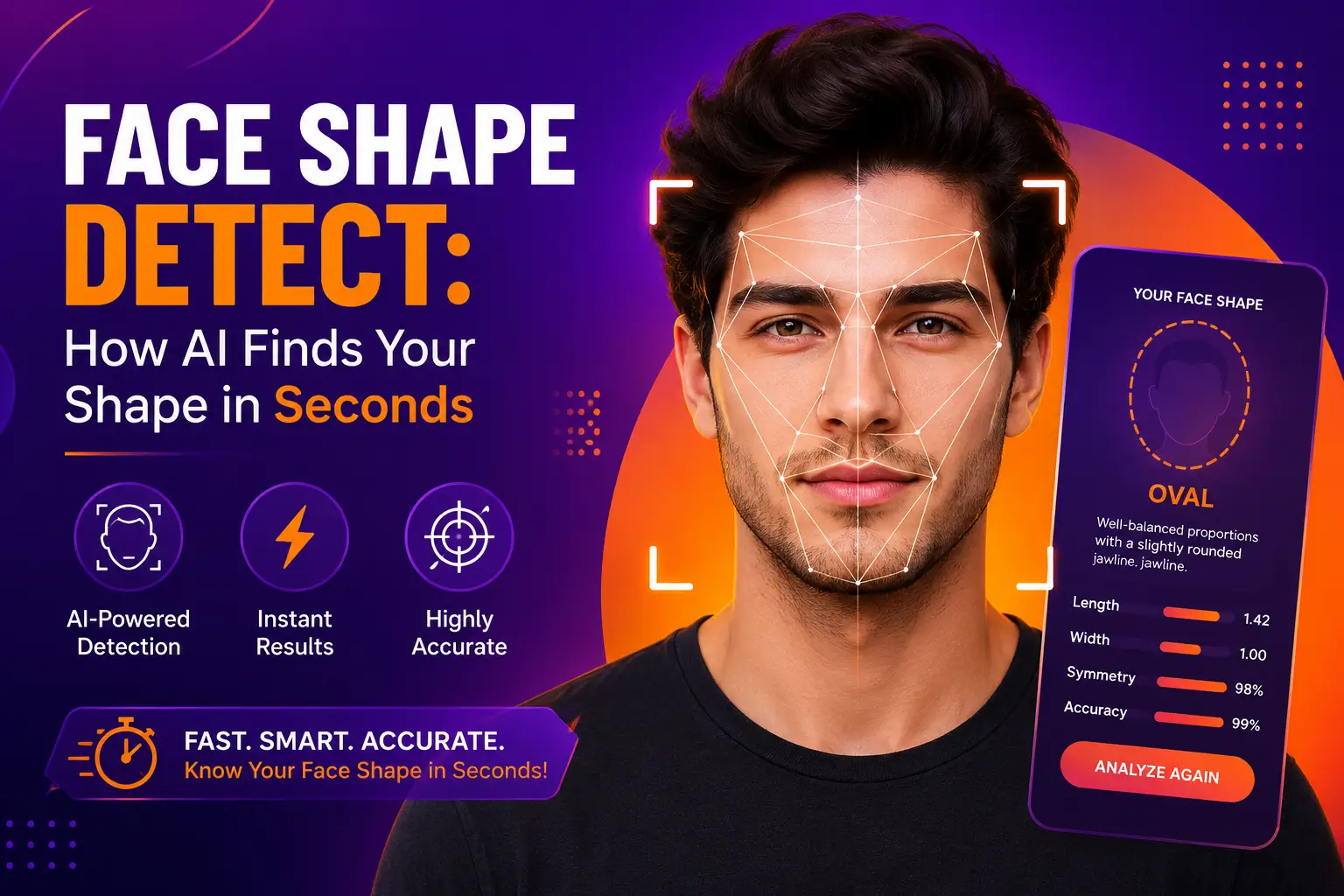
A face shape detector maps facial landmarks — forehead, cheekbone, and jaw width, plus face length — and compares their ratios to sort your face into one of 7 shapes in seconds, more consistently than eyeballing it in a mirror.
Face Shape Detect: How AI Finds Your Shape in Seconds?
To detect your face shape, you’re comparing four proportions — forehead width, cheekbone width, jaw width, and face length — to see which one dominates your outline.
The OvalFaceShape.com Face Shape Detector does this automatically from a single photo using facial landmark mapping, so you don’t need a tape measure or a guess in the mirror.
Who This Is For
This guide is for anyone who hasn’t confirmed their face shape yet and wants to know how detection actually works before trusting a result — whether that’s ahead of a haircut, a new pair of glasses, or just curiosity. If you already know your shape, skip ahead to the Oval Face Shape guide or Hairstyle by Face Shape for the next decision. Barbers, stylists, and opticians comparing tools for client use will find the accuracy section most relevant.
What Is a Face Shape Detector?
A face shape detector is a tool — usually AI-based — that identifies which of the standard face shape categories (oval, round, square, heart, diamond, oblong, and triangle) your face falls into by measuring proportions rather than relying on subjective description.
The OvalFaceShape.com Face Shape Detector runs this analysis on-device using a 468-point facial landmark mesh (built on Google’s MediaPipe FaceLandmarker model), so a photo is processed in the browser rather than uploaded to a server.
How AI Face Shape Detection Works?
The detector places landmark points along your hairline, cheekbones, jaw, and chin, then calculates the ratios between them — the same measurement logic used in clinical facial anthropometry research.
That research traces back to Leslie Farkas’s standardized landmark system, published in Anthropometry of the Head and Face (Farkas, 1994), which remains the reference point most face-shape tools — including competitors like oblongfaceshape.com’s detector — cite for their measurement methodology.
In practice, the two ratios that matter most are:
- Face length ÷ cheekbone width — the primary ratio separating oval and oblong faces from rounder or wider ones.
- Jaw width ÷ forehead width — separates heart-shaped and triangle faces (where one is clearly wider than the other) from square or round faces (where they’re close to equal).
On OvalFaceShape.com, a length-to-width ratio landing in roughly the 1.3–1.5 range is classified as oval; a ratio pushing past that ceiling, with forehead, cheek, and jaw widths staying close together, is classified as oblong. That threshold is the same boundary logic used across the category, though the exact cutoff varies slightly by tool.
Photo, Camera, or Manual Measurement — Which Detection Method Fits You
| Method | What you need | Speed | Best for |
|---|---|---|---|
| AI photo upload | One clear, front-facing photo | Seconds | Most people — fastest, no tools needed |
| Live camera capture | Device camera access | Under a minute | Anyone without a saved photo handy |
| Manual measurement | Tape measure or ruler, mirror | 2–3 minutes | People who want to see the raw numbers themselves, or don’t want to use a camera at all |
All three methods rely on the same four proportions — the difference is only in how the numbers get collected. Manual measurement is the most transparent (you see your own inputs) but is also the most error-prone, since a slightly tilted tape measure changes the ratio.
AI photo analysis removes that human error but depends on photo quality — even lighting and a hair-free hairline improve accuracy noticeably.
How Accurate Is Face Shape Detection?
No detector — AI or manual — should claim a single, absolute answer. Real faces frequently sit between two categories, which is why a well-built detector shows a confidence score or percentage breakdown rather than one flat label. A face reading, for example, 61% oval and 16% round is telling you something useful: it’s a genuine oval with softer, rounder edges, not a coin-flip result.
Accuracy also depends on input quality far more than model complexity. A blurry photo, hair covering the hairline, or an off-angle shot will shift the ratio calculation regardless of which detection method or model is behind it.
For the most reliable read, use a front-facing photo, pull hair back from the forehead and jaw, and avoid strong side lighting that creates shadow along one cheek.
Step-by-Step: Detect Your Face Shape in Under a Minute
- Choose your method. Photo upload for speed, live camera if you don’t have a saved photo, or manual measurement if you want to see the raw numbers.
- Prep the shot. Front-facing, even lighting, hair pulled back from the hairline and jaw.
- Run the analysis. The detector maps landmarks and calculates your forehead, cheekbone, jaw, and length ratios automatically.
- Read the confidence score, not just the label. A dominant percentage with a secondary shape close behind means you’re a blend — both guides are worth reading.
- Move to styling. Once you have a shape, go straight to the matching hairstyle or glasses guide for that result.
Why Two Detectors Can Disagree?
If you’ve run your photo through more than one tool and gotten different answers, it’s usually one of three things: a different ratio threshold between tools (one site’s “oblong” cutoff may sit at a 1.4 ratio, another’s at 1.5), a photo angle that shifts landmark placement, or a genuinely borderline face that a confidence-based tool would flag as a near-even split between two shapes.
None of that means either tool is “wrong” — it means the boundary between adjacent shapes is a spectrum, not a hard line.
Key Takeaways
- Face shape detection compares four proportions — forehead, cheekbone, and jaw width, plus face length — regardless of whether the method is AI-based or manual.
- AI photo detection on OvalFaceShape.com uses a 468-point landmark mesh processed on-device; no photo is uploaded or stored.
- A confidence score, not a single flat label, is the honest way to report a result — many faces blend two shapes.
- Photo quality (lighting, angle, hair off the face) affects accuracy more than which detection method you choose.
- Disagreement between tools usually comes from different ratio thresholds or a genuinely borderline face, not a broken tool.
FAQs
What is the most accurate way to detect face shape?
AI photo analysis using facial landmark detection is generally the most consistent method, since it removes the human error that comes with holding a tape measure at a slight angle. Manual measurement can be just as accurate if done carefully, but small measuring errors shift the ratio more than most people expect.
Is face shape detection still worth using in 2026?
Yes — AI-based facial landmark detection has become standard across styling, eyewear, and beauty tools because it turns a subjective guess into a repeatable, ratio-based result. It’s more useful now than a static reference chart because it accounts for your actual proportions rather than a rough visual match.
Is AI face shape detection more accurate than measuring manually with a tape measure?
AI detection tends to be more consistent because it isn’t affected by measuring-tape angle or human rounding error, but manual measurement remains valid if you measure carefully and use a mirror to keep the tape level. Neither method replaces the other — they’re solving the same ratio problem two different ways.
How much does it cost to detect my face shape?
Nothing — the OvalFaceShape.com Face Shape Detector is a free, browser-based tool that processes your photo on-device with no sign-up required. Most competing detectors, including manual and camera-based options, are also free.
Why did an AI face shape detector give me a different result than a quiz or chart?
A visual chart or quiz relies on subjective self-assessment, while an AI detector measures actual proportions from a photo — so a chart-based guess and a landmark-based result can genuinely diverge, especially for borderline faces. If a detector shows a confidence score, check whether your face is a close split between two shapes before assuming one tool is wrong.
Can a face shape detector work with any photo?
It works best with a clear, front-facing, evenly lit photo with hair pulled back from the hairline and jaw. Angled photos, heavy shadows, or hair covering the forehead or jawline can shift the landmark measurements and reduce accuracy.
What should I do after I detect my face shape?
Once you have a result — ideally with a confidence score — the next step is applying it to a real decision: check the matching hairstyle guide, glasses guide, or beard style guide for your detected shape rather than stopping at the label itself.