
Quick Answer:
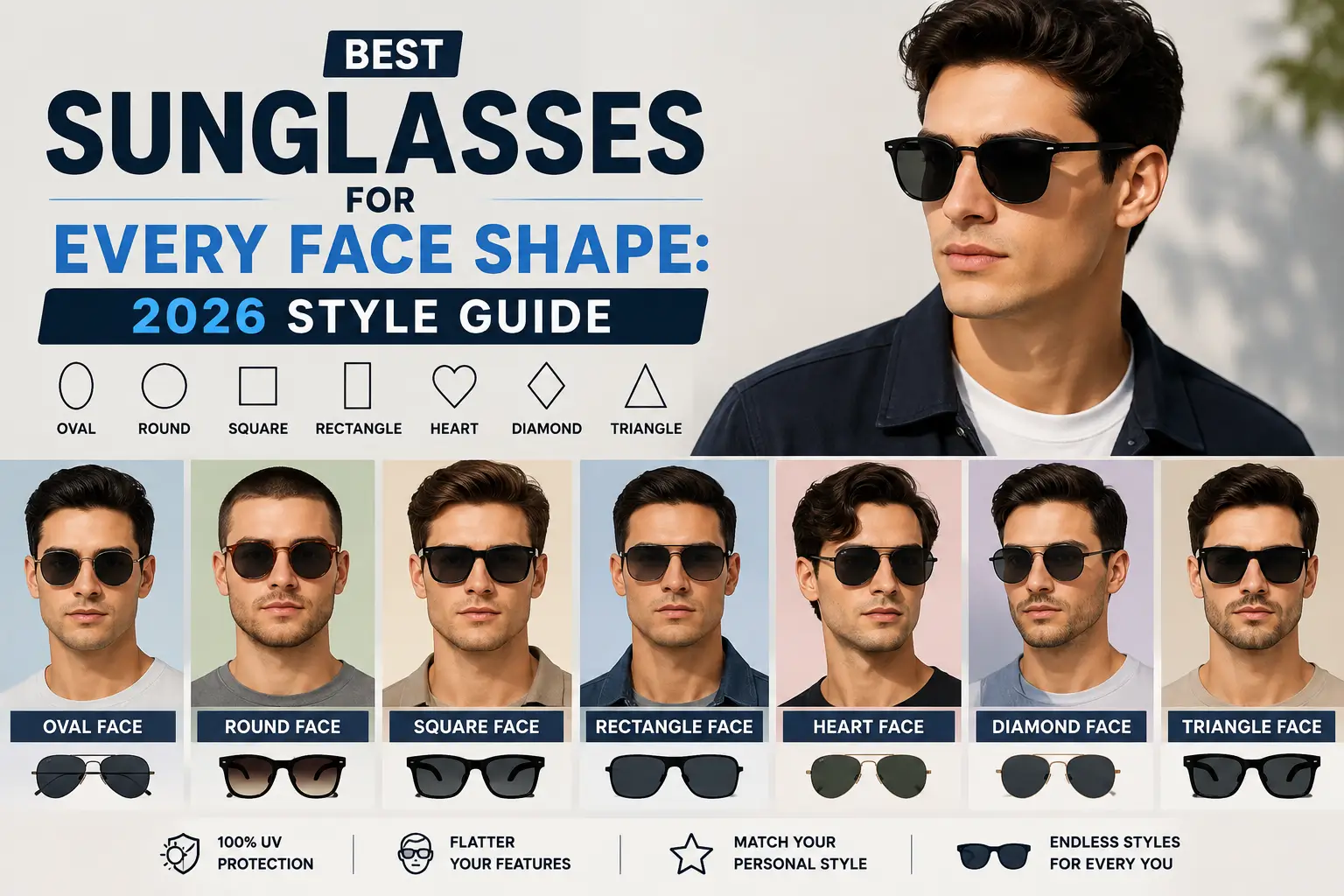
The best sunglasses depend on your face shape: round faces suit square/rectangular frames, angular faces suit round or cat-eye frames, heart faces suit aviators or bottom-heavy frames, and oval faces suit most styles. Choose UV400 or 99–100% UV protection for essential eye protection.
Choosing sunglasses for your face shape means matching frame lines to your bone structure, not your favorite trend. This guide is for anyone shopping for non-prescription sunglasses — for everyday wear, driving, or sport — who wants a frame that visually balances their features and protects their eyes.
Why Face Shape Matters for Sunglasses?
Sunglasses sit directly on the widest part of the face — the brow and cheekbone line — so their outline interacts with your face’s own outline more than almost any other accessory. The general styling principle used across the eyewear industry is contrast,
Frames that introduce the opposite quality your face already has (angular vs. curved) tend to read as more balanced. A round face gains definition from a rectangular frame; a square jaw softens next to a round or cat-eye lens.
This isn’t a rigid rule — it’s a starting point. Face shape is a spectrum, and many people sit between two categories.
How Face Shape Is Determined?
Face shape is usually assessed by comparing three measurements: forehead width, cheekbone width, and jawline width, against total face length.
A face shape analysis tool — like the site’s own Face Shape Detector — uses facial landmark points to calculate these ratios automatically; without a tool, you can approximate it by pulling your hair back and tracing your outline in a mirror.
- Oval: face length greater than width; jaw slightly narrower than the cheekbones.
- Round: width and length close to equal; soft jaw, full cheeks.
- Square: forehead, cheekbones, and jaw close to the same width; angular jaw.
- Heart: forehead widest point, narrowing to a pointed chin.
- Diamond: cheekbones widest, narrow forehead and chin.
- Oblong/Rectangle: face notably longer than wide, with a straighter jawline than oval.
Best Sunglasses by Face Shape
| Face Shape | Key Feature | Best Sunglasses Shapes | Frames to Limit |
|---|---|---|---|
| Oval | Balanced, longer than wide | Square, aviator, oversized, geometric | None strictly — oval is the most flexible shape |
| Round | Full cheeks, equal width/length | Rectangle, square, angular cat-eye | Round or small frames — they add width without adding structure |
| Square | Strong jaw, broad forehead | Round, oval, curved cat-eye, aviator | Square or heavy rectangular frames — they repeat the jaw’s angles |
| Heart | Wide forehead, narrow chin | Aviator, cat-eye, bottom-heavy or rimless styles | Top-heavy or oversized frames that widen the forehead further |
| Diamond | Narrow forehead/chin, wide cheekbones | Cat-eye, oval, browline | Narrow or boxy frames that ignore the cheekbone width |
| Oblong | Long face, straighter jaw | Wide round frames, oversized square, wayfarer | Small or narrow frames that lengthen the face further |
According to the American Academy of Ophthalmology, checking for a UV400 or 99–100% UV protection label matters as much as frame shape, since unrated dark lenses can actually let more UV reach the eye by causing the pupil to dilate in low light while offering no filtering.
Real Examples: Matching Frame to Face
- A person with a round face trying rectangular, slightly angular frames (e.g., a classic rectangular wayfarer) typically sees the frame add visible length and structure that a round frame on the same face would not.
- A person with a square jaw trying a curved cat-eye or aviator frame usually finds the curve softens the jawline’s angle instead of echoing it.
- A person with a heart-shaped face trying a bottom-heavy or rimless frame keeps the forehead from looking wider, since the frame doesn’t add extra visual weight at the top.
These aren’t universal guarantees — personal proportions, frame size, and lens width all shift the effect — but they reflect the contrast principle consistently applied across eyewear retailers and opticians.
Quick Decision Tree: Which Sunglasses Shape Should I Try?
- Is your jawline angular or soft?
- Angular → try round, oval, or cat-eye frames.
- Soft/round → try rectangle or square frames.
- Is your forehead noticeably wider than your jaw?
- Yes → try aviator, bottom-heavy, or rimless frames (likely heart shape).
- Are your cheekbones the widest point, with a narrow forehead and chin?
- Yes → try cat-eye or browline frames (likely diamond shape).
- Is your face notably longer than it is wide, with balanced proportions?
- Yes → most frame shapes work; oversized and geometric styles are a safe default (likely oval).
UV Protection: The Health Side of Choosing Sunglasses
Frame shape affects how you look; lens protection affects your eye health. The Skin Cancer Foundation notes that roughly 10% of all skin cancers occur on the eyelids, and UT MD Anderson Cancer Center cites Australian research finding about 90% of malignant eyelid tumors were basal cell carcinomas.
Cloud cover doesn’t fully protect you either — ReFocus Eye Health reports that up to 80% of UV rays pass through clouds and haze, and that UV exposure contributes to about 20% of cataracts worldwide.
Whatever frame shape you choose, confirm the label states 99–100% UV protection or UV400 before buying — style and eye protection are separate specs, and a fashionable frame with no UV rating still leaves your eyes exposed. Medical Eye Center
Key Takeaways
- Contrast is the core styling rule: match sunglasses shape to the opposite of your face’s natural lines.
- Oval faces have the most frame flexibility; round and square faces benefit most from a shape change.
- UV400 / 99–100% UV protection matters independently of frame shape or price.
- Face shape sits on a spectrum — if you’re between two categories, try both recommended frame sets.
- Use a landmark-based tool (like a face shape detector) for a more consistent read than eyeballing it in a mirror.
FAQs
Do sunglasses really need to match your face shape, or is that just marketing?
It’s a genuine styling principle, not just marketing — opticians and eyewear brands consistently recommend contrast-based matching because frames that oppose your face’s natural lines tend to look more proportioned. That said, it’s guidance, not a hard rule; personal style and comfort matter too.
Is matching sunglasses to face shape still relevant in 2026?
Yes. Major eyewear retailers (Sunglass Hut, Ray-Ban, Carrera) still build entire shopping tools around face-shape matching in 2026, and it remains the standard starting point recommended across the optical retail industry.
How is choosing sunglasses by face shape different from choosing prescription glasses?
The face-shape principles are the same, but sunglasses add two extra factors: lens tint (which affects glare and color perception) and UV rating, which prescription-only eyeglasses don’t need to specify in the same way.
Do more expensive sunglasses offer better UV protection?
Not necessarily. UT MD Anderson’s dermatology team notes price and UV protection aren’t directly linked — a low-cost pair labeled 99–100% UV protection can protect as well as a designer pair; what matters is the label, not the price tag.
What face shape works with almost any sunglasses style?
Oval, according to multiple eyewear guides (Ray-Ban, Sunglass Hut, Eyeconic) — its balanced proportions mean most frame shapes, including oversized and geometric styles, tend to suit it.
Can I trust an AI or app-based face shape detector to pick my sunglasses style?
Landmark-based tools that measure actual proportions (forehead, cheekbone, and jaw width against face length) tend to be more consistent than eyeballing your reflection, though results should still be treated as styling guidance rather than an exact rule.