
Quick Answer:
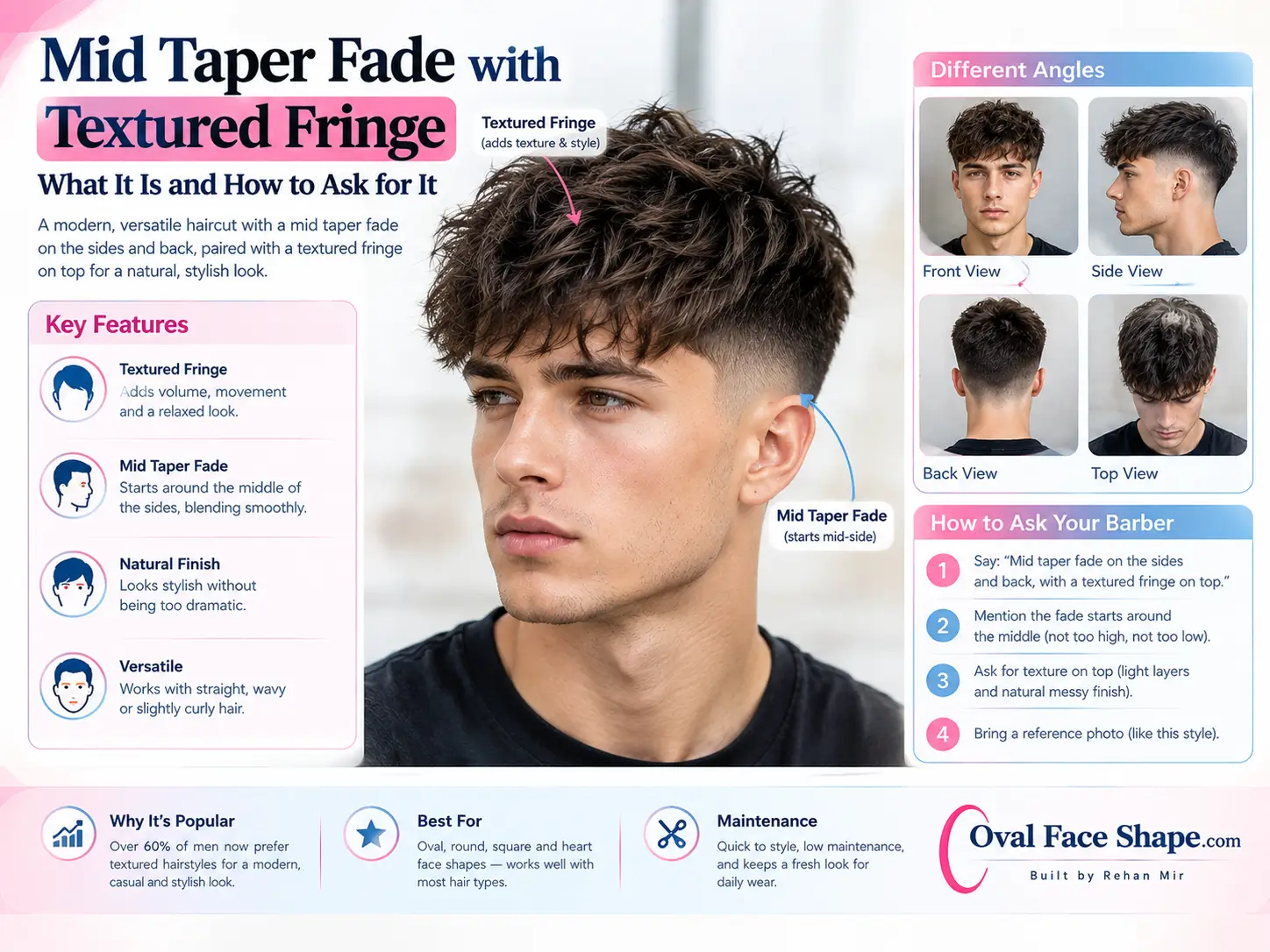
A mid taper fade with a textured fringe shortens the sides gradually from about temple height, keeping some length at the neckline, while the top stays longer and choppy.
By Muhammad Rehan Iqbal, Founder and Developer of OvalFaceShape.com, specializing in face shape analysis, interactive facial assessment tools, and educational styling guides.
A mid taper fade with a textured fringe is a men’s haircut that pairs short, gradually blended sides with a longer, choppy top that falls forward over the forehead. OvalFaceShape.com treats it as a face-shape decision as much as a barbershop one, because fringe length and fade height change how a face reads.
Who this guide is for:
This guide is for anyone choosing this cut before booking, on straight, wavy or curly hair. To confirm your face shape first, run the Face Shape Detector.
What Is a Mid Taper Fade?
A mid taper fade starts shortening the hair around temple height and blends down toward the sideburns and neckline. A taper leaves some length at the very bottom. A fade takes it to skin or very close.
Barbers use the phrase loosely. Many mean a taper with a fade-like blend, so say which finish you want at the bottom.
What Is a Textured Fringe?
A textured fringe is the front section cut to fall forward, then point-cut or razored so it separates into pieces. A blunt line would sit as one flat edge. It usually lands between the brow and mid-forehead.
Taper vs. Fade, and Mid vs. Low
“Mid” tells you where the shortening starts. “Taper” or “fade” tells you how short it gets at the bottom. That is why mid fade vs taper fade is a different question from mid vs low taper.
| Option | Starts | Bottom of the sides | Contrast |
|---|---|---|---|
| Low taper fade | Just above the ear | Keeps length | Subtle |
| Mid taper fade | Around the temple | Short, with some length | Medium |
| Mid skin fade | Around the temple | Skin | High |
Mid taper and mid taper fade usually mean the same cut. A low mid taper sits between the first two rows.
Variations Worth Naming
| Version | What changes | What to ask |
|---|---|---|
| Skin mid taper | Sides reach skin at the bottom | “Mid taper down to skin” |
| Burst mid taper | Fade arcs around the ear, length stays at the back | “Burst taper, leave the back long” |
| Blowout taper | Top is blow-dried up and back for volume | “Taper with a blowout on top” |
| Mid taper mullet | Sides tapered, back left long | “Mid taper, keep the nape length” |
| Middle-part version | Fringe parts centrally and falls both ways | “Textured fringe long enough to part” |
Mid Taper Fade by Hair Type
Curly and Wavy Hair
Keep the top long enough to show the curl, and taper only the sides. Curls spring up when dry, so ask the barber to check the length dry rather than stretched. A burst taper works well here because it keeps weight at the back for a rounder shape.
Straight Hair
Straight hair needs the texturizing to do the work, so ask for point-cutting. Thick straight hair tends to stand rather than fall. Matte paste or clay holds the choppy pieces in place.
Asian Hair
A review in Clinical, Cosmetic and Investigational Dermatology lists Asian hair as relatively straight with a round cross-section, a larger cross-sectional area than African or Caucasian hair (about 4,804 µm² vs 3,857 µm² for Caucasian hair), and an average growth rate of about 411 µm/day.
These are group averages, and individuals vary widely. The practical point is that thick, round-section straight hair holds a textured fringe well. The faster average growth rate (about 1.2 cm a month, my conversion) also means the taper blend softens sooner. nih
Black Men and Coily Hair
A mid taper with a textured coily top is a standard pairing. Reseachers report that hair from Caucasian, Asian and African subjects shows no differences in fiber structure but does differ in geometry, mechanical properties and water swelling. In practice, that means cut and style the top for its curl pattern, not against it. em-consulte
Which Face Shape Suits Mid Taper Fade?
This table is styling guidance, not a rule. If you are unsure of your shape, check it with the Face Shape Detector before choosing. For wider options, see Hairstyles for Every Face Shape.
| Face shape | Fringe | Taper height | Why |
|---|---|---|---|
| Oval | Any length | Mid | Balanced proportions allow flexibility |
| Round | Side-swept with lift | Mid to high | Height and tighter sides lengthen the face |
| Square | Longer, softer | Mid | Softens a strong jaw |
| Oblong | Shorter, forward | Low to mid | Shortens a long forehead and keeps side width |
| Heart | Side-swept, less forehead volume | Low to mid | Side weight balances a narrower chin |
| Diamond | Forward fringe | Low to mid | Adds forehead width, keeps cheekbones from dominating |
Curly men with round faces can read round-face curly hairstyles for men. Diamond faces have their own guide for men: diamond face hairstyles.
How to Ask Your Barber to get Mid taper or Textured Fringe?
Bring a photo and use the exact words: “Mid taper fade starting at the temple, soft blend above the ear, natural neckline. About three inches on top, point-cut, fringe to mid-forehead.”
Add the finish you want (taper or skin) and whether the top should be styled up (blowout) or forward. For curly hair, add “cut it dry”.
Styling and Upkeep
Use matte paste or clay on straight hair, curl cream and a diffuser on curly hair, and a blow-dryer for a blowout. At roughly 1 cm of growth a month, the blend on the sides visibly softens within a few weeks. The fringe usually stretches a bit longer before it needs a trim.
Key Takeaways
- A mid taper fade shortens sides from about temple height. “Taper” keeps length at the bottom, and “fade” goes to skin.
- Mid vs low describes where the shortening starts, not how short it gets.
- The textured fringe should be point-cut, and its length should match your face shape.
- Cut curly hair dry, and choose a burst taper if you want back volume.
- Run the Face Shape Detector before you book.
FAQs
What is a tapered mid fade?
It is a mid-height fade that tapers rather than cutting to skin, so some length remains at the neckline and around the ears. Ask your barber which finish they mean, because the term is used loosely.
Which is better, mid or low taper?
Mid is the balanced choice, with more shape than a low taper and less edge than a high one. Low is subtler and safest for office settings. Pick by the contrast you want.
Is a fade or taper better?
A fade gives sharper contrast and needs more frequent upkeep. A taper is more forgiving and grows out gently. Choose a taper for a softer look and a fade for a sharper one.
Can Asians get a textured fringe?
Yes. Thick, straight, round-section hair holds texture well, and a mid taper keeps the sides clean. Ask for point-cutting so the fringe separates into pieces.
Does a mid taper always mean the sides go to skin?
No. A taper leaves some length at the bottom. Only a skin taper or a fade goes to skin, so ask for the finish you want.
Is the mid taper fade still worth asking for?
It is a structural cut, not a trend, so its balance of shape and length does not depend on fashion. I have no reliable popularity data to quote.
How often should I get it cut, and what does it cost?
The taper blend softens within a few weeks at typical growth rates. Price varies by barbershop and region, and I could not find a reliable figure to quote.