
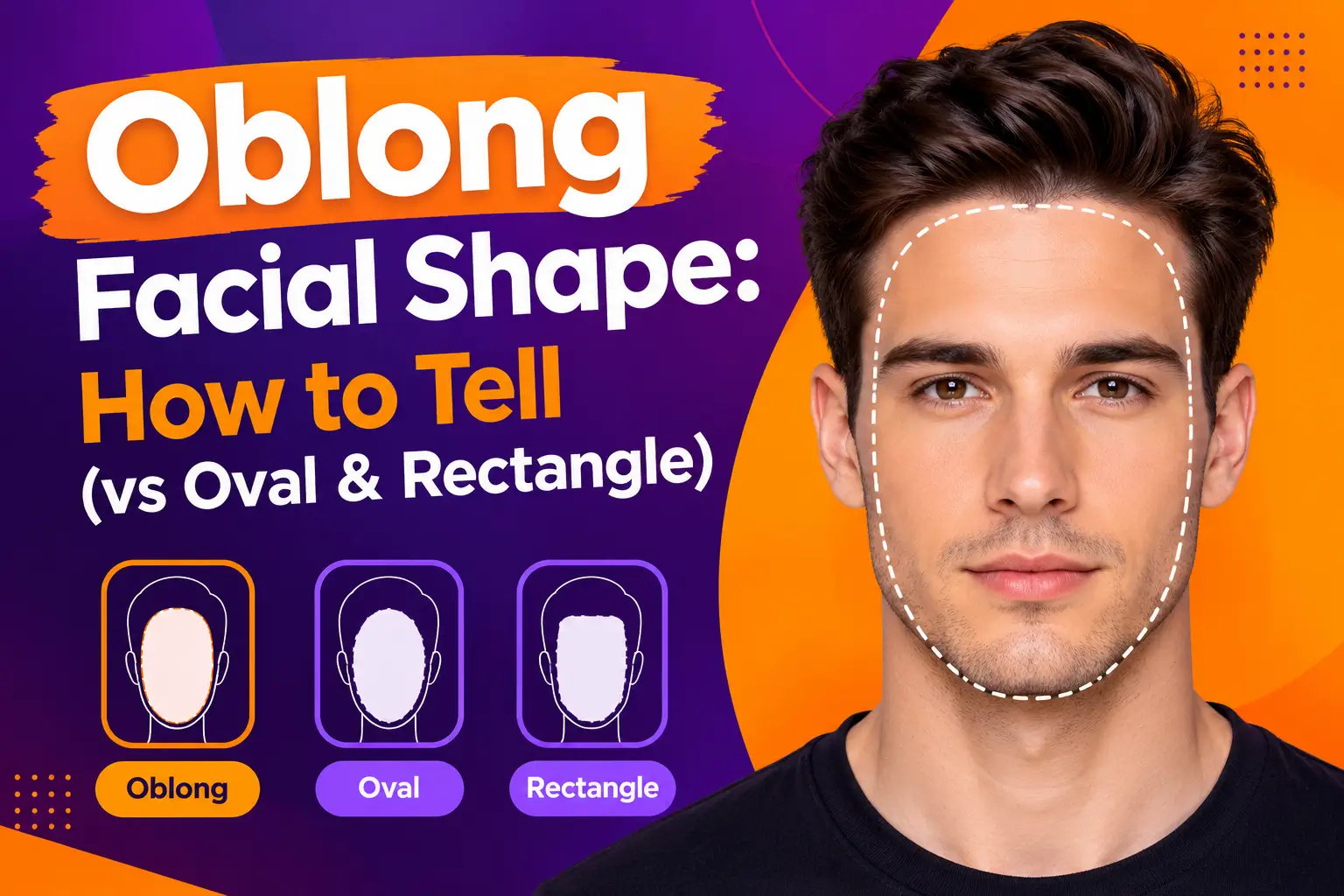
Quick Answer:
An oblong facial shape is longer than it is wide, with the forehead, cheekbones, and jaw at similar widths and straight sides. It differs from oval (which narrows at the jaw) and rectangle (which has an angular jaw). A ratio test confirms it in seconds.
Oblong Facial Shape: How to Tell It Apart From Oval and Rectangle
If you’ve been told your face is “long” and you’re trying to work out whether that means oblong, oval, or rectangle, this is the comparison OvalFaceShape.com built to settle it.
An oblong facial shape is one where face length clearly exceeds face width, with the forehead, cheekbones, and jawline measuring roughly the same, and the sides running relatively straight from hairline to chin.
This page is for one specific moment: you suspect your face is long, but you’re not sure which of the three “long” categories you actually fall into before you commit to a haircut or a new pair of glasses.
If you already know your shape and want styling depth, our full Oblong Face Shape guide covers hairstyles, glasses, and beard styles in detail — this page focuses on getting the identification right first.
What Makes a Face Oblong, Specifically?
Three features together define an oblong facial shape: length noticeably greater than width, similar widths across the forehead, cheekbones, and jaw, and straight rather than curved cheek lines. Remove any one of these and the shape drifts toward a neighbor — oval or rectangle.
The confusion is understandable. All three shapes are “long,” and casual descriptions online use the words interchangeably. The distinctions below are what actually separate them.
The Ratio Test
Face shape classification tools measure face length divided by cheekbone width. On OvalFaceShape.com’s own Face Shape Detector, an oval face runs up to roughly 1.5:1 — once that ratio climbs meaningfully above 1.5:1, the classification shifts to oblong.
Other detectors calibrate the exact cutoff differently: some set the oblong threshold at 1.6:1, others at 1.7:1. That’s not disagreement about what an oblong face is — it’s a difference in where each tool draws the boundary line, which is why two detectors can occasionally disagree on a borderline face.
The measurement method itself is on solid ground. A peer-reviewed study from Bangor University compared facial width-to-height measurements taken from 2D photographs, 3D scans, and manual anthropometry on the same individuals, and found high agreement across all three methods, demonstrating that facial ratio measurement is reliable regardless of which technique captures it.
That’s part of why an AI photo-based detector and a tape measure should land on the same answer. nih
Oblong vs. Oval vs. Rectangle
| Feature | Oblong | Oval | Rectangle |
|---|---|---|---|
| Length vs. width | Clearly longer | Slightly longer | Clearly longer |
| Forehead/cheek/jaw width | Similar | Cheeks widest | Similar |
| Jawline | Rounded, straight sides | Softly tapered | Angular, squared |
| Cheek line | Straight | Curved | Straight |
The Fastest Visual Check:
Pull your hair back and look at your jaw. A rounded jaw with straight sides points to oblong; a squared, angular jaw at the same proportions points to rectangle instead.
Real Examples
Alexa Chung is commonly cited as an oblong face shape example, with a face longer than it is wide and a fairly strong, rounded jawline. Among men, Ben Affleck and Adam Driver are frequently referenced as oblong examples — both show the elongated, consistently-wide structure without the sharp jaw angle that would tip the classification toward rectangle instead.
Why This Isn’t a Ranking?
Face shape is a geometry classification, not an attractiveness scale. An oblong facial shape shows up often in modeling and editorial photography precisely because the elongated line photographs with strong definition — it’s a difference in proportion, not a flaw to correct.
Confirm It With AI Instead of Guessing!
A ruler-and-mirror check gets you close, but it’s easy to misjudge your own jawline in a mirror. OvalFaceShape.com’s Face Shape Detector uses an on-device MediaPipe FaceLandmarker model to map dozens of facial points from a photo and calculate the same length-to-width ratio described above automatically. Try the Face Shape Detector →
Key Takeaways
- Oblong = long face + similar forehead/cheek/jaw width + straight sides.
- The ratio threshold (roughly 1.5:1–1.7:1 depending on the tool) varies by calibration, not by disagreement over the definition.
- The jawline is the fastest way to tell oblong apart from rectangle; cheekbone width is the fastest way to tell it apart from oval.
- Measurement method (photo, 3D scan, or manual) doesn’t change the result — only the classification threshold used does.
- This is a proportion, not a flaw — styling from here is about balance, not correction.
FAQs
Is an oblong facial shape the same as a long face?
Yes — “oblong” and “long face” describe the same shape. The formal criteria are length clearly exceeding width, similar forehead/cheek/jaw measurements, and straight sides.
How do I know if I’m oblong or oval?
Check your cheekbones: if they’re clearly the widest point and your jaw tapers inward, that’s oval. If your forehead, cheeks, and jaw are all similar widths, that’s oblong.
How do I know if I’m oblong or rectangle?
Look at the jawline shape rather than the proportions, which are similar for both. A rounded jaw means oblong; a squared, angular jaw means rectangle.
Is an oblong facial shape still relevant to identify correctly in 2026?
Yes — styling recommendations differ enough between oblong, oval, and rectangle (jaw-softening choices vs. width-adding choices) that misclassifying the shape can lead to the wrong advice, even though AI detectors have made correct identification faster than ever.
Can an AI tool misclassify an oblong face?
It can, usually on borderline ratios near a tool’s cutoff line. That’s a calibration issue, not a flaw in the measurement method itself, which peer-reviewed research has shown to be consistent across photo, 3D scan, and manual techniques.
What should I do once I’ve confirmed my face is oblong?
Move to a dedicated styling resource rather than guessing — our full Oblong Face Shape guide covers hairstyle, glasses, and beard recommendations specific to this shape.