
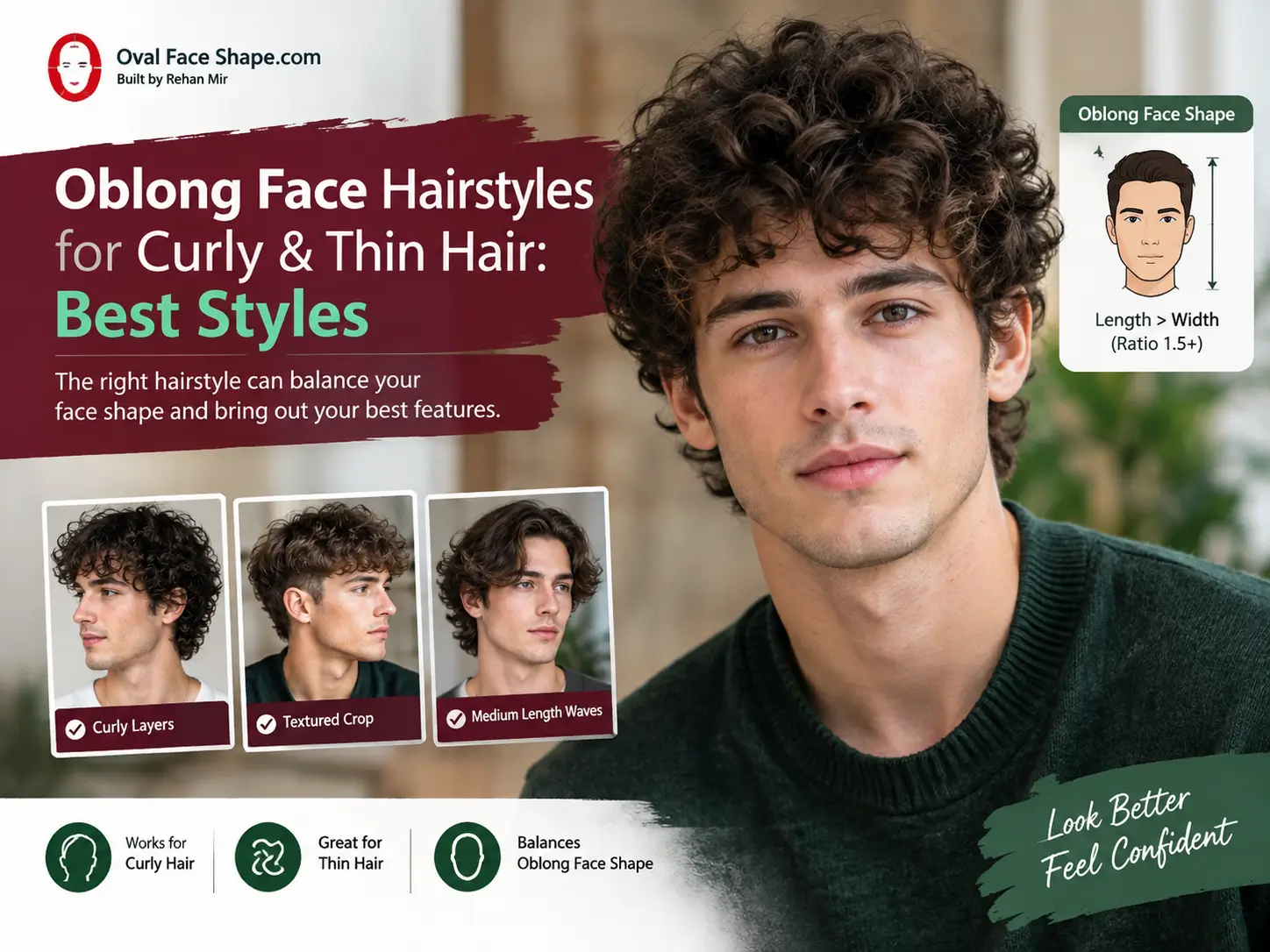
Quick Answer:
Curly hair adds natural width, so keep it slightly longer with a side part. Thin hair suits blunt cuts or bangs for structure. Thin, curly hair benefits from light layers and lightweight products to add volume without weighing curls down.
If you have an oblong face shape, every haircut decision comes down to one question: does this add width across the face, or does it add length? Curly hair and thin hair get you there through completely different routes — and if your hair is both, most guides don’t address your situation at all.
Who this guide is for:
This guide is for women at OvalFaceShape.com with an oblong face shape and curly or thin hair who want a cut matched to both. If you haven’t confirmed your face shape yet, the Face Shape Detector will do it in under a minute before you read further.
Why Oblong Faces Need Horizontal Width?
An oblong face shape is longer than it is wide, with the forehead, cheekbones, and jaw close to the same width and relatively straight sides. That’s the full measurement explanation — for the complete breakdown, the main oblong face shape guide covers it in detail.
Every hairstyle recommendation on this page follows the same rule: add volume at the sides, at cheekbone level and below. Height at the crown does the opposite — it stretches the face further, which is the one thing an oblong shape doesn’t need.
Curly Hair and Thin Hair Are Not the Same Problem!
Stylists distinguish two separate traits that people often lump together as “thin hair.” Hair diameter is how wide each individual strand is — described as fine, medium, or coarse.
Hair density is how many strands grow per square centimetre of scalp. You can have high density with fine strands — a lot of hair that still falls flat — or low density with coarse strands, where there isn’t much hair but each strand feels thick.
A study in the British Journal of Dermatology treats diameter and density as clinically distinct measurements for exactly this reason. Behindthechair
Understanding Curl Pattern and Hair Type
Curl pattern is a third, separate trait. The Andre Walker Hair Typing System, developed in the 1990s by hairstylist Andre Walker, classifies texture from straight (Type 1) through curly (Type 3) to coily (Type 4), and it’s a useful shorthand for describing what you’re working with when you talk to a stylist.
Curly and thin are answers to two different questions — which is exactly why they need separate technique, and why combining them needs a third approach. Wikipedia
Best Hairstyles for Curly Hair on an Oblong Face
Curly hair already creates horizontal volume on its own — the job is to direct that volume to the sides rather than upward.
Side-parted wash-and-go. A centre part on curly hair creates a vertical column of curl mass down each side of the face, which lengthens an oblong shape further. A deep side part shifts more curl volume onto one side, breaking that vertical line immediately with no cut change needed.
Curly shag or soft wolf cut. Shaggy layers that fan outward at the sides, paired with a curtain-fringe front section, handle the forehead and the sides at once. Keep the overall length at or above the shoulder — very long curls on an oblong face can re-lengthen the look you just corrected.
Chin-length curly bob. On tighter curl patterns especially, a bob that lands at or just below the jaw uses shrinkage to your advantage: the curls spring up shorter than the cut length, adding width right at jaw level.
Looking for the best curly hairstyles for an oval face? Explore our guide to the Best curly Hairstyles for Oval Face Shape.
Best Hairstyles for Thin or Fine Hair on an Oblong Face
Fine strands don’t create their own volume, so the horizontal width has to come from the haircut’s structure.
Curtain bangs. The single highest-impact change for straight, fine hair. Parted at the centre and swept toward the temples, they draw a horizontal line across the forehead before the eye can travel the full length of the face.
Blunt lob or bob. An unbroken, blunt edge reads as denser than layered ends on fine hair, and a line ending just below the jaw creates a strong horizontal frame at the lowest point of the face.
Face-framing layers with a side part. For fine hair worn long, a side part plus layers at cheekbone level is the lowest-effort fix — it breaks the “two straight vertical panels” look that a centre part creates on fine, straight hair.
Want to explore the best haircuts for an oblong face shape? Read our guide to Haircuts for Oblong Face Shape.
When Your Hair Is Both Thin and Curly?
This is the combination almost no guide addresses directly, because it behaves differently from thick curls and differently from thin straight hair. Low-density curls are easy to weigh down, which flattens the exact width you’re trying to create.
A few technique adjustments matter more here than the cut itself:
- Root clipping or diffusing upside down. Clipping curls at the crown while they dry, or diffusing with your head tipped forward, lets the weight of the curls lift the roots instead of flattening them. Better Not Younger
- Dry cutting. Ask for a stylist who cuts curls dry rather than wet — curl pattern looks completely different once it springs up, and cutting wet can remove length you actually needed for shape.
- Stacked layering, not thinning shears. Short layers that let curls sit on top of each other add visible fullness; heavy thinning removes strands you can’t afford to lose.
- Mousse or foam over cream. Lightweight, airy formulas hold curl shape without the weight that creams and heavy oils add to already-fine strands.
- A deep side part, not centre. Same principle as the straight-fine and curly sections above — it applies just as much here, arguably more.
Technique by Hair Texture
| Texture | Best structural fix | Daily styling priority |
|---|---|---|
| Curly, normal density | Side part, shag, or chin-length bob | Deep side part, air-dry |
| Thin/fine, straight | Curtain bangs or blunt bob | Round-brush blow-dry for the blunt line |
| Thin/fine and curly | Chin-length layered bob, dry-cut | Root clipping, diffuse upside down, mousse not cream |
What to Avoid When Styling Your Hair?
- Long, centre-parted hair with no layers or wave — the single most common mistake, on any texture. It creates an unbroken vertical line the full length of the face.
- High buns or top-knots — these add height directly above an already-long face.
- Heavy creams or oils on thin curly hair — they weigh curls flat, cancelling out any width the cut was meant to add.
What to Tell Your Stylist?
For curly hair:
“My face is oblong, so I need width at the sides, not height at the crown — please cut this dry and keep a deep side part.”
For thin hair:
“I want a blunt line, not heavy layering — my hair is fine, so I need the cut itself to create the fullness.”
For thin, curly hair:
“Please cut this dry, keep the layers stacked rather than thinned, and I need volume built outward at the sides, not lifted straight up.”
Key Takeaways
- Oblong faces need horizontal width, not vertical height — that rule doesn’t change by texture, but the technique to get there does.
- Curly hair already makes width; the job is directing it sideways with a deep part and the right cut length.
- Thin hair needs the haircut’s structure — bangs or a blunt line — to do the volume work strands can’t do alone.
- Thin, curly hair needs its own approach: dry cutting, root clipping or upside-down diffusing, stacked layers, and lightweight styling products.
- If you’re unsure of your exact texture combination, the Face Shape Detector confirms your face shape first — texture decisions come after that.
FAQs
Is curly hair bad for an oblong face shape?
No — it’s the opposite. Curly hair naturally creates horizontal volume, which is exactly what an oblong face benefits from. The mistake isn’t the curls; it’s wearing them centre-parted and long, which cancels out the width they’d otherwise add.
Do face-shape hairstyle rules still apply if I have curly or textured hair?
Yes, but the technique for reaching the same goal changes. The underlying rule — add width at the sides, avoid height at the crown — holds for every texture; only the cut and styling method used to achieve it differs.
What’s the difference between fine hair and thin hair for an oblong face?
Fine describes the diameter of each strand; thin (low density) describes how many strands you have. You can have fine hair with high density, or thicker strands with low density — and the styling approach for each combination is different, even though people often use the two words interchangeably.
Will a wolf cut work if my hair is thin and curly?
Yes, with one adjustment: ask for the layers to be cut dry and stacked rather than thinned out, since thinning removes strands that thin curly hair can’t spare. The shaggy, outward-fanning structure of a wolf cut is naturally well-suited to adding width without extra length.
What haircut length works best for thin, curly hair on an oblong face?
Chin-length to just-below-the-jaw tends to work best, because shrinkage brings the curls up shorter than the cut length, adding volume right at jaw level. Very long lengths on thin curls often go limp before they reach the shoulders.
Are bangs a good idea for thin, curly hair on an oblong face?
Curtain bangs can work well, but ask your stylist to cut them slightly longer than usual to account for shrinkage once the curl springs up.
A full blunt fringe is harder to maintain on thin curls, since it needs even density across the forehead to look intentional.