
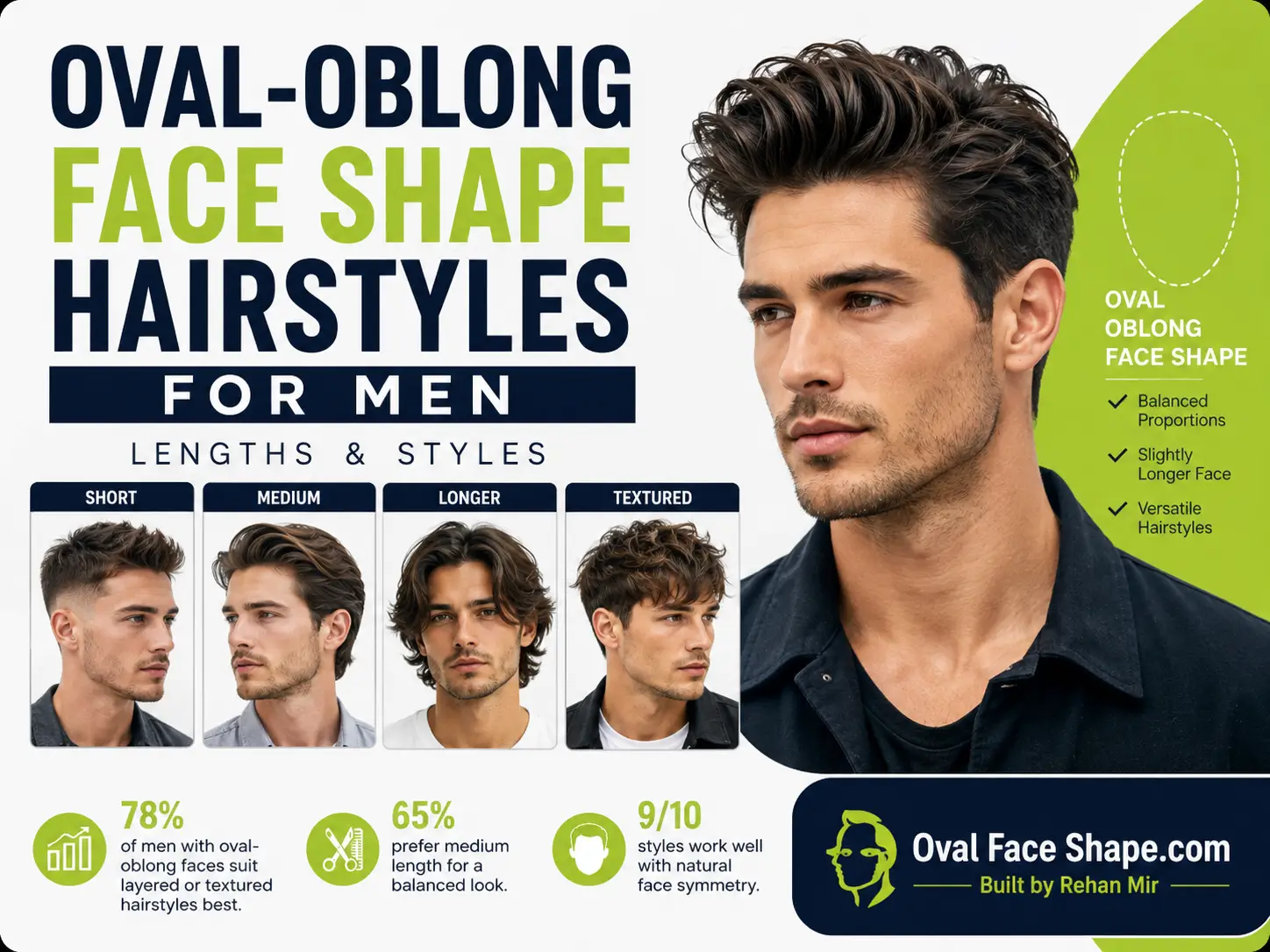
Quick Answer:
The best hairstyles for men with an oval-oblong face add width at the sides while limiting height on top. Crew cuts, textured quiffs, and side parts work well, while tall styles can make the face look longer.
Who for this guide:
This guide from OvalFaceShape.com’s Hairstyle by Face Shape series is for men whose face shape sits between two categories: longer than a pure oval, but without the flat, consistent sides of a true oblong face shape.
If you’re choosing a cut before a barber appointment and you’re not sure which set of rules applies to you, this is the use case this article is built for.
What Is an Oval-Oblong Face Shape?
A pure oval face shape has a length-to-width (L/W) ratio of roughly 1.3–1.5, with the cheekbones as the clear widest point and a gentle taper to the jaw.
A pure oblong face runs longer still, generally above 1.5, with the forehead, cheekbones, and jaw close to equal width and very little taper.
The oval-oblong blend sits right at that boundary — an L/W ratio around 1.45–1.6, with a face that reads as clearly long but still shows a mild cheekbone taper rather than the flat sides of a strict oblong.
Research on facial proportions published in Aesthetic Surgery Journal Open Forum found that attractive men’s facial height-to-width ratio averages close to 1.57 — almost exactly the range where this blend typically falls, which is one reason it’s such a common result rather than an unusual one.
How to Tell If You Have This Blend?
- Your face is visibly longer than it is wide, but not dramatically so
- Your cheekbones are slightly wider than your forehead and jaw — not perfectly flat like a true oblong
- A ruler-and-mirror check or the Face Shape Detector puts you close to the 1.5 ratio line rather than clearly above or below it
The Styling Principle: Add Width, Allow Some Height
For a true oblong face, the rule is strict:
Avoid height, add width wherever possible. For a pure oval, almost anything works. The oval-oblong blend sits in between — width-adding styles (side volume, horizontal fringe lines, texture) still do the most work, but because of the mild cheekbone taper, you can carry a little crown height that a strict oblong face can’t.
A study on facial width-to-height ratio from the University of York (published in PeerJ) found this ratio holds fairly stable across ordinary photo angles and expressions — meaning it reflects real bone structure, not a passing impression, which is why the same styling logic applies consistently whether you’re looking in a mirror or at a photo.
Best Hairstyles for an Oval-Oblong Face Shape
Crew Cut (Fade)
A crew cut with a fade is the single most reliable option for this blend. The tapered fade removes bulk gradually at the sides while leaving enough length on top to add horizontal texture,
This is the closest thing to a “safe default” for oval-oblong men, and it’s a request any barber can execute in one visit.
Long Crew Cut
A long crew cut — more length on top than a standard crew but still short at the sides — gives you room to add texture and slight side volume without tipping into height.
It suits the oval-oblong blend better than a very short crew cut because it has more horizontal presence.
Classic Crew Cut
The classic crew cut, kept short and uniform, is the lowest-maintenance option here. It works because it doesn’t add height in either direction.
The trade-off is that it offers less width-adding texture than the fade or long versions, so it suits men who prioritize simplicity over active proportion correction.
Textured Side Quiff (Moderate Height)
A quiff kept at moderate — not tall — height, swept to the side rather than straight up, adds horizontal movement while the oval component’s cheekbone width absorbs the small amount of added height. Full pompadour height is a step too far for this blend.
Classic Side Part
A side part at medium length (roughly 4–6cm on top) redirects visual movement horizontally and works in almost any setting, from office to casual. It’s the closest thing to a universal choice on this list.
Curtain Fringe / Center Part with Volume
Hair swept outward from a center or near-center part creates strong horizontal movement at the upper face — useful for the elongating effect of the oblong component — while complementing the oval component’s cheekbone structure.
French Crop with Light Fringe
The short fringe adds a horizontal line at the forehead. Because the oval component means the forehead isn’t the primary concern the way it is for a true oblong face, the fringe can stay lighter and less full here.
| Style | Best for | Maintenance |
|---|---|---|
| Crew cut (fade) | Most oval-oblong men, all-purpose | Low |
| Long crew cut | More texture without added height | Low-medium |
| Classic crew cut | Simplicity over active correction | Very low |
| Textured quiff | Some crown height, professional look | Medium |
| Side part | Universal, work-appropriate | Low |
| Curtain fringe | Strong horizontal emphasis | Medium |
Styles to Avoid
Tall pompadours and slicked-back styles with no side volume both work against the oblong component of the blend. Long, flat, center-parted hair with no texture emphasizes length without adding any width.
A tight skin fade with no top texture removes the exact side bulk this face shape benefits from.
Beard Pairings for an Oval-Oblong Face
A full or short boxed beard that adds width at the jawline pairs well with this blend, the same as it does for a true oblong face.
Because of the oval component, you have slightly more room than a strict oblong face to wear a medium-length beard without it reading as adding extra length.
See the Beard Styles by Face Shape guide for a full breakdown by jaw shape.
Key Takeaways
- An oval-oblong blend sits at roughly a 1.45–1.6 length-to-width ratio — longer than a pure oval, softer-tapered than a true oblong
- Crew cuts (fade, long, or classic) are the most consistently reliable cut family for this shape
- Moderate crown height is workable here in a way it isn’t for a strict oblong face — but tall, flat, or fully slicked styles still work against it
- A boxed or full beard that adds jaw width pairs naturally with any of the cuts above
FAQs
What is an oval-oblong face shape?
It’s a blended shape where your face measures longer than a classic oval (L/W ratio above ~1.45) but still shows a mild cheekbone taper that a true oblong face lacks.
Is an oblong face shape attractive on men?
Yes — face shape research consistently treats length and proportion as style variables, not attractiveness rulings. Longer, structured faces are common among conventionally attractive male faces studied in facial-proportion research.
Are oval and oblong the same face shape?
No. Oval runs about 1.3–1.5 L/W with clear cheekbone tapering; oblong runs above 1.5 with flatter, more consistent width top to bottom. The blend shares traits of both.
What’s the best haircut for an oblong face shape male overall?
A crew cut with a fade or a moderate textured quiff — both add horizontal emphasis without requiring high-maintenance styling.
Is a crew cut fade still a good choice in 2026?
Yes — it remains one of the lowest-maintenance, most barbershop-friendly requests, and its tapered sides suit width-adding proportion goals better than a uniform short cut.
Does losing or gaining weight change which cuts work?
Some — added facial fullness can soften a longer face’s proportions slightly, but the underlying bone-based L/W ratio (per the York/PeerJ research above) stays fairly stable, so the same cut family generally still applies.
Not sure exactly where you fall? Run your photo through the Face Shape Detector to see your specific ratio before booking a cut.