
Quick Answer:
An inverted triangle face shape has a wide forehead, high cheekbones, and a slim, often pointed chin. The face narrows sharply from the forehead to the chin, creating an inverted triangle appearance—the opposite of a triangle (pear) face shape.
If you’re trying to work out whether your face is oval, heart, or something else entirely, and the forehead keeps looking wider than everything below it, you’re likely dealing with an inverted triangle.
Who this guide is for:
This guide from OvalFaceShape.com explains what actually defines the shape, how it differs from the heart face it’s constantly confused with, and where to go next for hairstyles, glasses, and beard styling once you’ve confirmed it.
It’s built for anyone identifying their face shape before making a styling decision—and for stylists or barbers who want a quick, accurate reference.
What Is an Inverted Triangle Face Shape?
An inverted triangle face shape has its widest point across the forehead and temples, then tapers steadily through the cheekbones down to a narrow chin.
Picture a triangle balanced on its point: Broad at the top, tapering to a tip at the bottom. That’s the proportion the name describes.
The forehead is the dominant measurement. The jaw is the narrowest. Cheekbones sit somewhere between the two, usually closer to the forehead width than the jaw.
Key Characteristics
- Forehead: the widest part of the face, often with a straight, relatively flat hairline
- Cheekbones: noticeable but not the widest point — narrower than the forehead
- Jaw and chin: the narrowest area, frequently coming to a soft point or a narrow rounded curve
- Face outline: tapers in one steady line from temple to chin, without the jaw widening back out
| Feature | Inverted Triangle |
|---|---|
| Widest point | Forehead / temples |
| Narrowest point | Jaw / chin |
| Hairline | Usually straight or gently rounded |
| Cheekbone prominence | Moderate, not dominant |
Inverted Triangle vs. Heart vs. Triangle (Pear)
These three shapes get mixed up constantly because two of them share the same wide-top, narrow-bottom silhouette. Here’s the actual dividing line.
| Shape | Widest point | Narrowest point | Key tell |
|---|---|---|---|
| Inverted triangle | Forehead | Chin | Straight or rounded hairline |
| Heart | Forehead/cheekbones | Chin | Visible widow’s peak |
| Triangle (pear) | Jaw | Forehead | Bottom-heavy, opposite taper entirely |
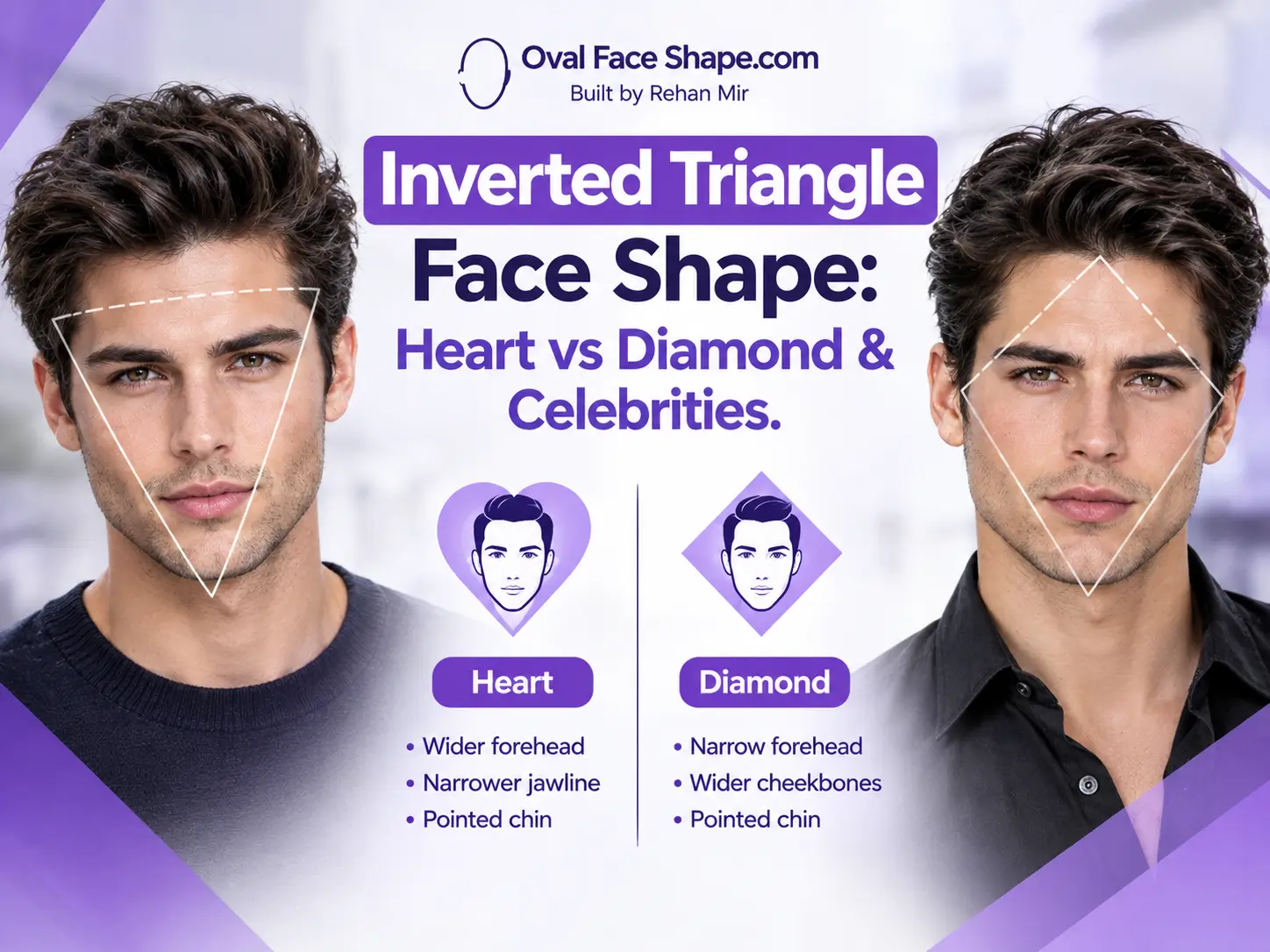
The single most reliable difference between inverted triangle and heart is the hairline. A heart face has a widow’s peak — a visible point at the center of the hairline.
An inverted triangle has a straighter or more rounded hairline across the same wide-forehead, narrow-chin proportions. If you’re unsure which applies to you, the styling advice for both is nearly identical, so it’s not a costly mistake either way.
Triangle (pear) is the mirror opposite of both: Jaw widest, forehead narrowest. Confusing “triangle” with “inverted triangle” is common in casual conversation, and it matters — the styling goal flips completely depending on which one you actually have.
How to Tell If You Have Inverted Triangle Face Shape?
You don’t need a full measurement kit to get a reasonable read. Ask yourself, in order:
- Is your forehead visibly wider than your jaw? No → you likely have a different shape. Yes → continue.
- Does your hairline come to a visible center point? Yes → heart shape. No → inverted triangle.
- Does your face narrow gradually, without the jaw flaring back out? Yes → confirms inverted triangle.
For a precise read instead of a visual guess, the Face Shape Detector on OvalFaceShape.com analyzes facial landmark measurements from a photo rather than relying on eyeballing proportions in a mirror — useful since foreheads are easy to misjudge when hair covers the temples.
Why the Proportions Look This Way?
Face-shape categories like this one are grounded in real craniofacial measurement, not just visual pattern-matching.
The standard reference point is the facial index: Vertical facial height (nasion to gnathion) divided by bizygomatic width (the distance between the outer points of the cheekbones), multiplied by 100.
This measurement framework traces back to Leslie Farkas’s anthropometric research at the University of Toronto, still the most widely cited normative dataset in the field.
An inverted triangle reading comes from combining a wide bizygomatic/forehead measurement with a narrow mandibular (jaw) width — not from face length alone, which is why length-based methods alone can misclassify it.
Diamond vs. Inverted Triangle Face Shape
It’s easy to mix up diamond and inverted triangle (also called upside down triangle or reverse triangle face shape) because both have a narrow chin.
The difference between a diamond and an inverted triangle face shape is where the face is widest. A diamond face is widest across the cheekbones, with a narrower forehead and a narrow chin. An inverted triangle face (also called an upside-down or reverse triangle) is widest across the forehead and narrows steadily to the chin, with cheekbones no wider than the forehead.
The two are easy to mix up because both finish in a narrow chin. Check the top of the face first: if your forehead is clearly the widest point, you have an inverted triangle; if your cheekbones are widest and your forehead narrows in, that’s diamond.
| Feature | Diamond | Inverted Triangle |
|---|---|---|
| Widest point | Cheekbones | Forehead |
| Forehead | Narrow | Wide |
| Chin | Narrow, often pointed | Narrow, tapered |
| Jawline | Angular, minimal width | Straight taper, no flare |
How Common Is an Inverted Triangle Face Shape?
Inverted triangle is one of the less frequently discussed face shapes in mainstream styling content — several broad “types of face shapes” guides skip it entirely and default readers toward square or heart advice instead, which doesn’t balance the same proportions correctly.
One industry analysis of face-shape classifications estimates diamond and inverted triangle together account for roughly one in seven faces, though this figure comes from a single site’s own tool data rather than a population-level anthropometric study, so treat it as directional rather than exact.
Most “X% of people have this shape” claims circulating online trace back to small, non-representative samples rather than global datasets — a caveat worth keeping in mind whenever you see a precise-looking percentage attached to any face shape.
Celebrities With an Inverted Triangle Face Shape
Reese Witherspoon and Scarlett Johansson are the two most consistently cited real-world examples of this proportion — both show a visibly wider forehead tapering to a narrower chin.
Ryan Gosling is also frequently referenced as a male example with the same forehead-to-jaw taper. These are useful visual anchors, not a checklist; plenty of people show the same proportions without matching any specific celebrity’s other features.
Explore our detailed guides to learn the face shapes of popular celebrities and understand the facial features behind each classification.
How to Style an Inverted Triangle Face Shape?
The general styling goal for an inverted triangle face is to soften the forehead’s width and add visual weight near the jaw, balancing the two ends of the taper rather than emphasizing it further.
- Hairstyles: Curtain bangs, side-swept fringe, and styles with volume at the jawline (a lob or layered bob for women; textured, jaw-grazing length for men) work better than anything that adds height or width at the crown. See our full Inverted Triangle Face Shape Hairstyles guide for cuts by length and gender.
- Glasses: Frames with detail weighted toward the bottom rim, or rounder/rimless styles at the top, avoid drawing more attention to an already-wide forehead. Full breakdown in our Glasses by Face Shape guide.
- Beards (for men): A fuller beard through the chin and jawline is one of the most effective tools available, since it directly adds the lower-face width the shape is missing. See Beard Styles by Face Shape.
- Makeup: Contouring the outer edges of the forehead and temples with a slightly deeper shade creates shadow that visually narrows that area, while a touch of highlighter along the jaw adds the opposite effect.
For a shape-by-shape comparison, including how inverted triangle differs from Heart Face Shape and Triangle Face Shape, those dedicated guides go deeper on each.
Key Takeaways
- Inverted triangle = forehead widest, chin narrowest, tapering in one steady line
- The hairline is what separates it from heart shape: straight/rounded (inverted triangle) vs. widow’s peak (heart)
- It’s the structural opposite of triangle (pear) faces, which are widest at the jaw
- Styling goal: soften the forehead, add width and weight near the jaw
- Reese Witherspoon, Scarlett Johansson, and Ryan Gosling are commonly cited real-world examples
FAQs
Is an inverted triangle face attractive?
Yes — there’s no evidence that any face shape is inherently more or less attractive than another. The defined jawline taper and strong forehead-to-chin structure of an inverted triangle read as angular and striking, qualities widely associated with confidence and definition in styling literature.
Is an inverted triangle attractive?
Attractiveness research doesn’t rank face shapes on a fixed hierarchy. A 2010 University of Toronto/UC San Diego study (Pallett, Link & Lee, Vision Research) found that perceived attractiveness tracks balanced facial proportions — specifically eye-to-mouth and interocular distances close to population averages — rather than any single outline. An inverted triangle face can absolutely fit that balance.
What are the top 3 most attractive face shapes?
There’s no single scientifically settled ranking. Oval and heart shapes tend to score consistently well across attractiveness studies, and square ranks especially high in preference research for men — but the same research (Pallett, Link & Lee, 2010) suggests proportion and symmetry matter more than which named shape you have.
Is an inverted triangle face shape the same as a heart-shaped face?
No, though they’re frequently confused. Both have a wide top and narrow chin, but a heart face has a widow’s peak hairline while an inverted triangle has a straighter or rounder one. The styling advice overlaps heavily, so misidentifying between the two rarely leads you astray.
Is inverted triangle a rare face shape, and do AI face-shape tools still classify it in 2026?
It’s one of the less commonly discussed shapes, and some AI face-shape detectors only classify the five most common categories (oval, round, square, oblong, heart), leaving triangle and inverted triangle to manual measurement. Confirming with the widow’s peak test above or a landmark-based tool remains the most reliable approach.
5 thoughts on “Inverted Triangle Face Shape: Heart vs Diamond & Celebrities”