
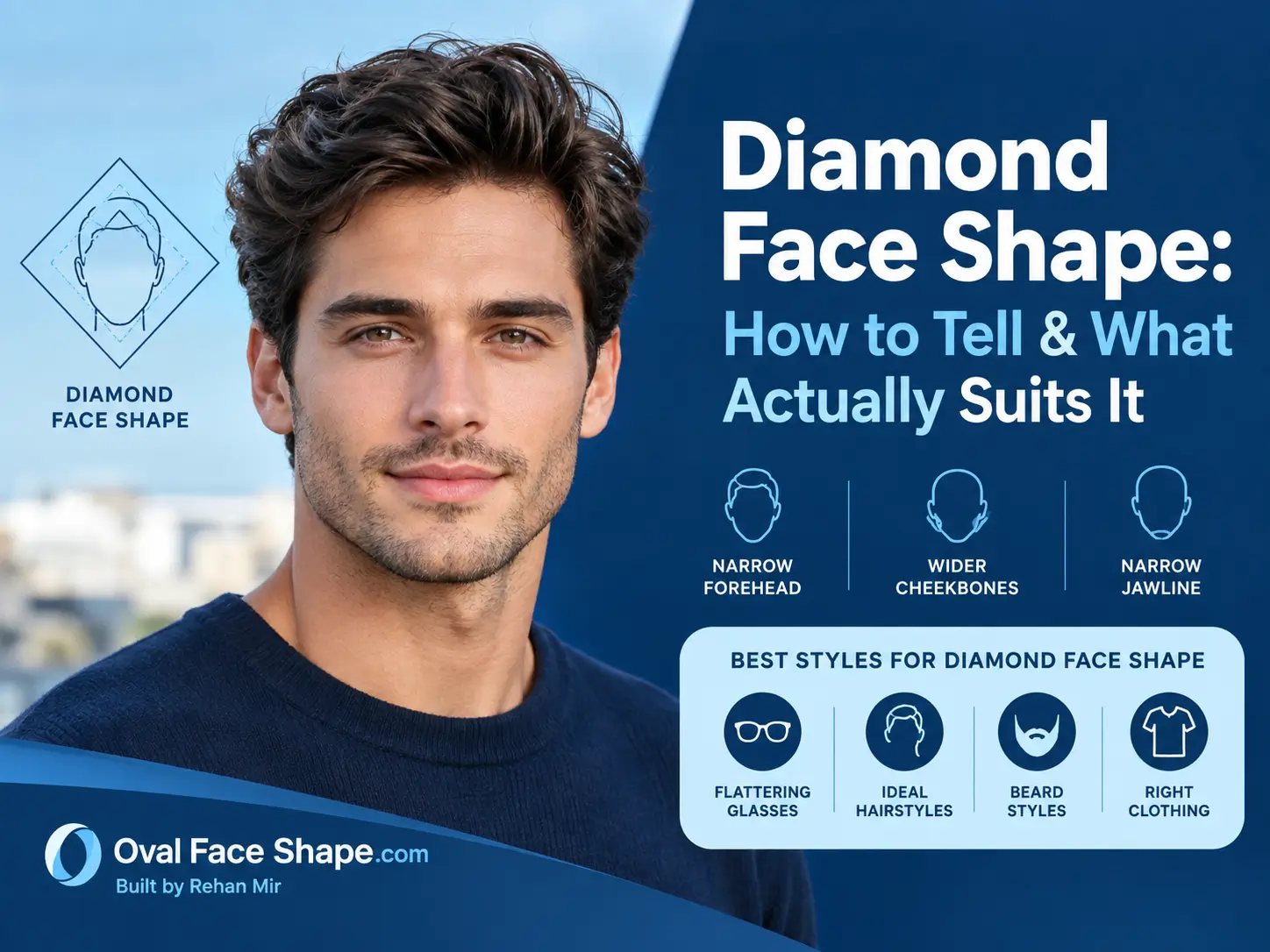
Quick Answer:
A diamond face shape is defined by high, prominent cheekbones that form the widest part of the face, with a narrower forehead and jawline that tapers to a pointed chin. This distinctive face shape is often confused with heart and oval face shapes.
Diamond Face Shape: How to Identify It, How Rare It Is, and What to Do Next
If your cheekbones stand out more than your forehead or jaw, you may have a diamond face shape — one of the seven categories OvalFaceShape.com’s Face Shape Detector identifies.
This guide is for:
This guide is for anyone confirming that suspicion before choosing a hairstyle or glasses, and for anyone who already ran an AI face-shape tool or quiz and wants to double-check a “diamond” or “heart” result. It’s styling guidance, not a medical classification — face shape sits on a spectrum, and plenty of people land close to two neighboring categories.
What Is a Diamond Face Shape?
A diamond face shape has cheekbones as its widest point, with a forehead and jawline that are both noticeably narrower, tapering to a defined, pointed chin.
In anthropometric terms, bizygomatic width (cheekbone to cheekbone) exceeds both forehead width and bigonial width (jaw corner to jaw corner) — usually by a visible margin, not a slight one.
The overall outline reads angular rather than curved: wide in the middle, narrow at both ends, like the gemstone the shape is named after.
How to Identify a Diamond Face Shape?
Pull your hair back, face a mirror straight on, and keep a neutral expression — smiling raises the cheeks and distorts the read. Compare three widths: forehead, cheekbones, jaw.
On a diamond face, the cheekbones clearly win, the forehead and jaw come in at similar widths to each other, and the chin comes to a visible point rather than a soft curve.
A simple self-check:
- Which is widest — forehead, cheekbones, or jaw? Forehead → check Heart. Jaw → check Square or Round. Cheekbones → continue.
- Is the cheekbone lead dramatic or only slight? Only slightly wider suggests Oval. Dramatically wider → continue.
- Does the chin come to a visible point? Yes → diamond fits. Soft and rounded → re-check Oval.
Because this comparison is hard to judge precisely in a mirror, the Face Shape Detector measures the same four points from a photo and gives a direct read instead of relying on self-assessment.
Diamond vs Heart vs Oval: Telling Them Apart
These three get confused most often because all three can show visible cheekbones.
| Feature | Diamond | Heart | Oval |
|---|---|---|---|
| Widest point | Cheekbones (clearly) | Forehead | Cheekbones (only slightly) |
| Forehead | Narrow | Widest point | Slightly narrower than cheekbones |
| Jaw | Narrow, similar to forehead | Narrow, tapered | Softly rounded |
| Chin | Pointed | Pointed or narrow | Rounded |
Still unsure? The Face Shape Detector scores all seven shapes from one photo instead of relying on a single side-by-side comparison.
Is a Diamond Face Shape Rare?
Diamond is consistently described as one of the least common face shapes across styling sites and AI tools, with several reporting figures in the roughly 5–12% range.
That figure comes from people who chose to use a face-shape tool, not a random population sample — treat it as directional, not exact. Some sites quote a single precise percentage (like “~5% from 51,000+ analyses”) without noting that self-selected tool users skew the number; we’d rather give you the honest range than a falsely precise one.
Craniofacial anthropometry research, including Farkas’s standard reference measurements of the head and face, established the measurement points these tools use — bizygomatic width, bigonial width, forehead breadth — but it wasn’t designed to establish how common each resulting shape is.
Want to learn about the rarest face shape? Explore our comprehensive guide to its characteristics, identification, and styling tips.
Diamond Face Shape Hairstyles
The general goal is adding visual width at the forehead and jaw without adding more at the cheekbones.
For women, side-swept or curtain fringes and chin-length lengths with soft waves do this directly — a full sleek center part does the opposite, since it exposes the cheekbone width with nothing to balance it.
For men, a French crop or forward-swept textured fringe adds forehead width the same way; a high skin fade or slicked-back style strips width from the one zone that needs it. For the complete breakdown by length and gender.
See our comprehensive guide on the Diamond Face Haircut guide.
Best Glasses for a Diamond Face Shape
Cat-eye and browline frames generally complement the cheekbones rather than compete with them, since the upswept or top-heavy structure adds emphasis at forehead level, exactly where a diamond face is narrowest.
Oval frames that extend slightly past the cheekbones soften the angular mid-face. Avoid narrow frames that sit right at cheekbone level — they amplify the widest point instead of balancing it.
The Glasses by Face Shape guide covers frame shapes in more detail, and contouring/highlighting technique is covered step-by-step in the Diamond Face Shape Makeup guide.
Is a Diamond Face Shape Attractive?
Some sites state flatly that prominent cheekbones are simply “desirable,” full stop. The actual research is more measured.
A large facial-perception study (N=922) that tested which features most drive attractiveness ratings found that eyebrow thickness and jawline prominence carried more weight than cheekbone prominence on its own — cheekbones are one contributing feature among several, not the single deciding factor.
Attractiveness is shaped heavily by styling choices too, which is exactly why the hairstyle and glasses sections above matter as much as the underlying bone structure.
Does a Diamond Face Shape Change With Weight or Age?
The bone structure behind a diamond shape is stable through typical weight changes, though added or lost facial fat changes how prominent the cheekbones look.
On aging, be cautious of any claim that cheekbones simply “get more defined” over time as a settled fact. Recent literature reviews of facial skeletal aging describe a more complicated picture — progressive orbital enlargement, midfacial retrusion, and cortical thinning, not a simple sharpening of the cheek area.
Any visible change some people notice is more likely soft-tissue and fat loss revealing the bone underneath than the bone itself becoming more prominent.
Key Takeaways
- A diamond face shape has cheekbones as the clear widest point, a narrow forehead and jaw of similar width, and a pointed chin.
- It’s one of the less common shapes reported by AI tools, but published rarity percentages reflect tool users, not the general population — be skeptical of anyone quoting a single precise figure with no caveat.
- Diamond is most often confused with heart (forehead widest) and oval (only a slight cheekbone lead).
- Attractiveness research suggests cheekbones are one contributing feature among several, not the deciding factor — styling choices matter as much as bone structure.
- Bone structure is stable with typical weight change; facial-aging literature describes complex, region-specific skeletal remodeling, not a simple “cheekbones sharpen with age” story.
FAQs
What is a diamond face shape?
A diamond face shape is one where the cheekbones are the widest part of the face, with a narrower forehead and jawline of similar width to each other, tapering to a pointed chin. It’s distinct from oval (only a slight cheekbone lead) and heart (forehead is the widest point).
Is a diamond face shape rare?
Yes, it continues to show up as one of the least common results across AI face-shape tools, typically in the roughly 5–12% range. That figure comes from self-selected tool users rather than a random population sample, so treat it as directional, not an exact population statistic.
Diamond vs heart face shape — what’s the real difference?
The deciding factor is which point is widest. In a diamond face, cheekbones are clearly the widest measurement. In a heart face, the forehead is widest and the face narrows steadily to the chin.
Measuring forehead against cheekbones settles it in most cases.
How can I check for sure if I have a diamond face shape?
Pull your hair back, face a mirror with a neutral expression, and compare forehead, cheekbone, and jaw width. If cheekbones are clearly widest, forehead and jaw are similar and narrower, and the chin is pointed, diamond is likely. The Face Shape Detector removes the guesswork from that comparison.
What hairstyles work best for a diamond face shape?
Styles that add width at the forehead and jaw without adding more at the cheekbones work best — side-swept fringes for women, French crops or forward-swept fringes for men. The full breakdown by length and gender is in the Diamond Face Haircut guide.
Is a diamond face shape attractive?
Cheekbone prominence is a contributing feature to perceived attractiveness, but large-sample research has found jawline prominence and eyebrow thickness actually carry more weight in attractiveness ratings than cheekbones alone — it’s one factor among several, not a single deciding trait.
Does a diamond face shape change with weight loss or aging?
The bone structure stays stable through typical weight change, though facial fat affects how prominent the cheekbones look. With aging, be cautious of claims that cheekbones simply sharpen over time.
The literature describes region-specific skeletal remodeling (orbital enlargement, midfacial retrusion) rather than a straightforward sharpening.
5 thoughts on “Diamond Face Shape: How to Tell & What Actually Suits It”