
Quick Answer:
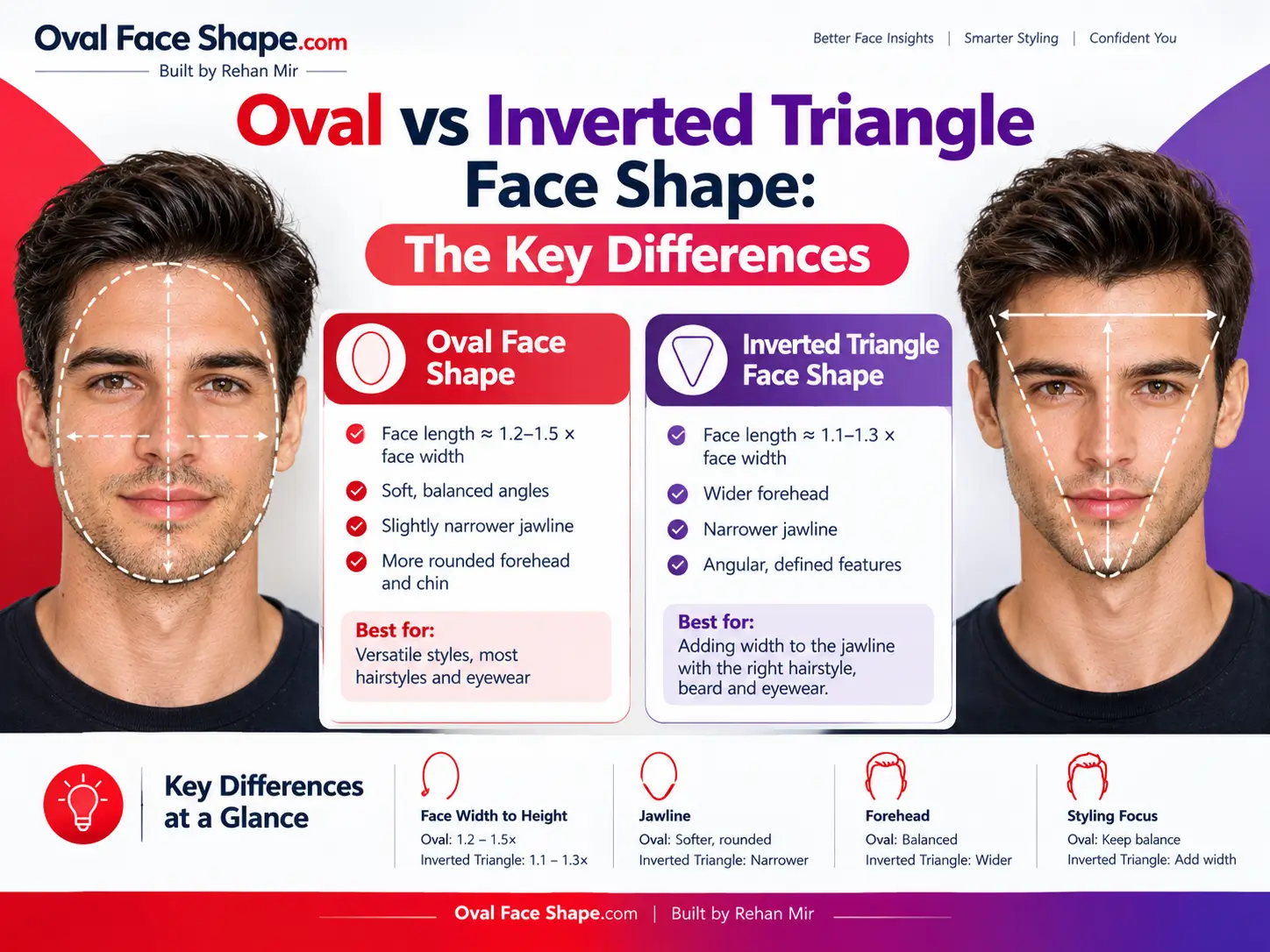
An oval face is balanced, about 1.3–1.5 times longer than wide, with a soft jaw. An inverted triangle is widest at the forehead and tapers to a narrow chin.
By Muhammad Rehan Iqbal, Founder and Developer of OvalFaceShape.com, specializing in face shape analysis, interactive facial assessment tools, and educational styling guides.
The difference between an oval and an inverted triangle face shape is where the width sits. An oval face is balanced, with a forehead, cheekbones and jaw that change gradually. An inverted triangle face is widest across the forehead and narrows steadily toward the chin.
Who this guide is for:
This guide is for anyone whose Face Shape Detector result at OvalFaceShape.com, or whose mirror check, keeps landing between the two and who wants to settle it before choosing a haircut.
Oval vs Inverted Triangle Face Shape: Side by Side
| Feature | Oval face shape | Inverted triangle face shape |
|---|---|---|
| Widest point | Cheekbones, with a gentle taper both ways | Forehead or upper face |
| Forehead vs jaw | Close in width | Forehead clearly wider than jaw |
| Jaw and chin | Soft, rounded | Narrow, often pointed |
| Length-to-width | About 1.3–1.5 | Varies, often slightly long |
| Visual feel | Balanced and even | Top-heavy, tapering |
| Styling goal | Keep the balance | Add width low, soften the top |
The 1.3–1.5 range is the oval standard used on OvalFaceShape.com, calculated as face length divided by cheekbone width.
Where the Two Shapes Get Confused?
The dividing line is the forehead-to-jaw relationship. On an oval face the forehead and jaw are close in width. On an inverted triangle face the forehead is visibly wider than the jaw, and the chin narrows to a point or a small curve.
Length alone cannot separate them, because both shapes can be slightly longer than wide. Face-shape guidelines such as those built on Farkas’s anthropometric landmarks (Anthropometry of the Head and Face, 2nd ed., Raven Press, 1994) measure widths at several levels, not one ratio. That is why the Face Shape Detector’s classifier compares forehead, cheek and jaw widths in addition to length.
Many faces sit between the two. If your forehead is only slightly wider than your jaw, you are probably an oval with an upper-face emphasis, not a true inverted triangle.
Oval vs Triangle Face Shape: Which “Triangle” Do You Mean?
“Triangle” is used two ways, and the opposite meanings cause most of the confusion. A triangle face, also called pear, is narrowest at the forehead and widest at the jaw, while an inverted triangle is the reverse.
If you searched “oval vs triangle face shape” and meant a wide jaw, read the pear face shape guide instead. Everything below is about the inverted triangle, which is also called the upside-down triangle or V-shaped face.
Diamond vs Inverted Triangle Face Shape
Diamond faces are widest at the cheekbones, with a narrow forehead and a narrow chin. Inverted triangle faces are widest at the forehead.
A diamond has wide cheekbones with a narrow forehead and chin, so check the forehead: If it is as wide as your cheekbones or wider, you are closer to an inverted triangle. If it is clearly narrower than your cheekbones, you are closer to a diamond.
Discover the key differences between Diamond vs. Inverted Triangle Face Shapes in our complete comparison guide.
Hairstyles for Men
Oval: An oval face suits most cuts, so choose by hair type and lifestyle, such as a classic taper or a textured crop.
Inverted triangle: The aim is to avoid adding more volume on top and to keep the sides from looking too sharp. A longer fringe or side-swept front softens a wide forehead, and some length at the sides adds width near the jaw. A beard fills out a narrow chin, which is covered in the beard styles by face shape guide.
For cut-by-cut detail, see the inverted triangle hairstyles guide.
Hairstyles for Women
Oval: An oval face carries almost any length. Hair is chosen for texture and maintenance, not for shape correction.
Inverted triangle: Chin-length to shoulder-length cuts add fullness below the cheekbones. Side-swept bangs or curtain bangs soften the forehead, and waves or curls at the ends balance the narrow chin. Heavy volume at the crown makes the top look even wider.
The hairstyles for every face shape guide covers the full range.
Celebrity Comparisons between Oval and Inverted Triangle
Celebrity face shapes are judgment calls from photos, which vary with angle, lighting and hairstyle. The Face Shape Detector makes the same kind of call from landmark measurements.
When you compare yourself to a celebrity, compare the same three things in a straight-on photo: Forehead width, cheekbone width and jaw width. For examples, use the celebrity face shapes hub and the dedicated inverted triangle celebrities page.
Quick Check: Which One Are You?
- Pull your hair back and face a mirror straight on.
- Compare forehead width and jaw width.
- If they look close, you lean oval.
- If the forehead is clearly wider and the chin tapers, you lean inverted triangle.
- If the cheekbones are the widest point, check diamond.
For a measured result, run the Face Shape Detector. It uses MediaPipe’s face landmark model and processes the photo in your browser.
Key Takeaways
- Oval is balanced, and inverted triangle is widest at the forehead.
- Forehead vs jaw width is the deciding test. Length alone does not separate the two shapes.
- “Triangle” can mean pear or inverted triangle, so check which one a source means.
- Diamond has its widest point at the cheekbones, not the forehead.
- Styling for an inverted triangle adds width low and softens the forehead.
- Face-shape labels are styling guides, not medical measurements.
Next step: confirm your shape with the Face Shape Detector, then open the matching styling guide.
FAQs
What is the main difference between oval and inverted triangle face shapes?
The main difference is where the width sits. An oval face is balanced and rounded, while an inverted triangle is widest at the forehead and narrows to the chin.
Is “oval vs triangle face shape” the same as “oval vs inverted triangle”?
No. A triangle face is widest at the jaw, and an inverted triangle is widest at the forehead. Check which one a guide means before following its styling advice. (misconception)
Can I be between oval and inverted triangle?
Yes, and it is common. If your forehead is only slightly wider than your jaw, treat yourself as an oval with an upper-face emphasis.
Is an oval face better than an inverted triangle face?
No. Oval is called versatile for hairstyling because it needs less balancing, but no shape is objectively better.
Is face shape still a useful guide for choosing a haircut?
Yes, as a starting point. It narrows the options, but hair type, density and lifestyle matter as much.
How do I check my shape for free?
Use a mirror check and compare forehead and jaw width, or run the free Face Shape Detector.