
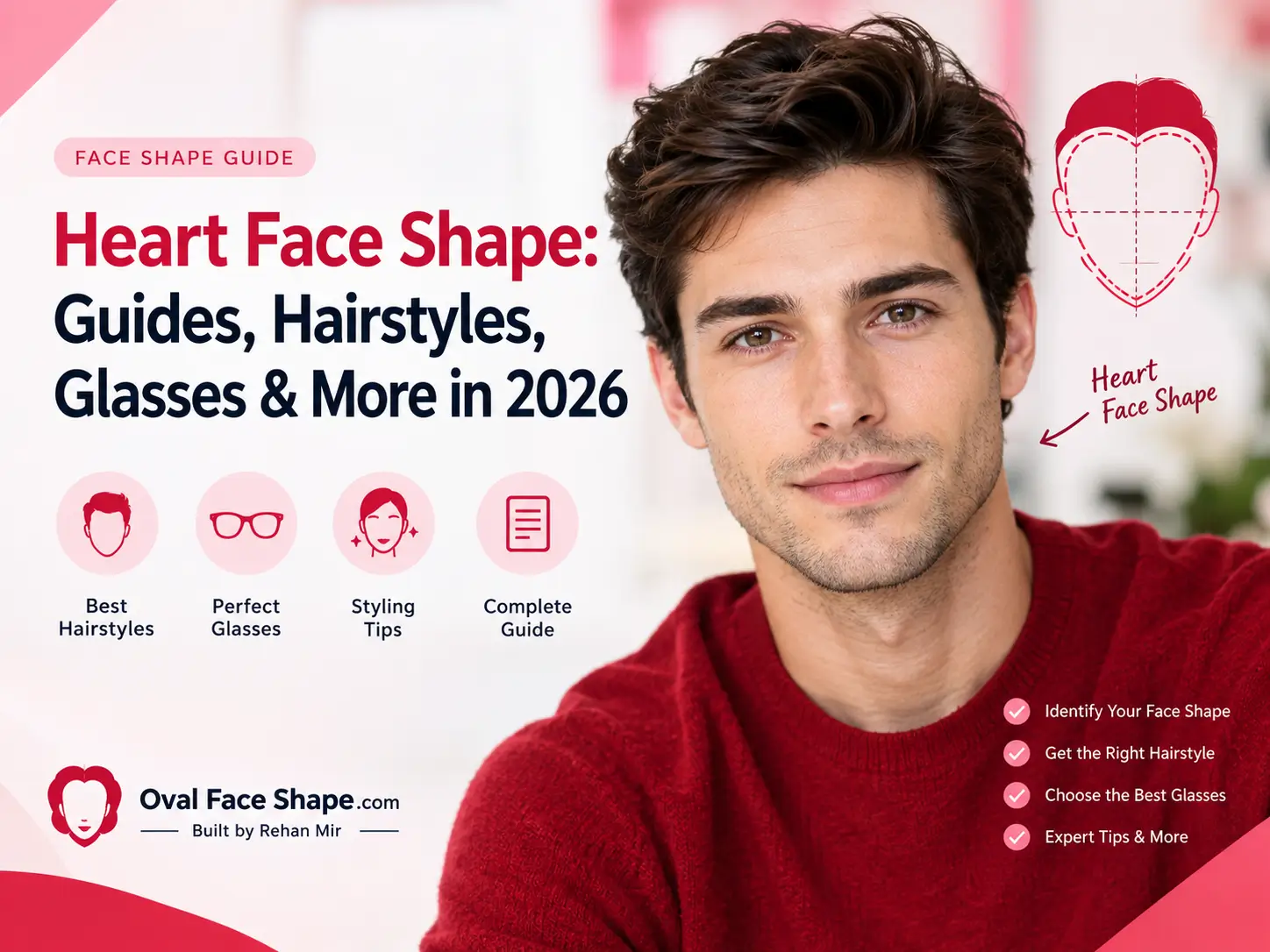
Quick Answer:
A heart-shaped face has a wide forehead, prominent cheekbones, and a narrow, pointed chin, sometimes with a widow’s peak. Chin-length hair, lower-face volume, and bottom-heavy glasses can help balance its proportions.
A heart face shape is defined by one clear proportion: The forehead is the widest part of the face, and the jawline narrows steadily down to a slim or pointed chin. It’s one of the seven core face shapes covered on OvalFaceShape.com, alongside oval, round, square, diamond, triangle, and oblong.
What Is a Heart Face Shape?
The shape gets its name from the playing-card heart symbol — wide at the top, tapering to a point at the bottom. High, prominent cheekbones sit between the wide forehead and the narrow chin, and many heart faces (though not all) have a widow’s peak, a V-shaped dip at the center of the hairline.
A rounded hairline without the peak is still a heart shape if the forehead-to-chin taper is present — the taper, not the hairline, is what defines the category.
How to Know If You Have Heart One?
Pull your hair back and check three points against a mirror or photo:
- Forehead — is it visibly the widest measurement across your face?
- Chin — does it come to a narrow point or slim curve, not a square edge?
- Cheekbones — are they prominent but clearly narrower than the forehead?
If all three are true, you likely have a heart face shape. If your cheekbones — not your forehead — are the widest point, you’re probably looking at a diamond shape instead.
For a precise read using facial landmarks rather than a visual guess, the Face Shape Detector on OvalFaceShape.com analyzes these four proportions directly from a photo.
Heart vs. Oval vs. Inverted Triangle
| Shape | Widest point | Chin | Common tell |
|---|---|---|---|
| Heart | Forehead | Narrow, tapered | Widow’s peak (often) |
| oval | Cheekbones | Softly rounded | Length slightly exceeds width |
| Inverted Triangle | Forehead | Narrow, tapered | Straight or rounded hairline, no peak |
Is My Face Heart or Oval?
The two are confused because both taper toward the chin. The difference is where the width sits: on an oval face, the cheekbones are the widest point and the forehead is noticeably narrower; on a heart face, the forehead itself is the widest measurement.
If you’re between the two, the Face Shape Detector’s landmark comparison is more reliable than a visual guess in a mirror.
Best Hairstyles for Women
The goal is adding visual width or volume at jaw level to offset the wider forehead. Chin-length bobs, lobs, and layered cuts that flare out at the jaw all work well.
Side-swept bangs or a deep side part break up forehead width without adding to it — a center part does the opposite, since it draws a line straight down the face’s widest zone. Soft waves or curls starting at the chin add fullness exactly where a heart face needs it.
Best Hairstyles for Men
The same forehead-versus-chin balance applies, but through different tools. Length and volume at the sides and back — a textured crop or a style with a bit more fullness through the temples and jaw area — help visually widen the lower face.
Avoid very short, tight sides paired with a lot of height on top, since that combination exaggerates the forehead-to-chin taper rather than softening it.
Facial hair that adds fullness along the jaw and chin — light stubble or a boxed beard — works the same way makeup contouring does for women. It fills in the narrowest part of the face.
Best Glasses for a Heart Face Shape
Frames that are wider or heavier at the bottom than the top counterbalance the forehead. Aviators, rimless or light-rim styles, and cat-eye or oval shapes all work because they shift visual weight downward or soften the width up top rather than adding to it.
Bold, heavy browline frames are the one style to be cautious with — they sit directly on the face’s widest zone and can make the forehead look wider still.
“Want to learn how to apply makeup for a heart face shape? Read our detailed Heart Face Shape Makeup Guide for practical tips, techniques, and styling advice.”
Key Takeaways
- A heart face shape is defined by a forehead wider than the jaw, tapering to a narrow chin.
- A widow’s peak is common but not required for the shape.
- Women’s styling and men’s styling both aim to add width or fullness at jaw level — the difference is in the tools (hair volume/parting vs. facial hair and side volume).
- Glasses should be bottom-weighted or rimless; avoid bold browline frames.
- If you’re unsure whether you’re heart or oval, the widest point of the face — forehead vs. cheekbones — is the deciding measurement.
Muhammad Rehan Iqbal is the Founder and Developer of OvalFaceShape.com, where he builds interactive facial-assessment tools and styling guides combining web development, SEO, and facial-analysis expertise.
FAQs
Is heart face shape attractive?
Yes — it’s one of the more frequently cited “flattering” face shapes in styling media, largely because of its high, defined cheekbones. Attractiveness in face-shape discussions is subjective and style-dependent, not a fixed ranking.
How rare is a heart face shape?
It’s a mid-frequency shape — less common than oval or round, more common than diamond — and appears more often in women than men. Exact percentages vary by dataset and methodology, so treat any single figure as an estimate rather than a fixed statistic.
Can a heart face have a straight hairline instead of a widow’s peak?
Yes. The defining trait is the forehead-to-chin taper, not the hairline shape — a heart face with a rounded or straight hairline is still a heart shape.
Do heart-shaped faces suit bangs?
Side-swept bangs generally work better than a blunt, straight-across fringe, since a straight fringe sits across the widest part of the face and can emphasize forehead width rather than softening it.
Is heart face shape the same as inverted triangle?
They’re closely related but not identical. Inverted triangle typically has a straighter, more angular jaw taper and no widow’s peak, while heart faces tend to have a softer, rounder chin curve and, often, a widow’s peak.
5 thoughts on “Heart Face Shape: Guides, Hairstyles, Glasses & More in 2026”