
Quick Answer:
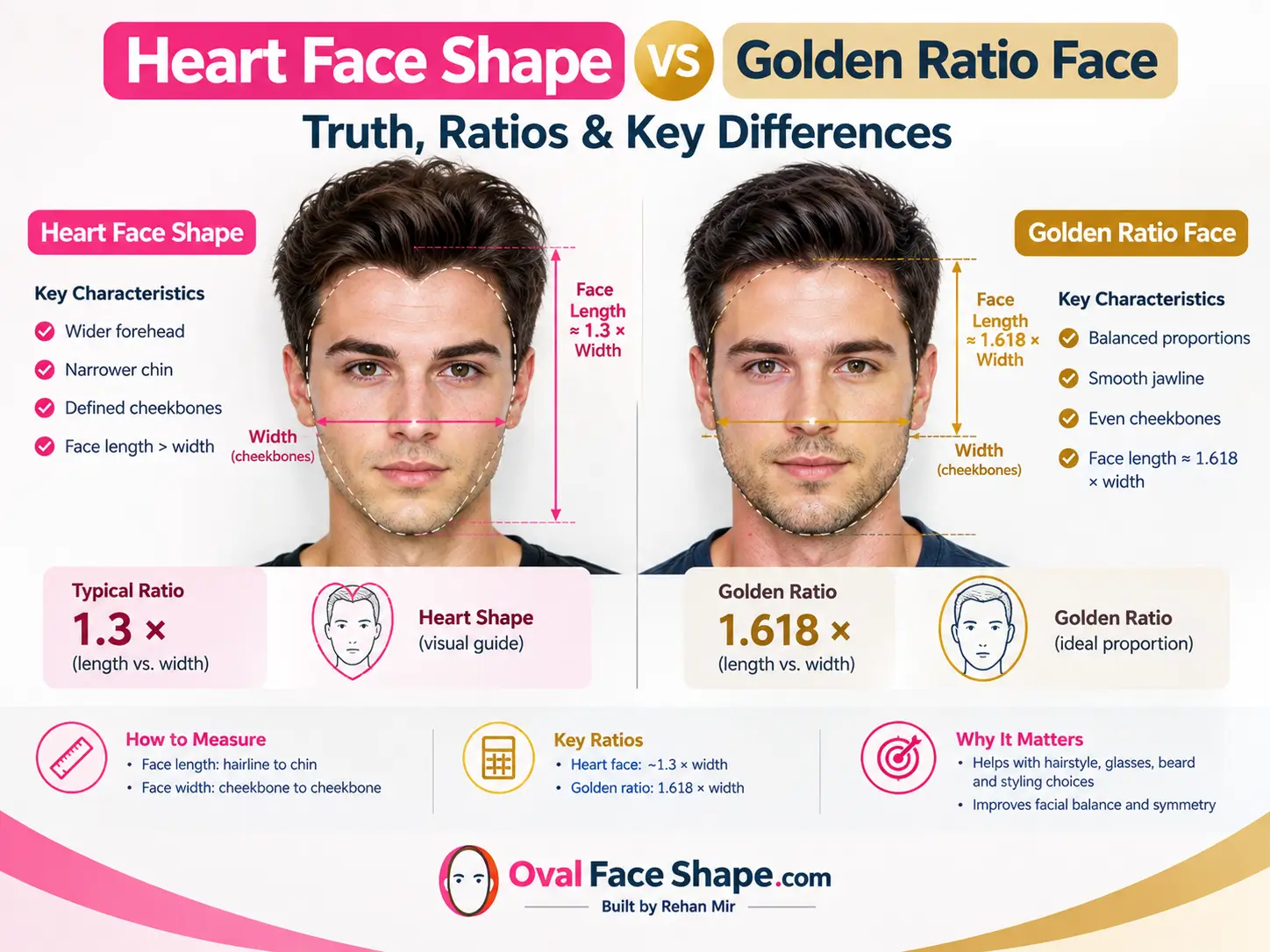
A heart face shape classifies structure — wide forehead, narrow chin. The golden ratio scores proportions against φ = 1.618. Heart faces carry an L/W ratio of 1.3–1.5, below the phi ideal, so the two systems measure different things.
By Muhammad Rehan Iqbal — Founder and Developer, OvalFaceShape.com
A heart face shape and a golden ratio face are not the same thing. One tells you the shape of your face. The other scores how your proportions compare to a mathematical constant. Conflating them leads to wrong conclusions — about attractiveness, about styling, and about which test is worth running.
Who this guide is for:
This guide is for anyone who has identified, or suspects, a heart face shape and wants to know how it maps to the golden ratio test. It also covers whether a heart face scores well on phi, what the hairstyle implications are, and whether it matters for men or women differently.
Heart Face Shape vs. Golden Ratio: Two Different Systems
The golden ratio face is not a specific face shape. It is a measurement framework based on the mathematical constant phi (φ), approximately 1.618, applied to facial features to assess proportional harmony.
A heart face shape, by contrast, is a geometric classification — it describes your face’s structure. Your forehead is the widest measurement, your cheekbones taper inward, and your jaw narrows to a pointed or V-shaped chin.
In a heart face, the hairline width is greater than the cheekbone width, which is greater than the jawline width, and the face length is greater than the face width.
Discover the key differences between an oval face shape and a Golden Ratio face in our detailed comparison of facial proportions, measurements, and the science behind the Golden Ratio.
The two different system details!
The two systems use different inputs and answer different questions. Shape classification uses relative widths — forehead versus jaw.
A golden ratio face test checks proportions including head height divided by head width, the distance between outer eye edges divided by mouth length, the distance between eye centres divided by nose width, the vertical distance from hairline to chin divided by hairline to nose tip, and the distance from eyeline to lips divided by eyeline to nose tip.
You can have a textbook heart face and score anywhere from low to high on a phi test — the shape category does not predict the ratio score.
Heart Face Shape L/W Ratio vs. Phi 1.618
OvalFaceShape.com’s face shape data shows the heart face shape carries a length-to-width ratio of 1.3–1.5×, with the forehead as the widest point and a narrow, tapered jawline.
The table below maps where a heart face typically lands on the measurements used in a golden ratio face test, against the phi ideal.
| Measurement | Heart Face Range | Phi Ideal (φ = 1.618) | Gap |
|---|---|---|---|
| Face length ÷ cheekbone width (L/W) | 1.3–1.5 | 1.618 | Below phi — moderate gap |
| Forehead ÷ cheekbone width | 0.97–1.13 | ~1.0 | Often near ideal |
| Jaw ÷ cheekbone width | 0.60–0.84 | ~0.62 | Often near ideal |
| Mouth width ÷ nose width | Individual | 1.618 | Unrelated to shape category |
| Hairline-to-chin ÷ hairline-to-nose tip | Individual | 1.618 | Unrelated to shape category |
L/W and width ratios sourced from OvalFaceShape.com’s Face Shape Detector dataset. Mouth/nose and facial thirds ratios are individual measurements independent of shape category.
On OvalFaceShape.com’s published phi proximity data, diamond and heart faces show a typical length-to-width ratio of 1.15–1.45, placing them at a moderate distance from 1.618. Divide your face length by your width, compare to 1.618 — but treat 1.3–1.5 as a normal, common range, not a “failing” score.
The L/W shortfall on a heart face is structural, not a flaw: The wide forehead relative to the narrow jaw limits how close the overall ratio can sit to phi, regardless of how strong the other proportion pairs are.
Where a heart face can score well is on the width-proportion checks. The jaw-to-cheekbone ratio on a heart face typically runs 0.60–0.84, and the forehead-to-cheekbone ratio runs 0.97–1.13 — both of which can land close to their respective golden ratio targets, particularly the jaw taper.
What this means in practice:
A heart face will not score near the top of the L/W golden ratio check. But a full multi-ratio phi test — which measures mouth-to-nose width, chin proportions, and eye-to-mouth span — can return stronger scores on those individual pairs. Shape category and phi score are measuring different things.
Does a Heart Face Shape Score Well on the Golden Ratio Test?
Partially — and the answer depends on which ratio pairs are being measured.
The L/W ratio of a heart face (1.3–1.5) sits below the phi ideal of 1.618. On that single check, most heart faces will not score at the top of the scale. Almost no real face matches the golden ratio perfectly.
The golden ratio (≈ 1.618) is referenced in facial aesthetics discussions, including Stephen R. Marquardt’s “Marquardt Beauty Mask” concept — but OvalFaceShape.com presents it as an aesthetic reference point, not a proven scientific standard, as its validity is debated within the research community.
Explore our complete guide to the Marquardt Phi Mask to understand how it works, what it measures, and what research reveals about its accuracy.
The mouth-to-nose, chin proportions, and eye-to-mouth ratios — the three pairs OvalFaceShape.com’s Golden Ratio Face Detector actually measures — are independent of face shape. They depend on where your features sit on your face, not on your forehead-to-jaw width relationship.
A heart face with well-placed, proportionate features can score solidly on those checks even when the L/W falls short.
Is a Heart Face Shape Attractive?
Yes — and the research here is more consistent than on the golden ratio question.
Research has linked a length-to-width ratio of approximately 1.44, with a smooth jawline and near-perfect facial symmetry, to the ideal female face — characteristics associated with heart-shaped proportions. Science identifies oval and heart as closest to ideal face shape proportions in most Western attractiveness research.
The V-shaped taper from wide cheekbones to a pointed chin creates a youthful facial structure — a trait that appears consistently in attractiveness literature across multiple cultural contexts.
The key nuance:
It is the proportional relationships a heart face creates — wide mid-face, defined jaw taper — that score well, not the shape label itself. A heart face with strong symmetry and well-placed features will read as attractive independent of its phi score.
Heart Face Shape and the Golden Ratio: Hairstyle Implications
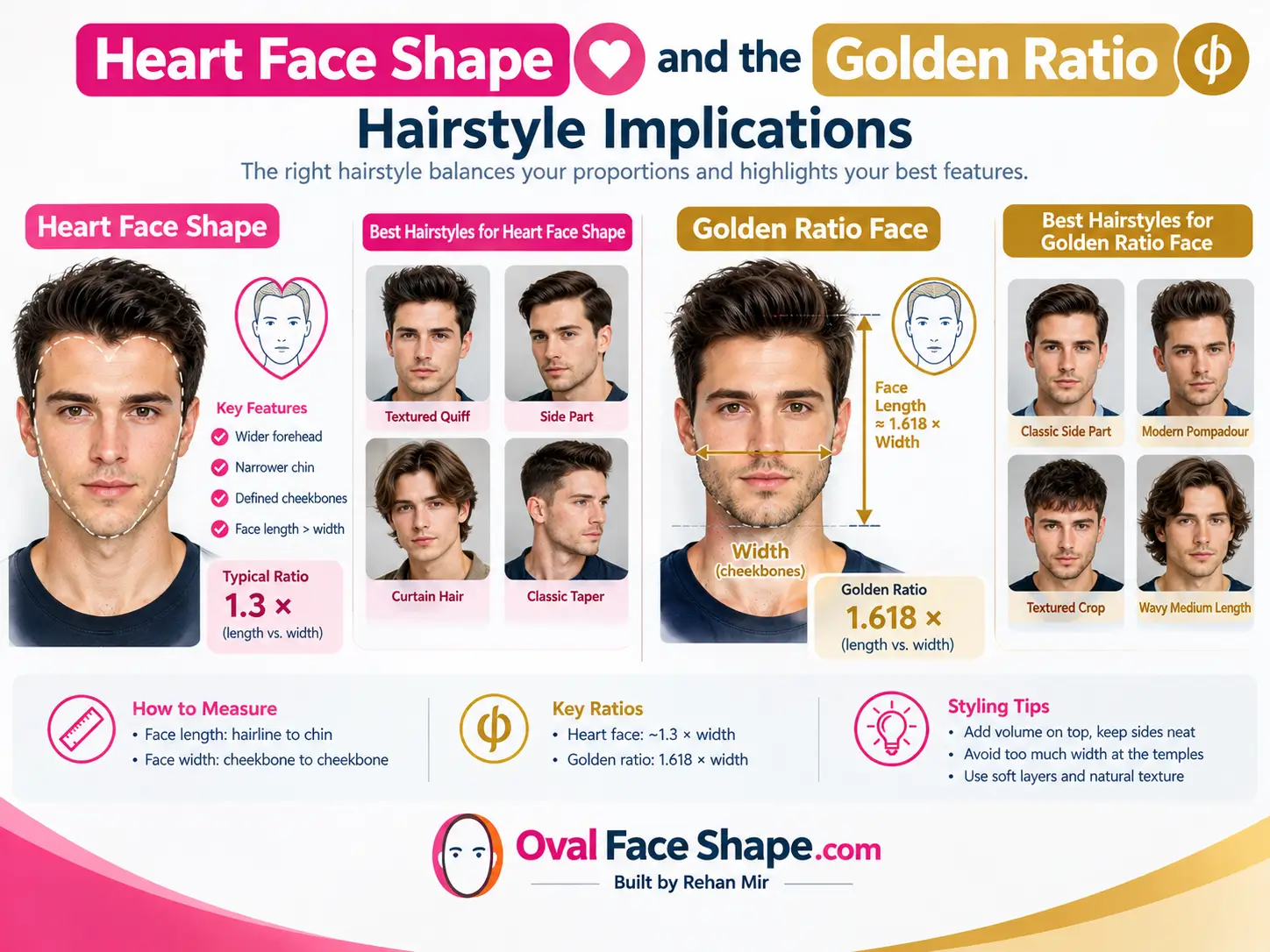
The golden ratio test is most useful for a heart face as a styling reference, not a score to maximize.
The L/W shortfall in a heart face — wide forehead relative to face length — shows up visually as a heavier upper face. Bringing the perceived L/W ratio closer to a balanced range is the underlying logic behind most heart face styling advice:
- Long layers reaching the jawline — add visual length to the lower face, narrowing the perceived forehead dominance
- Side-swept bangs or curtain fringe — reduce the apparent forehead width, which is the dominant measurement pulling the ratio below phi
- Chin-length volume (bobs, lob cuts) — add width exactly where the heart face is narrowest, balancing the jaw-to-cheekbone gap
- Avoid: full fringe or cuts above the jaw — these emphasize the wide forehead and visually shorten the face simultaneously, widening the L/W gap further
For a full breakdown by length and gender, see OvalFaceShape.com’s heart face shape guide.
Heart Face Shape Rarity: Men vs. Women
Based on 51,247+ face shape analyses, heart faces represent 14.1% of the population — placing them fourth by frequency after oval (28.4%), oblong, and round.
Heart faces are more common in women. The forehead width in a heart face typically measures 1.5 times the width of the chin, creating an inverted triangle silhouette — a structure that male skull development, with its tendency toward broader mandibles and wider jawlines, makes less frequent.
For men specifically:
The rarest face shape is diamond, at roughly 5% of the population. Heart sits at 14.1% overall but is less frequent in men than that figure suggests. If you’re a man who has been told you have a heart face, it is genuinely less common among men — but it is not classified as rare.
Discover the rarest face shape and rarest eye shape in our comprehensive guide, backed by research and evidence.
Key Takeaways
- A heart face shape classifies structure; the golden ratio scores proportions — they are different systems and do not predict each other
- OvalFaceShape.com’s Face Shape Detector data places the heart face L/W ratio at 1.3–1.5 — treat this as a normal, common range, not a “failing” phi score
- 23 A ratio of 1.3–1.5 is a normal, common range — not a failing score
- The width proportion checks (jaw-to-cheekbone, forehead-to-cheekbone) of a heart face can land near their golden ratio targets even when the L/W check falls short
- OvalFaceShape.com’s Golden Ratio Face Detector measures three specific ratio pairs (mouth ÷ nose width, chin proportions, eye ÷ mouth width) — these are independent of face shape and must be run separately from shape classification
- Heart faces score well in attractiveness research, linked to a youthful facial structure with wide cheekbones and a tapered jaw
- Heart faces represent 14.1% of the population; they are less common in men; the rarest shape is diamond (~5%)
- Run the Face Shape Detector first to confirm your shape, then run the Golden Ratio Face Detector to see your specific ratio pairs
Confirm your face shape before running any ratio test. OvalFaceShape.com’s Face Shape Detector identifies your shape from a single photo — then the Golden Ratio Face Detector shows you exactly which proportion pairs you’re hitting.
FAQs
Is a heart face shape attractive?
Yes. Heart faces score among the highest of all face shapes in attractiveness research, alongside oval. The wide cheekbone-to-pointed-chin taper is associated with a youthful facial structure across multiple cultural contexts.
What are the top 3 most attractive face shapes?
No universal ranking exists in the research. Oval and heart score highest in most Western studies; square ranks well for men. Attractiveness is driven by symmetry and proportion, not the shape label alone.
How do I check if my face has the golden ratio?
Divide your face length (hairline to chin) by your cheekbone width and compare to 1.618. For a full result, use OvalFaceShape.com’s Golden Ratio Face Detector — it measures mouth ÷ nose width, chin proportions, and eye ÷ mouth span against phi automatically.
Does knowing my heart face shape make the golden ratio test redundant?
No. They measure different things. Your face shape tells you structural widths. The golden ratio test scores specific feature-to-feature proportion pairs. A heart shape does not predict a high or low phi score — run both for a complete picture.
Is the golden ratio still a valid measure of facial beauty in 2026?
It remains a widely used reference in aesthetic medicine and styling, but its scientific validity as a beauty predictor is debated. OvalFaceShape.com presents the golden ratio as an aesthetic reference point, not a proven scientific standard. Use it as a proportion diagnostic, not a beauty verdict.
Which face shape is the rarest for men?
Diamond, at roughly 5% of the population. Heart faces are the next least common among men — male jaw development skews toward broader mandibles, making the heart face’s narrow-chin structure less frequent in men than the overall 14.1% population figure suggests.
Can a heart face score near the golden ratio ideal if the proportions are right?
Yes, on specific ratio pairs. The L/W check (1.3–1.5 vs. phi’s 1.618) will fall short structurally. But the mouth-to-nose, chin, and eye-to-mouth ratios are independent of face shape — a heart face with well-placed, proportionate features can score strongly on those checks.