
Quick Answer
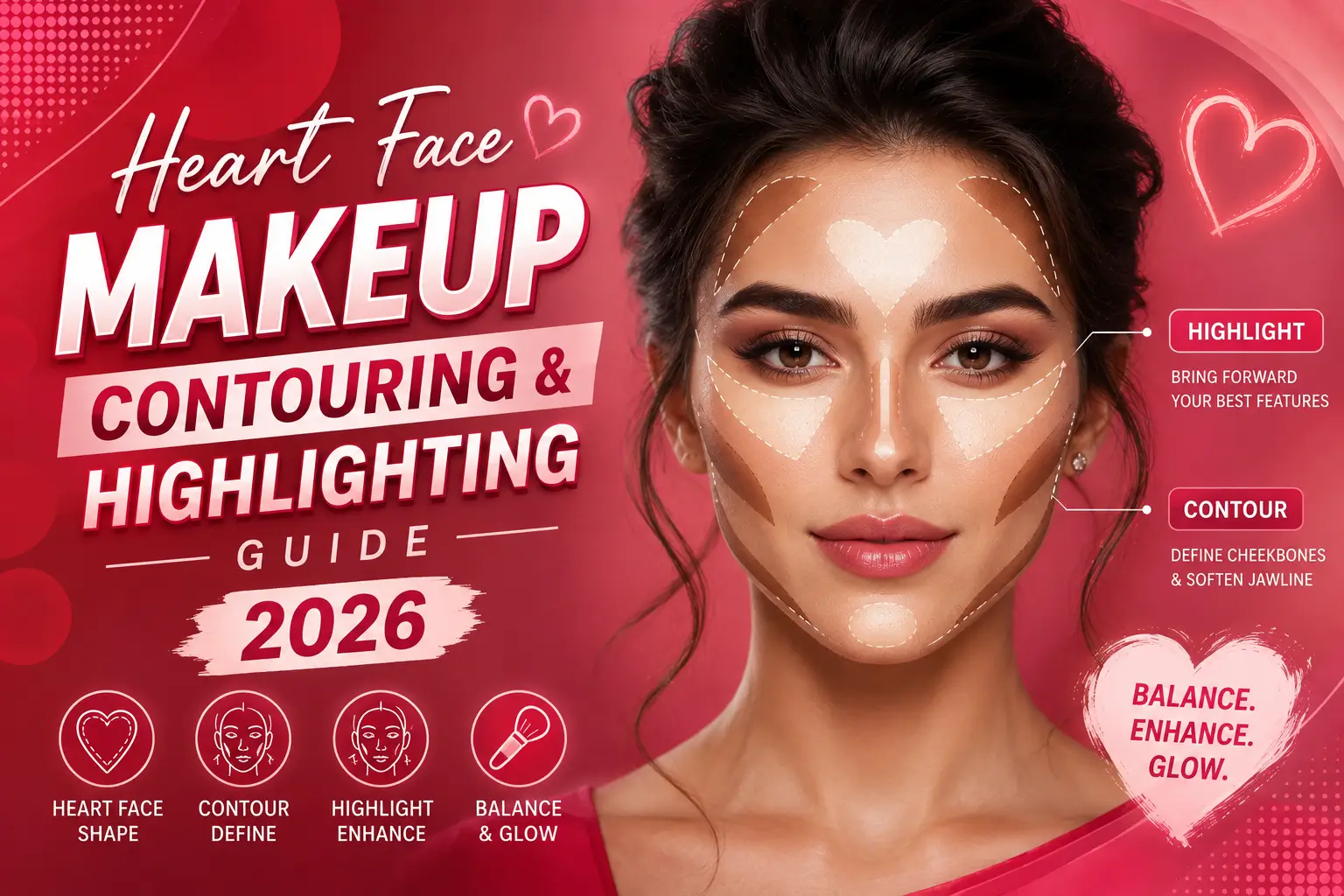
For a heart-shaped face, soften the wide forehead and balance the narrow chin. Contour the temples and outer forehead, then highlight the center of the forehead, cheekbones, and chin. Apply blush lightly along the outer cheeks toward the temples, and choose a softly curved brow shape. These techniques create visual balance without changing your natural face shape.
Who this is for:
Anyone who’s confirmed (through a mirror check, a face shape quiz, or a makeup artist) that they have a heart-shaped face and wants a repeatable, everyday-to-event makeup routine — beginners learning to contour for the first time and experienced makeup users refining placement.
What Defines a Heart-Shaped Face?
A heart-shaped face is widest across the forehead and temples, with prominent cheekbones and a narrow, tapered chin — the outline resembles an upside-down triangle with a softened point, similar to the classic “heart” symbol. Reese Witherspoon, Scarlett Johansson, and Vanessa Hudgens are commonly cited examples of this shape.
If you’re not certain this is your shape rather than oval or diamond, OvalFaceShape.com’s free Face Shape Detector compares your forehead, cheekbone, and jaw width to identify it in seconds — worth doing before you commit to a contour routine, since heart and diamond techniques differ in a few key places.
Where to Contour a Heart-Shaped Face?
The technique is different from an oval or round face: instead of contouring only under the cheekbones, you also work the top of the face.
- Temples and forehead sides — Apply a matte bronzer or contour powder, two to three shades darker than your foundation, in a soft arc from the hairline down toward (but not into) the eyebrow. This narrows the widest point of the face.
- Under the cheekbones — Follow the natural hollow from ear to the corner of the mouth with a smaller brush, keeping the line soft rather than sharp.
- Sides of the nose and under the chin — A thin stripe of contour on either side of the nose and just beneath the chin adds visual length and softens the point of the chin.
Celebrity makeup artist Diana Kraut, speaking to IPSY about contouring for this shape, notes that contouring around the temples of the forehead typically works best for heart-shaped faces because it creates more balance with the rest of the face. Kevyn Aucoin
Where to Highlight?
Highlighting pulls attention toward the areas you want to visually widen — mainly the lower half of the face, which balances the wide top.
- Center of the forehead, in a small vertical strip
- Tops of the cheekbones, just above your contour line
- Center of the chin and along the jawline, to add the illusion of width where the face naturally narrows
Use a concealer or cream highlighter one to two shades lighter than your foundation, and blend with a damp sponge so there’s no visible line between contour and highlight.
Blush Placement for Heart Faces
This is the step most tutorials get wrong. Because cheekbones are already the most prominent feature on a heart face, heavy blush on the apples can overemphasize width you’re trying to soften. Sofia Tilbury, Global Artistry Director at Charlotte Tilbury, recommends a different placement: apply blush to the apples of the cheeks starting slightly lower, then sweep it in a curved, C-shaped motion along the cheekbones and up toward the temples.
A New York makeup artist echoes the caution on quantity, noting that going heavy on blush on this face shape can overstate an area that’s already pronounced. aol
Eyebrow Shape
Brows frame the widest part of a heart face, so their shape matters more here than on most other face shapes. A soft, curved arch — rising and falling gradually rather than sitting flat — breaks up the horizontal width of the forehead. A flat, straight brow does the opposite: it extends the forehead’s line and makes it read even wider. Keep the arch natural rather than sharply angular for the same reason.
Common Mistakes to Avoid
- Over-contouring the temples so the line looks harsh instead of blended — always soften the edge with a clean brush or sponge.
- Piling blush onto the apples without sweeping it toward the temple, which exaggerates cheekbone width.
- Skipping the chin/jaw highlight, which is the step that actually creates balance — contour alone only narrows, it doesn’t add the counterbalancing width.
- Choosing a bronzy, warm-toned contour instead of an ashy, cool-toned one, which can look like dirt rather than shadow on camera and in daylight.
Key Takeaways
- Heart faces are widest at the forehead/temples and narrowest at the chin — the makeup goal is to soften that taper, not eliminate it.
- Contour the temples and forehead sides; highlight the forehead center, cheekbone tops, and chin.
- Apply blush in a C-curve from the outer cheek toward the temple rather than loading the apples.
- A soft, curved brow arch reduces how wide the forehead reads.
- These are styling techniques, not permanent or medical changes to bone structure.
Makeup techniques like these sit alongside hairstyle choices as the two most common ways people adjust how a heart-shaped face reads visually — see Best Hairstyles for a Heart-Shaped Face for the styling counterpart to this routine, and Eyebrow Shapes for Heart Face Shapes for a deeper dive on brow mapping specifically.
FAQs
Is a heart-shaped face considered attractive?
Yes — high, defined cheekbones are widely considered a flattering feature, and multiple makeup artists specifically call out the heart shape’s cheekbone prominence as an asset to highlight rather than hide, not a flaw to correct.
Is heart-shaped face makeup still relevant in 2026?
Yes. Contouring-specific product sales are still growing — the global contour makeup kit market is projected to grow at roughly 6.28% annually through 2030 — and face-shape-based application remains the standard teaching method used by working makeup artists, not a passing trend.
How is heart-face makeup different from oval-face makeup?
Oval faces are already balanced, so contour is used sparingly, mostly under the cheekbones. Heart faces need contour at the top of the face (temples/forehead) plus deliberate highlighting at the bottom (chin/jaw) to counter the taper — a two-directional technique oval faces don’t need.
Do I need expensive products to do this, or will drugstore contour work?
Placement matters more than price. A basic matte bronzer or contour stick and a cream or powder highlighter are enough — the technique described above works with any brand as long as the contour shade is matte and cool-toned rather than shimmery or orange-based.
Why do some tutorials tell heart faces to avoid blush entirely?
That advice is overcorrecting. The concern is really about placement and amount — a light, C-shaped sweep toward the temple (per Tilbury’s technique above) adds color without exaggerating cheekbone width, so blush isn’t off-limits, it just needs a specific placement.