
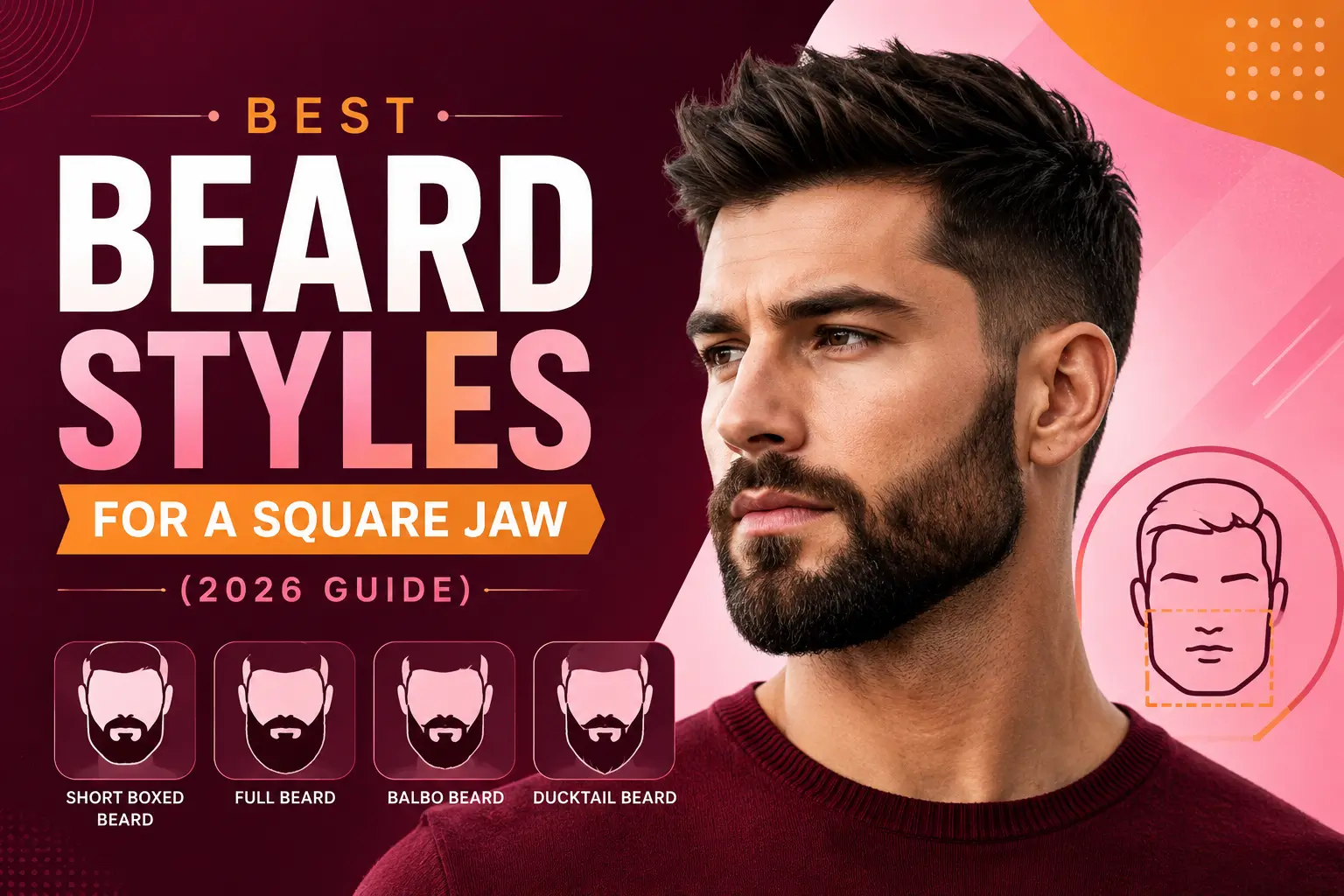
Quick Answer:
If you have a square jaw, the beard styles that work best are ones that either soften the angle (rounded full beard, circle beard, textured medium beard) or intentionally sharpen it (short boxed beard, tight stubble, anchor beard). Which direction to choose depends on whether you want your jawline to stand out or settle into a more balanced overall shape.
Who this is for:
Men with a wide, angular jawline — whether or not their overall face shape is square — who want a beard that works with that jaw instead of against it, before a haircut, a barber visit, or a beard-growing decision.
Square Jaw vs. Square Face Shape: Not the Same Thing!
These two terms get used interchangeably online, but they describe different things. A square jaw refers specifically to the mandible — the lower jawbone — having a wide, flat, well-defined edge with a distinct gonial angle (the corner where the jaw turns up toward the ear) close to 90 degrees. A square face shape is broader: it means the forehead, cheekbones, and jaw are all roughly the same width, so the whole face reads as boxy, not just the jaw.
You can have a strong, square jaw sitting under an oval, triangular, or diamond face shape — in which case styling advice built for a full square face shape won’t fit your actual proportions. If you’re not sure which applies to you, a quick way to check is to compare your forehead and cheekbone width to your jaw width in a mirror or with our Face Shape Detector — if all three are close in width, you likely have a full square face shape; if only the jaw stands out, you’re working with a square jaw on a different overall shape, and the styling below is built for exactly that case.
Why Beard Choice Matters More on a Square Jaw
A strong jawline is already the face’s most visually dominant feature — sharp mandibular angles catch light and draw the eye before anything else does. Facial hair sits directly on top of that structure, so it either reinforces the angularity or breaks it up.
The global beard grooming market was valued at $24.1 billion in 2018 and is projected to reach $43.1 billion by 2026, growing at roughly a 7.7% annual rate, according to a market report distributed via ResearchAndMarkets.com — a sign that intentional, shape-matched facial hair styling has moved from niche grooming advice into mainstream demand rather than a passing trend. The VOU
Beard Styles That Work With a Square Jaw
| Style | Effect on Jaw | Maintenance | Best For |
|---|---|---|---|
| Rounded full beard | Softens corners with curved, longer growth | Medium–high (regular shaping) | Fuller beard growth, softer everyday look |
| Circle beard | Isolates chin/mustache, removes cheek bulk | Medium | Thinner cheek growth, refined look |
| Textured medium beard | Breaks the flat jawline with visible texture | Medium | Balanced, natural appearance |
| Faded beard | Gradual fade from cheek to fuller jaw/chin | High (barber upkeep) | Modern, structured look |
| Anchor beard | Traces jaw with a defined point, clean cheeks | Medium | Sharpening the jaw intentionally |
| Short boxed beard | Tight, structured lines close to the skin | Low–medium | Low-maintenance definition |
| Designer stubble | Light coverage that follows jaw contour | Low | Everyday, subtle emphasis |
Softening styles (rounded full beard, circle beard, textured medium) use curved edges and added volume at the chin to round off the corners where the jaw meets the ear. Sharpening styles (short boxed beard, anchor beard, tight stubble) keep lines close and defined, letting the natural angle of the jaw show through — a legitimate choice if you want the jawline itself to be the statement, not something to balance out.
A faded beard — where hair tapers from short at the cheek to fuller at the chin and jaw — is worth calling out separately: it interrupts the single flat horizontal line a square jaw can create, without hiding the jaw’s shape entirely. It requires more upkeep than the others here, generally a barber visit every two to three weeks to keep the transition clean.
Styles to Avoid (Or Use With Caution)
- Very long, untamed beards — length without shape adds bulk to an already wide lower face
- Wide mutton chops — add width exactly where a square jaw doesn’t need more of it
- Thin pencil mustaches worn alone — too small to balance a strong jawline; works only as part of a fuller style
- Beards that stop abruptly at the jaw corner without any taper — this exaggerates the sharp angle rather than working with it
How to Maintain a Square-Jaw Beard?
- Trim along the jawline every 1–2 weeks to keep the taper or curve intentional rather than growing out into a flat line.
- Use a beard oil or balm to keep growth manageable at the cheek-to-jaw transition, where uneven density is most visible on a wide jaw.
- Book a barber shaping appointment every 3–4 weeks for faded or anchor styles — these depend on a clean line that’s hard to maintain solo.
- Re-evaluate length seasonally; a style that softened your jaw at 10mm can start to add bulk if left to grow past 20mm without reshaping.
Key Takeaways
- A square jaw is a jawline trait, not automatically the same as a square face shape — check which one you actually have before choosing a style.
- Rounded, textured, and faded beards soften a strong jaw; short boxed beards and tight stubble sharpen it intentionally.
- Avoid wide mutton chops, shapeless long beards, and beards with no taper at the jaw corner.
- Faded and anchor styles need regular barber upkeep; stubble and short boxed beards are the lowest-maintenance options.
- This is styling guidance based on common barbering practice, not a clinical or medical assessment of your face.
FAQs
Is a square jaw the same as a square face shape?
No. A square jaw describes the mandible’s width and angle; a square face shape means the forehead, cheekbones, and jaw are all roughly equal in width. You can have a square jaw on an oval, triangular, or diamond face.
Are beard styles for square jaws still relevant in 2026?
Yes — face-shape-matched grooming has grown alongside the broader beard care market, which industry analysis places on a path from roughly $24 billion in 2018 toward $43 billion by 2026, according to a report distributed via ResearchAndMarkets.com, reflecting sustained demand for intentional, structured facial hair over undefined growth. The VOU
Should I soften my square jaw or let it show?
Both are valid. Rounded and textured beards soften the angle for a more balanced look; short, structured beards like the anchor or boxed beard let the jawline stay the visual focus. The choice comes down to personal style, not a rule you have to follow.
Do I need a barber, or can I maintain this at home?
Stubble and short boxed beards are manageable at home with a quality trimmer. Faded and anchor beards involve a precise transition line that’s much easier to keep clean with a barber every 2–3 weeks.
Can beard oil actually change how my jawline looks?
Not the bone structure itself, but oil and balm affect how evenly the beard lays and fills in along the jaw, which changes how sharp or soft the jawline reads visually — that’s a styling effect, not a structural one.
My cheek growth is patchy — which styles still work?
Circle beards and anchor beards intentionally keep the cheeks clean, so patchy cheek growth doesn’t matter as much; the visual weight sits at the chin and jaw instead.
1 thought on “Best Beard Styles for a Square Jaw (2026 Guide)”