
Quick Answer:
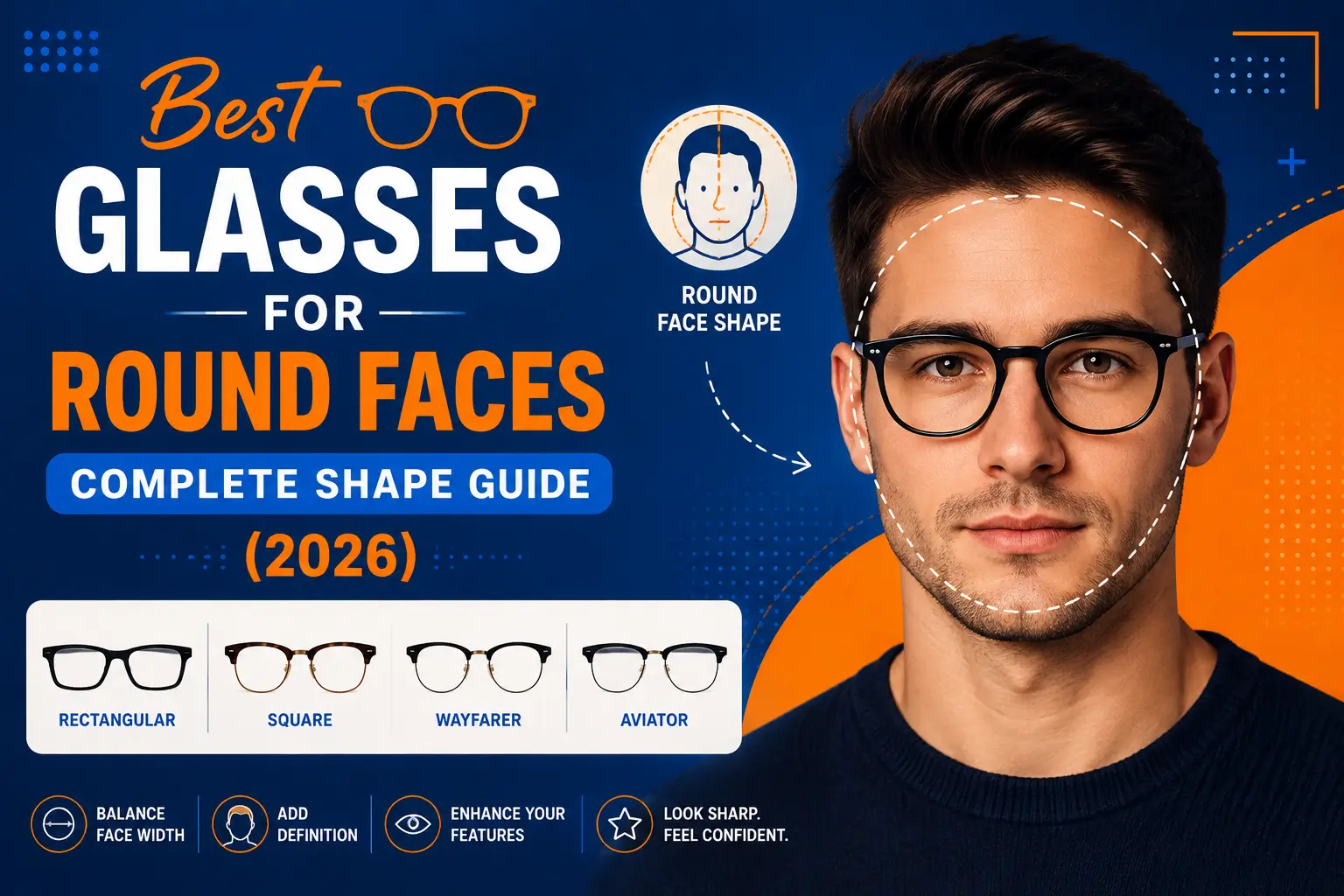
If your face is as wide as it is long, with soft curves and a rounded jawline, the most flattering glasses are those that add contrast, such as rectangular, square, or geometric frames with a straight or angular top line, or cat-eye frames. They introduce the structure a round face naturally lacks, while fully round or small oval frames tend to echo — and exaggerate — the roundness.
Who this guide is for:
Anyone with a round face shape — soft jawline, full cheeks, and roughly equal face width and length — who’s choosing prescription glasses, sunglasses, or blue-light frames and wants a shape that adds structure rather than roundness. It’s built for first-time frame buyers, people shopping online without an in-store fitting, and anyone re-evaluating an old “rule” they were told years ago.
Key Takeaways
- Round faces are close to equal in width and height, with soft curves and no dominant angles — the opposite of what strong frame shapes provide.
- Rectangle, square, geometric, and cat-eye frames add the angular contrast that visually elongates and defines a round face.
- Round, oval, and very small frames tend to mirror the face’s natural curves and can make it look softer or wider.
- Frame width and bridge fit matter as much as shape — a frame that’s too narrow makes cheeks look wider by comparison.
- These are styling guidelines, not fixed rules — personal style and comfort should always have the final say.
What Makes a Face “Round”?
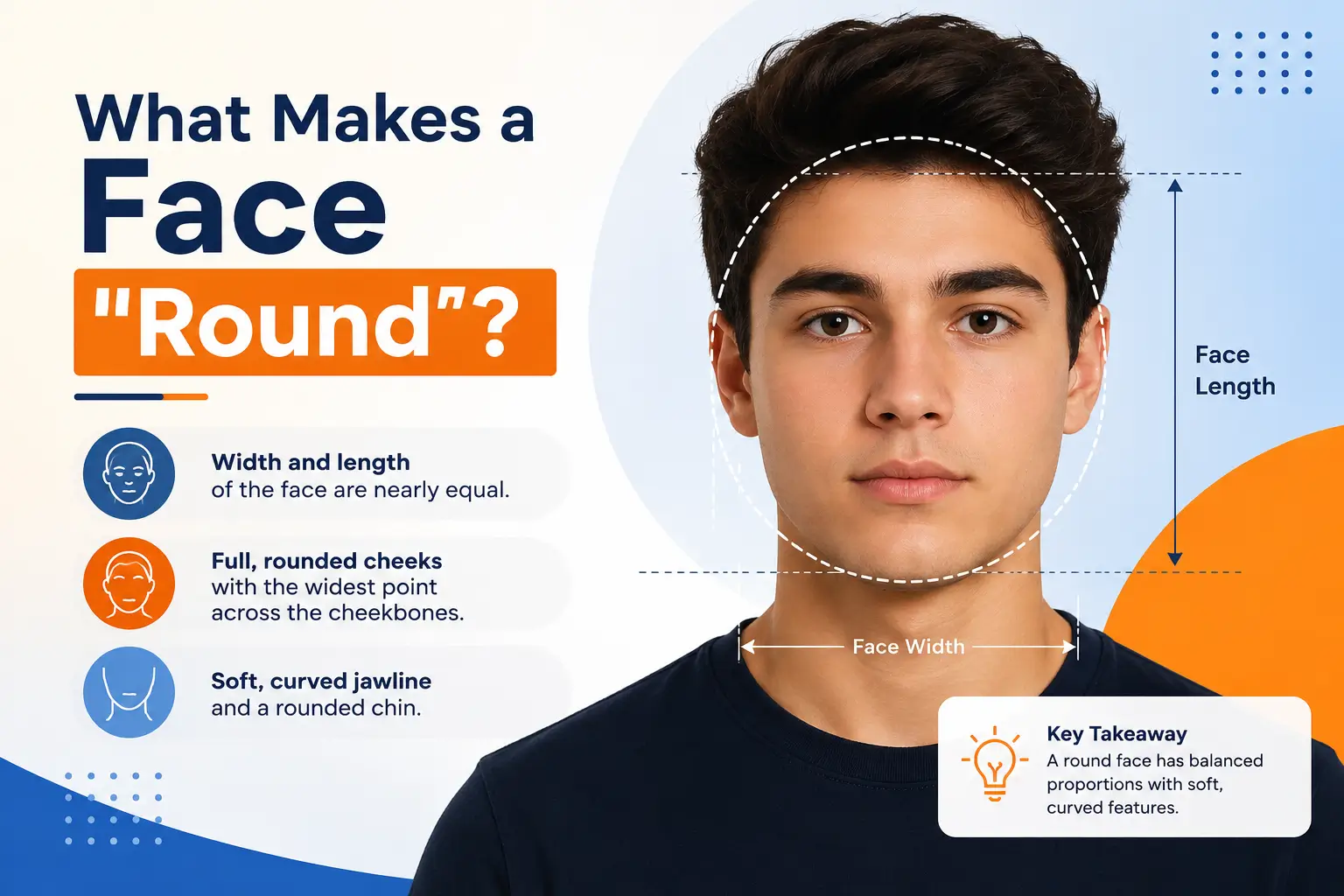
A round face shape has a hairline and jawline with similar, gently curved widths, full cheeks, and a rounded chin with no strong angle. The forehead is usually wide, and the overall length and width of the face are close to equal — unlike an oval face, which is visibly longer than it is wide, or a square face, whose jawline is angular rather than curved.
Why Frame Shape Matters: The Contrast Principle
Opticians generally recommend picking frames that contrast with your natural face shape rather than repeat it. Sharon Dao, an optometrist at Cosmopolitan Eyecare, describes the classic guideline as choosing “frames that are the opposite of your face shape to balance out proportions.
” For a round face, that means angles: a straight brow line or squared-off corners break up the continuous curve of the cheeks and jaw, creating the visual impression of length and definition that a round face doesn’t have on its own.
Best Glasses Shapes for a Round Face
- Rectangle frames — the most reliable choice; horizontal lines and squared corners lengthen the face and add definition around the eyes.
- Square frames — similar effect to rectangles, with slightly softer corners; works well in bold acetate for a stronger look.
- Cat-eye frames — upswept outer corners lift the brow area and draw the eye upward and outward, away from full cheeks.
- Browline frames — a heavier top rim contrasts with the rounded lower half of the face and anchors the eyes.
- Geometric frames — hexagon or angular shapes offer contrast with a more fashion-forward edge than a classic rectangle.
Frame Shapes to Approach Carefully
Round and oval lens shapes tend to repeat the curve of a round face rather than balance it, which can make the face look softer or fuller than intended. Very small or narrow frames create the same problem from a different angle: when the frame is noticeably narrower than the widest part of the face, the cheeks read as wider by comparison.
This doesn’t make round or small frames “wrong” — it just means they work against, rather than with, the contrast principle above.
Frame Comparison at a Glance
| Frame Shape | Effect on a Round Face | Best For |
|---|---|---|
| Rectangle | Elongates, adds structure | Everyday and professional wear |
| Square | Adds strong definition | Bold, statement looks |
| Cat-eye | Lifts brow, draws eye up | Softer contrast with personality |
| Browline | Anchors upper face | Vintage-inspired, classic style |
| Round/Oval | Mirrors natural curve | Only if softness is the goal |
Fit, Color, and Material
Shape is the biggest factor, but fit and color reinforce it. Choose a frame width close to the widest point of your face — too narrow, and the cheeks look wider; too wide, and the structure gets lost. Darker tones (black, tortoiseshell, deep navy) create more visible contrast and a slimming effect than very light or transparent frames, which soften the outline instead of defining it.
Quick Self-Check
- Stand in front of a mirror — is your face close to as wide as it is long, with a rounded jaw? If yes, you likely have a round face shape.
- Prefer more structure? Start with rectangle or square frames.
- Want structure with softer personality? Try cat-eye or browline.
- Unsure? A face shape detector tool gives a faster, more consistent read than eyeballing it in a mirror.
Common Misconceptions
A common misconception is that round faces can’t wear round glasses at all — they can, it’s just a stylistic choice that leans into softness rather than balancing it.
Another is that face-shape rules are strict requirements rather than starting guidelines; personal style, skin tone, and comfort matter just as much as geometry.
Why This Still Matters in 2026?
With roughly 166.5 million American adults — about 63.7% of the adult population — wearing prescription eyeglasses, according to The Vision Council, frame selection remains one of the most common style decisions people make. As more shopping moves online without an in-person fitting, understanding why a shape works — not just which one to click — matters more than ever for avoiding a return.
FAQs
Do round faces really need “opposite” shaped glasses?
Not strictly — it’s a guideline, not a rule. Angular frames tend to add contrast and definition, but round or soft frames are a valid choice if you prefer that look.
Are round face glasses still relevant in 2026?
Yes. The underlying principle — contrast between face shape and frame shape — hasn’t changed, though frame trends (thicker acetate, geometric shapes) shift year to year.
Round face vs. oval face — how do I tell the difference for glasses?
A round face is close to equal in width and height with a curved jaw; an oval face is visibly longer than wide with a slightly narrower jaw. Oval faces have more flexibility in frame shape, while round faces benefit more from added angles.
Do square frames really look better than round frames on a round face, or is that just a sales tactic?
It’s a genuine optical effect, not just marketing — straight lines and corners create visual contrast against curves, which is why opticians recommend it, though the difference is subtle and personal style still matters.
Is buying glasses online without trying them on risky for round faces?
It can be, since frame width and fit matter as much as shape. Use a virtual try-on tool and check the frame’s width measurement against your face’s widest point before buying.
Can men and women with round faces follow the same frame guidance?
Yes — the contrast principle is about geometry, not gender; rectangle, square, and cat-eye frames work the same way regardless of who’s wearing them.
The Bottom Line
Round face glasses come down to one principle: add the structure your face doesn’t already have. Rectangle, square, geometric, and cat-eye frames do that reliably; round, oval, and undersized frames work against it. Treat this as a starting point, not a rulebook — fit, color, and personal style decide the rest.