
Quick Answer:
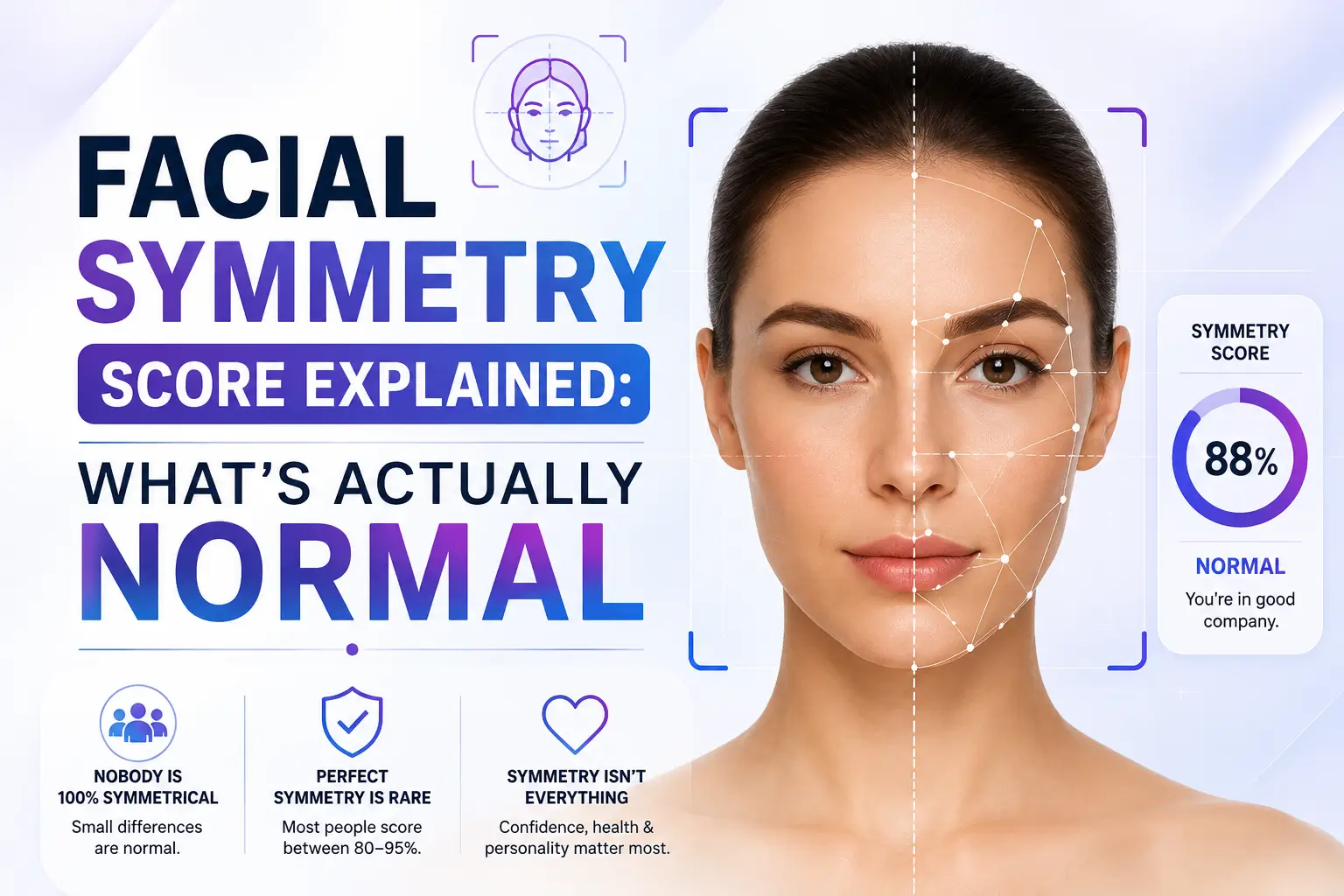
Facial symmetry is how closely the left and right sides of your face match. Perfect symmetry is extremely rare, and most people have small natural differences that are completely normal. AI symmetry scores are estimates, not medical diagnoses, and an 85–95% score is typically considered highly symmetrical.
Key Takeaways
- Nearly everyone has some measurable facial asymmetry — perfect symmetry is biologically rare, not the norm.
- Small, longstanding asymmetry is a normal human variation; sudden new asymmetry is a different situation and warrants medical attention.
- A photo-based “symmetry score” measures one image under specific conditions, not a fixed, permanent trait.
- Research links moderate symmetry to perceived attractiveness and health, but symmetry is one factor among several, not the whole picture.
- Different apps can give different scores for the same face because they use different landmarks, angles, and lighting assumptions.
How Facial Asymmetry Is Actually Measured?
Clinicians and researchers typically calculate an asymmetry index by comparing the position of paired facial landmarks — the outer corners of the eyes, the edges of the mouth, the zygion (the widest point of the cheekbone), the gonion (jaw angle) — against the face’s vertical midline.
A 3D-scan study of healthy young adults found this kind of measurable asymmetry to be common even in faces perceived as “normal,” not exceptional, since facial asymmetry is common in so-called normal faces.
Curious to discover the rarest face shape and explore the latest face shape statistics? Read our in-depth guides to uncover the data, trends, and key differences behind each face shape.
Consumer facial-symmetry tools work on a simplified version of the same idea: AI landmark detection maps points like the eyes, nose bridge, lips, and jawline in a single photo, then compares left-right spacing to produce a percentage score. PubMed Central
There are two broad types of asymmetry researchers distinguish. Directional asymmetry is a consistent pattern across most people — several studies report the left side of the face is slightly more often the “dominant” or larger side, with lateral guidance found to be most predominant on the left side of the face across multiple studies.
Fluctuating asymmetry is smaller, more random variation that differs from person to person and is the kind most researchers use as a marker of developmental stability. Smile Tracker
So How Much Asymmetry Is “Normal”?
More than typical intuition would suggest. One review study found average facial asymmetry across a sample of adults measured under one millimeter, yet other imaging-based research puts detectable asymmetry above 50% of the general population once radiographic methods are used, since more than 50% of people show detectable asymmetry when researchers use radiographic imaging, while in everyday life most of this asymmetry is too subtle for others to notice.
That gap matters: what a machine can measure and what a human eye can perceive are two different thresholds. Perception research suggests people generally don’t register asymmetry as asymmetry until it crosses roughly 4 millimeters of deviation from the midline, a threshold well above the roughly 0.8 millimeter average measured across a 191-person study — in other words, the asymmetry a symmetry app flags is usually invisible in a normal conversation. AKJournalsAKJournals
Self-reported data tells a similar story from the other direction: in a cross-sectional study, about 28.7% of participants said they’d personally noticed facial asymmetry, most commonly in their teeth and eyebrows, and fewer than a quarter said it actually bothered them, with 24.4% of participants reporting they were bothered by their asymmetry despite roughly a third identifying it in the first place. nih
Why Your Score Changes From Photo to Photo?
This is the part most symmetry-test pages skip. A single-photo symmetry score is sensitive to head tilt, camera angle, lens distortion, lighting, and expression — a smiling photo and a neutral one can produce meaningfully different numbers because muscle activation itself is rarely perfectly symmetrical, even in a genuine smile.
That’s not a flaw unique to any one app; it’s a limitation of measuring a 3D structure from a single 2D image. Comparing two or three photos and looking for a consistent pattern gives a more honest read than treating one selfie as a final verdict.
Does Asymmetry Affect Attractiveness?
Evolutionary psychology research has repeatedly linked facial symmetry to perceived attractiveness and even perceived health, going back to influential work by researchers like Gillian Rhodes and David Perrett, whose review found facial symmetry strongly linked to perceptions of both attractiveness and trustworthiness.
But symmetry isn’t the only — or even the dominant — factor: facial averageness (how closely proportions match a population norm) and sexual dimorphism (how strongly masculine or feminine a face reads) contribute independently to attractiveness judgments, with natural variation in symmetry covarying with attractiveness ratings across multiple studies, though this holds only so long as any change doesn’t create structural abnormalities.
In practice, this means a lower symmetry score doesn’t equate to a less attractive face — it’s one input among several, and mild asymmetry is part of what makes an expression read as genuine rather than artificial. SAGE PublicationsSemantic Scholar
When Asymmetry Is a Medical Question, Not a Cosmetic One?
Everything above describes longstanding, ordinary asymmetry — the kind everyone has to some degree. That’s different from sudden-onset asymmetry: new drooping, numbness, weakness, or altered movement on one side of the face, especially alongside slurred speech or confusion. That combination needs urgent medical evaluation, not a photo app. A cosmetic symmetry score is a visual-analysis tool, not a diagnostic one, and it isn’t designed to detect neurological or muscular conditions.
Where Face Shape Fits In?
Asymmetry and face shape are related but separate ideas: face shape describes overall proportions (width, length, jaw and forehead relationship), while symmetry describes left-right balance within that shape. If you’re curious how your proportions classify overall, the Face Shape Detector tool maps those measurements directly, and knowing your shape also informs how contouring, eyebrow shaping, and glasses selection can visually soften minor asymmetry — covered in the contouring for face shapes guide and glasses by face shape guide.
FAQs
Is having an asymmetrical face normal?
Yes. Research consistently finds that some degree of facial asymmetry is typical rather than exceptional, with detectable differences found in over half of people studied using imaging methods, even though most of that asymmetry is too subtle for others to notice in daily life. Perfectly symmetrical faces are the statistical outlier, not the standard. AKJournals
Is facial symmetry still relevant to attractiveness research in 2026?
Yes, though it’s understood as one factor among several rather than a standalone rule. Modern evolutionary-psychology research treats symmetry alongside averageness and sexual dimorphism as independent contributors to attractiveness judgments, rather than symmetry alone determining how attractive a face is perceived to be. Semantic Scholar
Why do different face-symmetry apps give me different scores?
Because each app uses its own landmark set, and a single photo is affected by head angle, lighting, lens distortion, and expression. The same face photographed differently can score differently without any real change in the face itself — comparing a few photos gives a more reliable pattern than trusting one result.
What’s the difference between a symmetrical face and a “good” face shape?
Face shape describes your overall proportions — width versus length, jaw and forehead relationship. Symmetry describes left-right balance within that shape. You can have a strongly symmetrical face in any shape category, and asymmetry doesn’t change which shape category you fall into.
Can facial asymmetry get better or worse over time?
It can shift somewhat with growth, aging, dental changes, and habits like chewing on one side, but ordinary asymmetry is a stable, lifelong trait for most people rather than something that needs correcting. Longitudinal research on children found facial asymmetry is detectable from early childhood and tends to reduce somewhat with age, though it doesn’t disappear.
When should facial asymmetry be checked by a doctor instead of an app?
When it appears suddenly, worsens quickly, or comes with numbness, weakness, drooping, or speech changes. Longstanding, gradual asymmetry that’s always been there is a cosmetic curiosity; new, rapid asymmetry is a medical signal.