
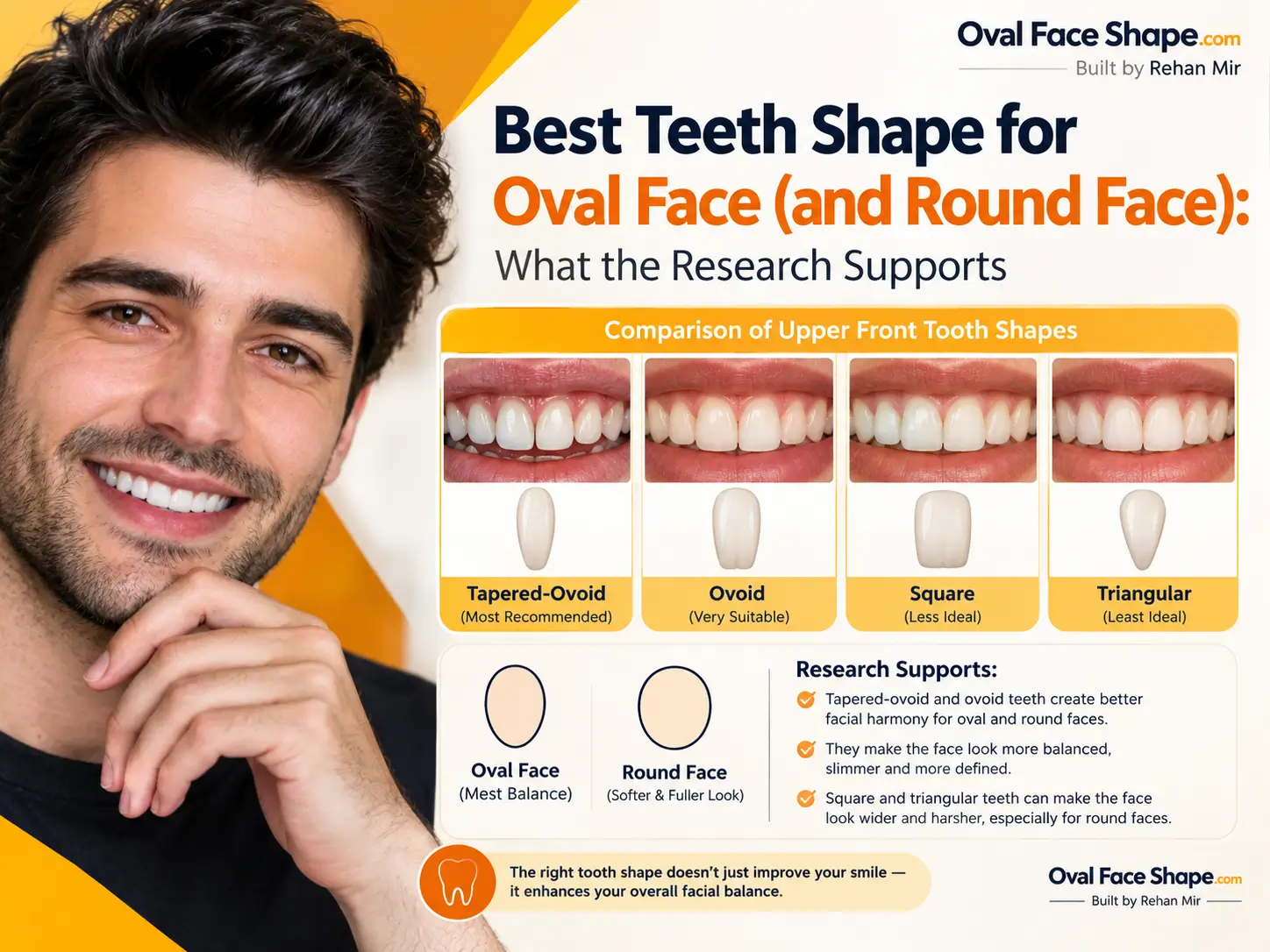
Quick Answer:
For an oval face, softly rounded (ovoid) or tapered-ovoid front teeth are the best-supported choice; gently squared edges suit a bolder look. No shape is medically required.
By Muhammad Rehan Iqbal, Founder and Developer of OvalFaceShape.com, specializing in face shape analysis and educational styling guides. Educational guidance, not dental advice.
The best teeth shape for an oval face is a softly rounded (ovoid) or tapered-ovoid upper incisor, with gently squared edges as a bolder alternative. An oval face has no dominant angle, so most natural shapes look balanced on it. The real choice is the look you want.
An oval face shape is a face about 1.3 to 1.5 times longer than it is wide at the cheekbones, with a softly curved jaw. “Tooth shape” here means the outline of the upper front teeth (incisors) as designed in veneers, bonding or crowns.
Who this guide is for:
This guide is for OvalFaceShape.com readers comparing shapes before a cosmetic dental consultation. Not sure your face is oval? Read the oval face shape guide first, because round and square faces get different advice below.
Best Teeth Shapes for an Oval Face
| Shape | Look | Fit for an oval face |
|---|---|---|
| Tapered-ovoid | Rounded edges, narrowing toward the gumline | Top-ranked in perception research; soft and youthful |
| Ovoid (rounded) | Curved edges, no sharp corners | Echoes the face’s soft curves; the most natural choice |
| Gently squared (ovoid-square) | Straighter edge, softened corners | Adds definition without harshness |
| Flat square or triangular | Hard edges or sharp points | Square ranked least attractive, triangular second-least, in one study |
Which Teeth Shape Looks Most Attractive?
In a 2016 UCL Eastman Dental Institute study in the Journal of Dentistry, 90 people (30 dentists, 30 dental technicians, 30 patients) ranked five incisor shapes on one female smile photo. Tapered-ovoid won overall (50%), ovoid placed second (36.7%), and square ranked least attractive (43.3%). Dentists favored tapered-ovoid (70%), while patients favored plain ovoid (56%). uclucl
The limits matter. The photo showed teeth only, with no lips or face, so the study says nothing about oval faces specifically. Participants described square teeth as looking worn, aged and masculine.
Best Teeth Shape for an Oval Face: Female vs. Male
For a female smile, tapered-ovoid or ovoid is the best-supported choice. Earlier studies summarized in the same paper found oval favored for female smiles and rectangular for male ones.
For a male smile, dentists typically work with ovoid-square or rectangular shapes. Spear Education notes that the incisal edge largely decides whether teeth read as masculine (sharp, bold) or feminine (round, soft). speareducation
That split is a design choice, not anatomy. In a Central Indian sample, oval was the most common natural form in both men (57%) and women (60%), with no gender variation. upi
Does Face Shape Really Predict Tooth Shape?
Leon Williams proposed in 1914 that incisor shape mirrors the inverted face outline. In the mid-1950s, Frush and Fisher added sex, personality and age (the dentogenic concept). The system became a simple guide mainly for choosing artificial teeth. uclnih
| Study | Sample | Finding |
|---|---|---|
| Wegstein et al., 2014 (3D scans) | 117 people | Weak, non-significant correlation; not accurate enough for clinical use |
| Habib et al., 2015 | Saudi subpopulation | No highly defined face-tooth relationship |
| Kostić et al., 2023 | 90 dental students | Teeth matched the face in 54.4%; authors call the theory imprecise but usable as a guide three dimensional analysis of the correlation between anterior tooth form and face shape |
So “oval face, rounded teeth” is a convention, not an anatomical rule. Preference research, like the UCL ranking, is the stronger basis for choosing.
Teeth Shape by Face Shape: Oval, Round, Square, Long and Heart
| Face shape | Common clinic advice | Evidence |
|---|---|---|
| Oval | Rounded, tapered-ovoid or gently squared | Preference data only |
| Round | Longer, more rectangular teeth to add vertical definition | Convention; no controlled study found |
| Square | Rounded or oval edges to soften angular lines | Convention; none found |
| Long | No established rule | One orthodontic study found no link between tooth shape and facial hyperdivergence (long-face pattern) |
| Heart | Slightly shorter, rounded teeth | Convention; none found BookClub logo |
Clinic guides even disagree: one pairs oval faces with square teeth to add fullness, while others favor oval or slightly rounded teeth. That disagreement shows these are conventions.
For a round face, check the round face shape guide before applying the advice above in reverse.
Beyond Shape: Proportion, Smile Line and Midline
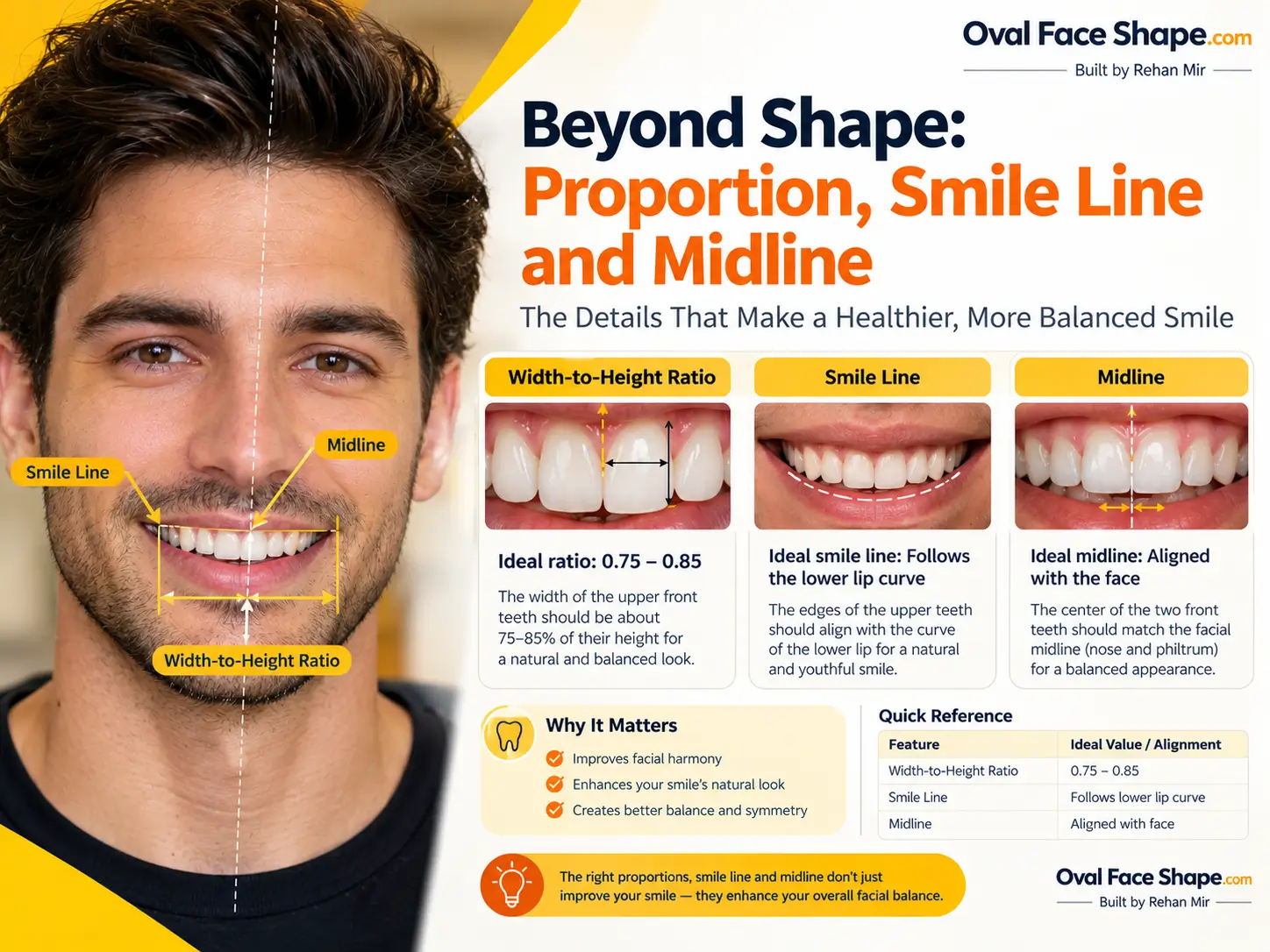
- Width-to-height: central incisor width is usually about 75-80% of height. In a Pakistani sample (230 and 286 participants across two phases), the proposed lateral-to-central ratio was 77%. uclusm
- Golden proportion: only 17% of natural casts fit it in one study, so strict ratios are not a reliable target. ucl
- Smile line: in a UAE study, 25 prosthodontic raters rated symmetry and an upper lip just covering the gum margins as most pleasing.
- Midline: a 1-2 mm deviation from the facial midline generally cannot be detected by eye. nih
How to Use This in a Consultation?
- Name the shape family: tapered-ovoid, ovoid, ovoid-square, square or triangular.
- Bring photos of smiles you like. Patient preference is the most important opinion.
- Ask for a mock-up on your own lips and gum line before committing. ucl
- Expect your dentist to be pickier than you: in the UCL study, 80% of dentists spotted the shape changes versus 33% of patients. ucl
Key Takeaways
- Tapered-ovoid and ovoid are the best-supported shapes for an oval face; gently squared is the bolder option.
- Square ranked least attractive in the UCL study; flat edges can read as worn.
- Matching teeth to face shape is a convention, and studies disagree.
- Masculine and feminine tooth shapes are design choices, not natural differences.
- Confirm your face shape first, then judge options with a mock-up.
Not sure your face is truly oval? Run the Face Shape Detector before you bring photos to your dentist.
FAQs
What is the most attractive tooth shape?
No shape wins universally. Tapered-ovoid and ovoid ranked highest in the best-known ranking study, which used a female smile; patients leaned ovoid and dentists leaned tapered-ovoid. Culture and personal taste still decide.
Is an oval face rare?
No reliable prevalence figure exists for the seven-shape system, because results depend on how faces are classified. One study of 2,000 young adults using Williams’ older three-form system labeled 83.3% as oval, but that is not comparable.
Discover the rarest face shape and rarest eye shape with our in-depth guides. Explore the facts, uncover what makes these features uncommon, and learn what research reveals about their rarity.
What is the Gen Z teeth trend?
Reports conflict. A Forbes Health and OnePoll survey of 2,000 U.S. respondents found 72% of Gen Z compare their teeth with others on social media. Some dentists report Millennial and Gen Z patients requesting more natural-looking, thin translucent veneers, while another cosmetic dentist reports younger patients going for bright, uniform smiles. This rests on dentist accounts and one survey, not population data.
What is the prettiest face shape for a girl?
There is no objectively prettiest face shape. Oval is often called the balanced reference shape because no feature dominates, but attractiveness also depends on symmetry, expression and personal taste.
What is the best teeth shape for a round face?
Clinic guides usually suggest slightly longer, straighter-edged teeth to add vertical definition. That is a design convention, not a tested rule.
Can an AI tool tell me my ideal tooth shape?
No. A face-shape tool can confirm your face shape category, but tooth shape depends on your lips, gum line and bite, which only a dentist can assess in person.
Can I change tooth shape without veneers?
Often yes. Dentists can reshape enamel, add bonding or place crowns, depending on your teeth. An exam decides which option fits.