
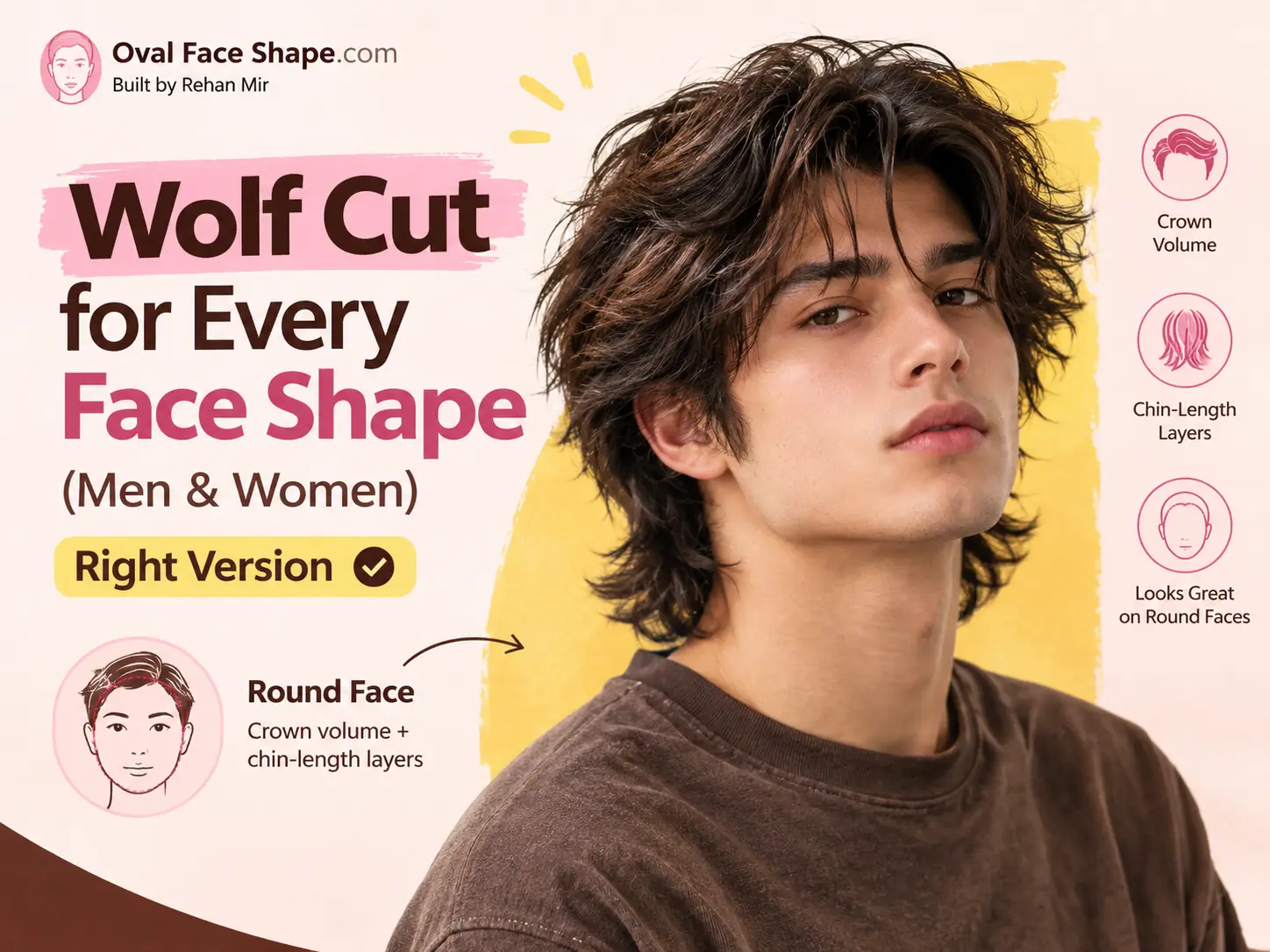
Quick Answer:
A wolf cut works on every face shape when the layers are adjusted: crown height for round, soft jaw layers for square, a shorter cut for oblong, nearly any version for oval.
A wolf cut is a layered haircut that pairs the short, choppy crown of a shag with the longer, tapered back of a mullet. This guide matches it to seven face shapes (oval, round, square, oblong, heart, diamond, and triangle), for men first, with adjustments for women.
A wolf cut works for every face shape because it has three adjustable levers: crown height, the length where face-framing layers start, and the fringe. Oval faces suit nearly any version. Round faces need height with trimmed sides, square faces need soft pieces at the jaw, and oblong faces need a shorter cut with side fullness.
By Muhammad Rehan Iqbal, Founder and Developer of OvalFaceShape.com, specializing in face shape analysis, interactive facial assessment tools, and educational styling guides.
Who This Guide Is For:
Men choosing a wolf cut before a barber visit are the main audience. Women and anyone still confirming their shape will find adjustments below. It covers what to ask for, not how to cut it. To confirm your shape first, use OvalFaceShape.com’s Face Shape Detector.
Which Face Shape Suits a Wolf Cut?
Celebrity hairstylist Cheryl Bergamy told Fox News that almost anyone can wear the cut. She named round, oval and heart faces as the easiest fits and said other shapes need customizing.
Advice on round faces conflicts online, and the difference comes down to where the fullness lands. No peer-reviewed study tests wolf cuts against face shape. The table below is stylist consensus plus proportion logic.
| Face shape | Men: best adjustment | Women: best adjustment | Avoid |
|---|---|---|---|
| Oval | Any length; textured crown; curtain fringe optional | Any version; curtain bangs optional | Bulk that hides balanced proportions |
| Round | Crown height, tapered sides, layers ending at or below the jaw | Crown volume, side-swept bangs, layers from the chin down | Fullness at cheek level |
| Square | Wispy pieces at the jaw, textured fringe | Wispy jaw layers, curtain bangs | Blunt ends at jaw length |
| Oblong/rectangle | Shorter cut, fullness at the sides, longer fringe | Curtain bangs, side volume | Extra crown height, long flat layers |
| Heart | Medium length, weight in the lower layers, light fringe | Layers starting at the chin | Heavy crown volume |
| Diamond | Soft fringe; sides tucked behind or framing the cheekbones | Soft layers at forehead and chin | Volume at the cheekline |
| Triangle (pear) | Crown and temple volume, tapered sides at jaw level | Lighter jaw layers, crown lift | Weight at jaw level |
Wolf Cut for Men With an Oval Face
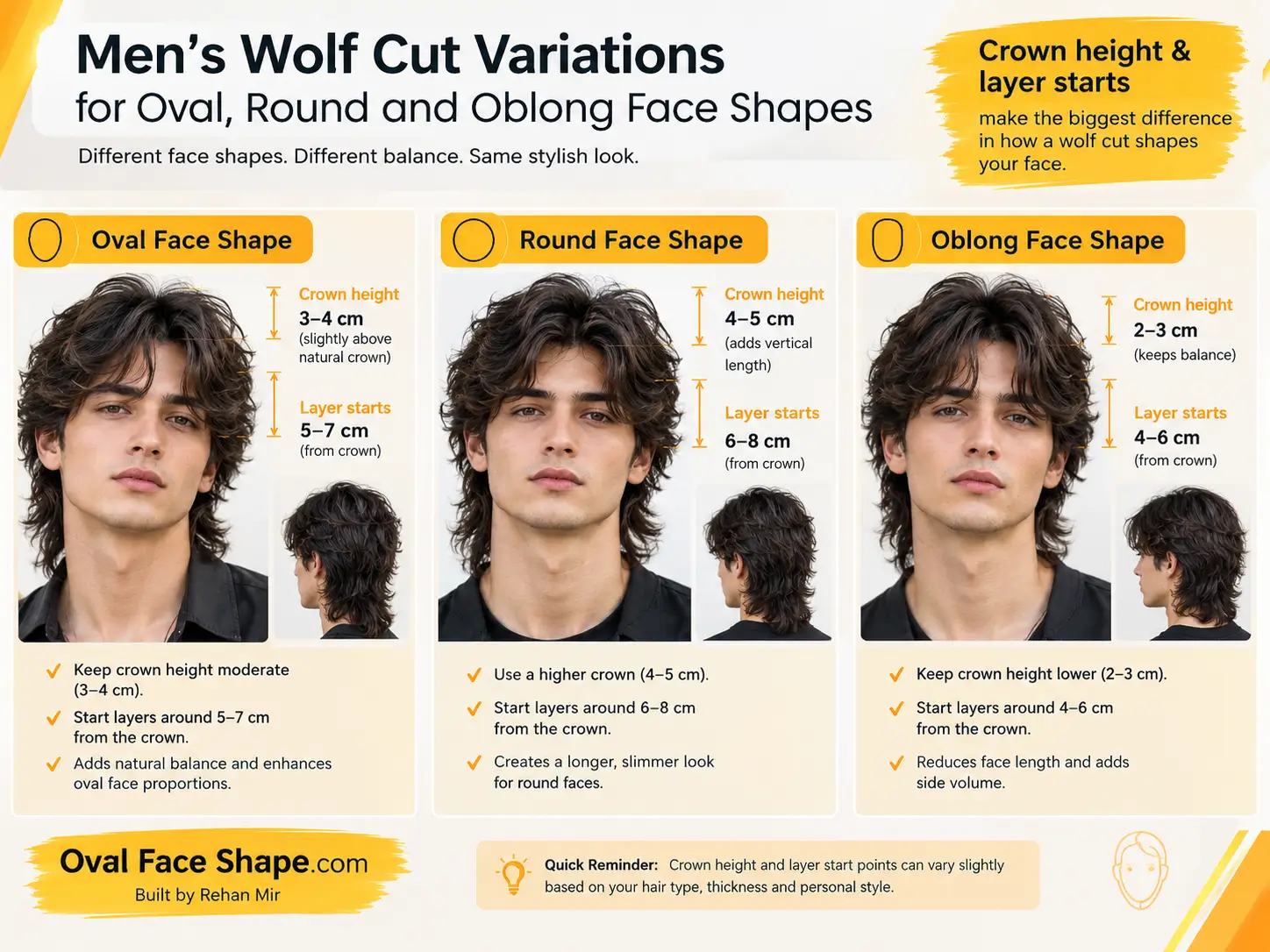
An oval face suits almost every men’s wolf cut, so choose by hair type and upkeep rather than correction. In OvalFaceShape.com’s working standard, oval means a length-to-cheekbone-width ratio of roughly 1.3 to 1.5, measured on the landmarks described in Farkas’s Anthropometry of the Head and Face.
A short wolf cut on an oval face can carry a very textured crown without looking harsh. Keep the back long enough to read as a wolf cut instead of a short crop.
For other men’s haircuts for an oval face, see the oval face hairstyles for men guide.
Wolf Cut for Men With a Round Face
A wolf cut works on a round face when the volume sits above the cheeks, not at them. Four adjustments do most of the work:
- Build height at the crown so the silhouette reads taller.
- Taper the sides instead of leaving width at the cheeks.
- Start face-framing layers at or below the chin.
- Choose a side-swept curtain fringe over a full, blunt one.
The same logic applies to a chubby face. A short version works if the crown stays full and the nape is tapered, and a long version adds a downward line.
See the round face shape guide to confirm your shape.
Wolf Cut for Square, Oblong, Heart, Diamond and Triangle Faces
- Square: wispy, moving pieces at the jaw soften the line; blunt ends at jaw length repeat it.
- Oblong: a shorter cut with side fullness avoids adding length. Compare yours in oval vs oblong face shape.
- Heart: weight in the lower layers balances a narrower chin, while heavy crown volume widens the forehead further.
- Diamond: keep volume away from the cheekline; a soft fringe and sides that frame the cheekbones work better.
- Triangle: crown and temple volume balances a wider jaw, so avoid weight at jaw level.
Short vs Long Wolf Cut for Men
A short wolf cut suits oblong faces and strong jaws, provided the sides keep some softness. It is also the easiest first version because the layers are forgiving.
A long wolf cut (also searched as “wolf cut men long”) draws the eye downward. That helps round, square and heart faces but adds length to an oblong face, so go shorter there.
Wolf Cut for Women by Face Shape
The face-shape logic is identical; The styling differs. Women usually add curtain bangs and softer face-framing layers. Men more often keep a textured crown with a longer back and use a taper to add height for round faces or keep width for oblong ones.
Hair Texture, Density and Upkeep
Face shape is only half the decision. Wavy and thick hair lets the layers hold shape. Fine, straight hair needs fewer, longer layers or the ends look sparse. Tight curls need the dry silhouette discussed before any cutting.
A 2026 paper in the Journal of Cosmetic Dermatology (Callender et al.) proposes a framework for classifying hair texture. Layers lose shape as they grow, so plan regular trims.
How to Know if a Wolf Cut Suits You?
- Measure your ratio. Divide hairline-to-chin length by cheekbone width. Up to about 1.5 reads oval, higher reads oblong, and close to 1.0 to 1.15 with a soft jaw reads round. These are styling thresholds, not a diagnosis. The Face Shape Detector uses the same length-to-width logic, so its result maps straight onto the table above.
- Check your texture against the section above.
- Bring a barber brief, plus front, side and back reference photos:
- Oval: “Textured crown, back past my ears, show me a curtain fringe option.”
- Round: “Height at the crown, tapered sides, front pieces ending at or below my chin line.”
- Oblong: “Keep it shorter, leave weight at the sides, fringe long enough to sit across my forehead.”
- Be honest about styling time. Daily effort matters as much as shape.
Key Takeaways
- A wolf cut for every face shape works through crown height, face-framing length and fringe.
- Oval: nearly any version. Round: crown height, tapered sides, layers at or below the chin.
- Oblong: shorter cut, side fullness. Square: soft jaw pieces.
- Men and women follow the same logic with different styling.
- Texture and upkeep matter as much as shape.
FAQs
Who should not get a wolf cut?
People who dislike daily styling, or who have very fine, straight hair that shows little shape. Face shape rarely rules it out; layer placement does.
Is the wolf cut still worth getting?
Trends cycle, but the shag-mullet structure is long established. Choose it for fit and upkeep, not popularity.
What is the difference between a wolf cut, a mullet and a shag (and a werewolf haircut)?
A shag is layered throughout and a mullet is short at the front and sides with a long back. The wolf cut blends both with less contrast than a mullet. “Werewolf haircut” is usually just another name for it.
Can men with short hair get a wolf cut?
Often yes, as a short version. You need some crown length and enough at the back to show contrast, otherwise plan a grow-out with your barber.
How often should I trim a wolf cut?
Every 6 to 8 weeks is commonly advised, but growth rate and length vary. Ask your barber for a schedule.
Is an oval face rare?
There is no reliable prevalence figure, because results depend on the classification method and thresholds used. Treat shape labels as styling guides.
Does a wolf cut make a round face look slimmer?
It changes perceived proportion, not the face. Crown height and tapered sides make the silhouette read taller; fullness at the cheeks does the opposite.
Next step:
Not sure of your shape? Run the Face Shape Detector and bring the result to your barber.