
Quick Answer:
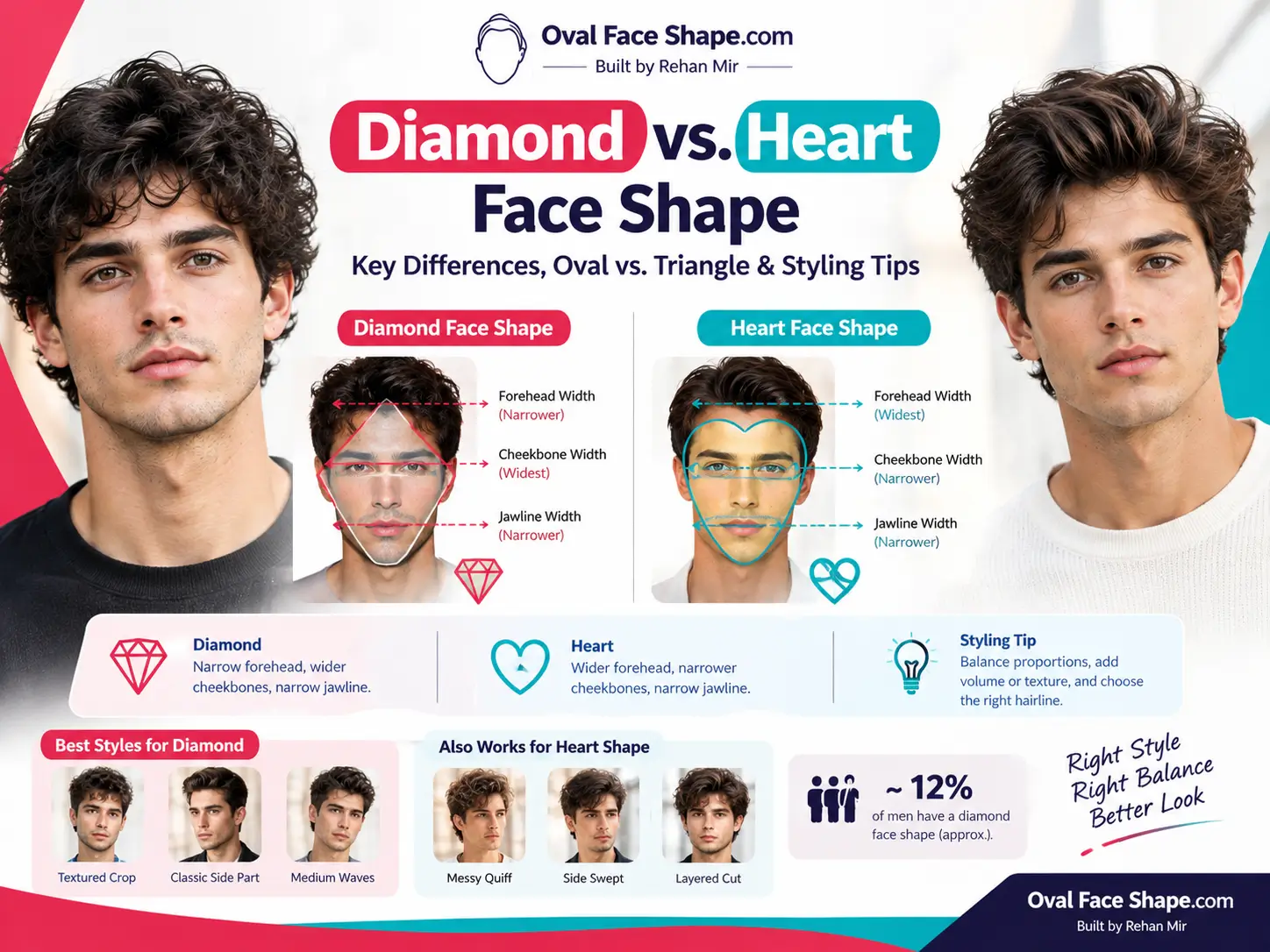
Heart faces are widest at the forehead; diamond faces are widest at the cheekbones with a narrow forehead. Both taper to a chin, so compare forehead width to cheekbone width.
By Muhammad Rehan Iqbal, Founder and Developer of OvalFaceShape.com, specializing in face shape analysis, interactive facial assessment tools, and educational styling guides.
A heart face is widest across the forehead and narrows to a pointed chin. A diamond face is widest at the cheekbones, with a narrower forehead and chin. Because both shapes taper downward, the fastest way to separate them is to compare forehead width with cheekbone width.
Who this guide is for:
This guide is for anyone whose quiz, detector or mirror check landed between the two shapes. It helps you decide which one to follow before choosing a hairstyle or glasses. OvalFaceShape.com’s heart face shape guide and diamond face shape guide cover each shape in full, so this page stays on the comparison.
Diamond vs Heart Face Shape at a Glance
| Feature | Heart | Diamond |
|---|---|---|
| Widest point | Forehead | Cheekbones |
| Forehead | Broad, sometimes a widow’s peak | Narrow |
| Cheekbones | Prominent, but narrower than the forehead | The widest, most prominent area |
| Chin | Narrow, pointed | Narrow, pointed |
| Styling goal | Balance a wide upper face | Add width at forehead and jaw |
A heart face is typically widest across the forehead or upper cheekbone area, then narrows toward a smaller, more pointed chin. A diamond face has wider cheekbones with a narrow forehead and chin.
What Actually Separates a Heart From a Diamond?
The deciding measurement is forehead width compared with cheekbone width. One hat guide puts the main difference at the hairline, which is narrower on a diamond face. A wig guide makes the same point: A diamond forehead is not as wide as a heart forehead.
If your forehead is as wide as or wider than your cheekbones, you lean heart. If your cheekbones are clearly the widest line, you lean diamond.
How to Test Diamond vs Heart at Home?
- Pull your hair back and photograph your face straight on, at eye level.
- Mark three widths: across the forehead, across the cheekbones, and at the jaw corners.
- Compare the forehead and cheekbone widths. The wider one decides your shape.
- Check the chin. Both shapes taper, so it is a tiebreaker only.
One style guide gives a similar rule:
If you fit the heart description but your cheekbones are the standout feature, you are likely a diamond. A mirror gives a decent impression, but measuring is described as the most reliable approach.
The Face Shape Detector runs that comparison from a photo.
Diamond vs Heart Face Shape for Men and Women
The classification is the same for everyone. What changes is how hair and facial hair alter the visible outline.
For women:
The main variable is hair. Wig guidance for heart faces points to chin-length or shorter cuts, side-swept fringe and inward-facing layers. For diamond faces, the same type of guidance asks for fullness at the forehead hairline and near the chin.
For men:
Short hair exposes the forehead, so the forehead-to-cheekbone comparison is easier to read. A beard adds width at the jaw, which changes how balanced the lower face looks. This is styling logic rather than measured research, so test it on your own photo.
Diamond vs Oval vs Triangle: Where the Neighbors Fit?
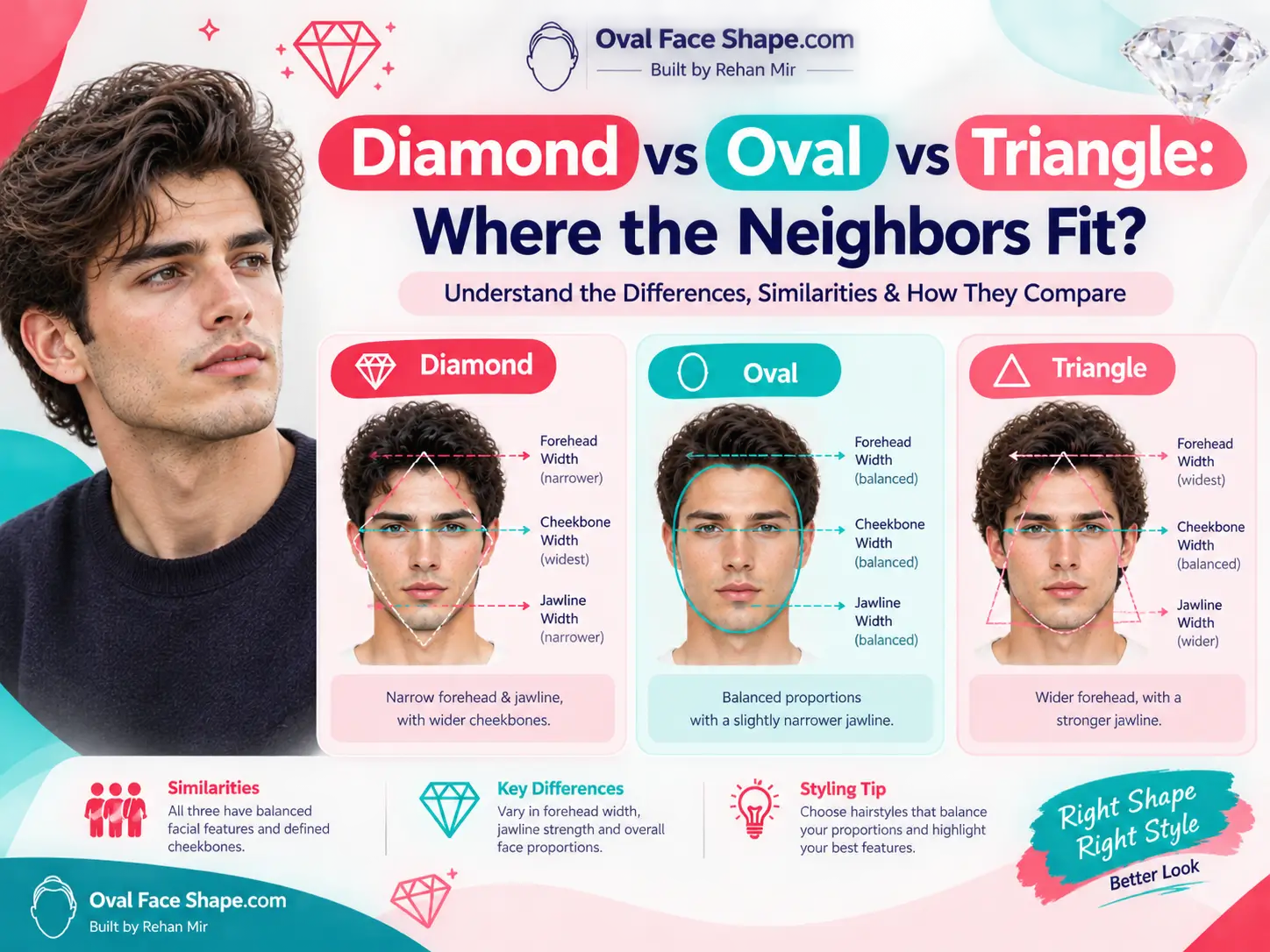
- Oval: usually about one and a half times as long as it is wide. The widths change gradually, with no sharp point.
- Heart: wide forehead, narrow chin.
- Diamond: wide cheekbones, narrow at both ends.
- Triangle (pear): the reverse of a heart, widest at the jaw.
The names also overlap. Experts quoted by Allure note that the same face can be called diamond by one person and oblong by another. Compare widths rather than trusting a label.
Explore the key differences in our guides to oval vs. heart face shapes, oval vs. oblong face shapes, and oval vs. round face shapes to understand their defining features and learn how to distinguish them accurately.
Why Quizzes, Tools and Online Threads Disagree?
Face-shape categories are style references, not fixed rules. Borderline faces sit between two categories, and tools handle that differently. One detector-focused article notes that the same celebrity can come out as diamond in landmark-based tools but heart in others, and that 68-point and 468-point models see angles differently.
Use our Face Shape Quiz, Face Shape Detector, and Face Shape Calculator to identify your face shape, verify your results, and uncover the facts behind conflicting claims in online discussions.
Camera distance, angle and hairstyle change apparent width. Age matters too: gravity usually shifts facial volume downward over time, moving a face toward a more triangular look. If you compare opinions on a forum, make sure everyone is judging a straight-on, hair-back photo. aol
Does Face Shape Decide Attractiveness?
Popular lists often crown the heart shape. I could not find peer-reviewed research testing heart against diamond. The research I found measures other traits.
- A multi-population study found that femininity affected men’s ratings of women’s faces, and that symmetry had no effect.
- A five-country study found that averageness and sexual dimorphism did not universally predict attractiveness. nih
Neither shape wins on the evidence available.
Styling Differences That Follow From the Shapes
- Hair: a heart face usually benefits from volume near the jaw, and a diamond face from fullness at forehead and chin. One hair brand argues long hair suits diamond faces well. See hairstyles by face shape for full options.
- Glasses: one eyewear brand’s quiz suggests cat-eye or oval frames for diamond faces and square frames for heart faces. Treat that as a starting point, and see glasses by face shape.
- Neighbor comparison: oval face shape is the usual fallback when neither heart nor diamond fits.
These are guidelines. If a style flatters you, it works regardless of the label.
Key Takeaways
- Heart is widest at the forehead; diamond is widest at the cheekbones.
- Forehead width vs cheekbone width is the deciding comparison.
- Tools disagree on borderline faces, so measure from a straight-on, hair-back photo.
- Face shape is a styling aid. The studies I found don’t rank heart against diamond for attractiveness.
FAQs
Am I diamond or heart shaped face?
You are heart-shaped if your forehead is the widest part of your face, and diamond-shaped if your cheekbones are. Measure both from a straight-on photo with your hair pulled back, and let the wider one decide.
What is the luckiest face shape?
No face shape is measurably luckier. Claims about lucky shapes come from traditional face reading, and I found no research linking a face-shape category to luck.
What is considered the prettiest face shape?
There is no single answer. Online lists often favor heart or oval, but the research I found points to traits like femininity and distinctiveness rather than a named shape, and it varies across populations.
Can my face shape change over time?
Apparent shape can shift. Aging moves volume downward, and hair, weight and photo angle all change how your widths read, so recheck every few years.
Is face shape still worth using for style choices?
Yes, as a starting point. The categories are style references rather than rules, so use them to narrow options and then judge by how a cut or frame looks on you.
Why do different tools call my face different shapes?
Borderline faces sit between categories, and tools measure landmarks differently. Pick the result that matches your forehead-vs-cheekbone comparison, or check two tools.
Next step:
Not sure which side of the line you fall on? Run the Face Shape Detector and compare the result with your own measurements.