
Quick Answer:
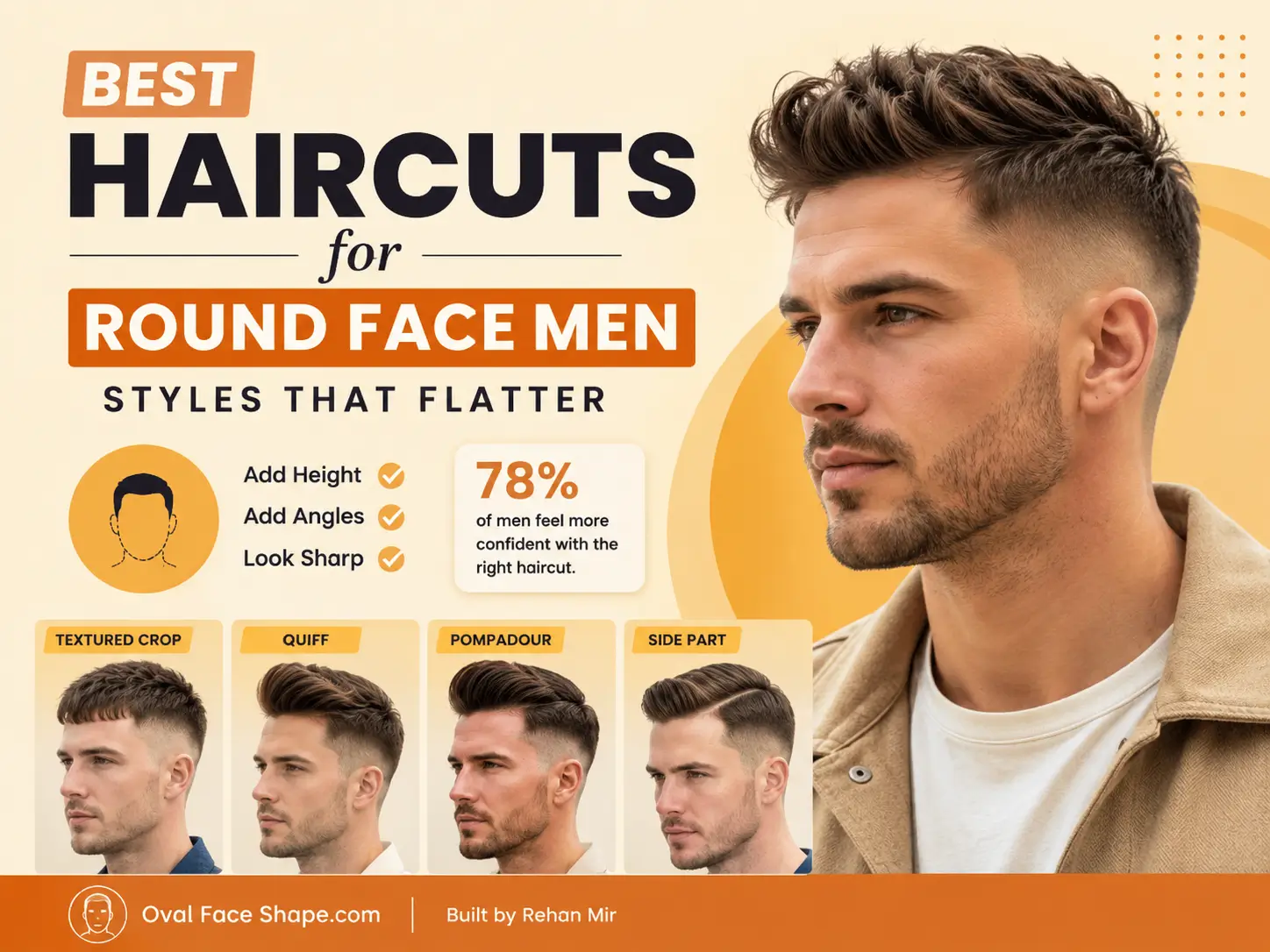
The best haircuts for round faces keep the sides tight and add height or texture on top to create a more elongated look. Top choices include quiffs, textured crops, pompadours, and taper fades.
This guide is for men who already suspect — or have confirmed with the Face Shape Detector — that they have a round face shape and now need one specific, barber-ready answer, not a 30-item scroll.
If you haven’t checked your shape yet, the Round Face Shape guide covers identification in full;
This page is only about the haircuts.
Round Face Shape: Proportions and Key Features
A round face shape means facial length and width are close to equal, with a soft jawline and fuller cheeks rather than sharp angles. That equal-proportion measurement is the same logic behind the facial width-to-height ratio (FWHR) used in facial-proportion research.
A measure that researchers at Bangor University confirmed shows high agreement whether taken from 2D photographs, 3D scans, or physical anthropometry.
You don’t need calipers to use the idea: the goal of every cut below is to visually stretch that ratio by adding vertical length and removing bulk at the sides. nih
The Two Rules That Actually Matter
Every effective round-face cut follows two mechanics, not a vibe:
- Add height at the crown. Volume directly above the head — not the sides — draws the eye upward and lengthens the apparent face.
- Remove width at the sides. Anything that bulks out at ear level (afros without taper, blunt bowl cuts, heavy medium-length sides) widens the face and fights the first rule.
Best Hair Cuts by Hair Type
Straight hair:
The textured crop is the strongest default. Short, choppy layers on top with a taper or skin-fade on the sides break up symmetry without adding width. Ask your barber for “a textured crop, low taper, disconnected fringe.”
Wavy hair:
A quiff uses the natural bend to hold height without heavy product. Direct the fringe up and slightly back; keep the sides tapered, not faded to the skin, so the transition doesn’t look abrupt against wave texture.
Curly or coily hair:
Curls already carry natural volume upward, which works in your favor — a high-top fade or curly fringe lets the curl pattern do the height work for you. Avoid growing curls outward at the sides; that adds the width you’re trying to remove.
Thick, straight hair:
The pompadour needs enough density to hold its shape without flattening by midday — thick hair is close to ideal for it. Comb straight up and back off a side or middle part.
Fine or thin hair:
Skip anything that depends on volume alone. A French crop with a textured fringe and a low taper gives structural height through the cut itself, not through product-dependent lift that fine hair can’t sustain past a few hours.
Round Face Shape Hairstyles Comparison
| Cut | Best hair type | Mechanic | Ask your barber for |
|---|---|---|---|
| Textured crop | Straight | Vertical texture, tight sides | Low taper, disconnected fringe |
| Quiff | Wavy | Height at crown | Tapered sides, forward-swept fringe |
| High-top fade | Curly/coily | Natural curl height | High fade, curl left long on top |
| Pompadour | Thick, straight | Combed vertical lift | Side part, strong-hold product |
| French crop | Fine/thin | Structural height from the cut, not volume | Low taper, blunt-textured fringe |
What to Avoid!
Blunt bowl cuts, heavy medium-length sides with no taper, and high skin fades paired with a flat top all add width or remove the vertical contrast the face needs. A full, wide beard with no taper at the jaw has the same effect below the jawline.
See the Beard Styles by Face Shape guide for round-specific shaping.
Round vs. Square vs. Oval: A Quick Self-Check
Round is frequently confused with square (similar width, but square has an angular jaw and defined corners) and oval (oval is longer than it is wide, with a gently tapering jaw).
If your jaw is soft and rounded and your face length and width look close to equal in a mirror check, round is the likely match — run it through the Face Shape Detector to confirm before committing to a cut.
Key Takeaways
- Round face shapes have close-to-equal length and width with a soft jawline; the goal of every cut is added height and reduced side width.
- Textured crop, quiff, pompadour, high-top fade, and French crop each solve this differently depending on hair type.
- Avoid bowl cuts, wide untapered sides, and high skin fades paired with flat tops.
- Confirm round vs. square vs. oval with the Face Shape Detector before booking a cut.
FAQs
Is a round face shape attractive on men?
Yes — round faces read as youthful and approachable, and the right haircut simply gives you the option of a sharper or softer look depending on the style you want, not a correction of a flaw.
Does losing weight change a round face shape?
Weight loss can reduce cheek fullness and make jaw angles more visible, but it doesn’t change the underlying bone-based proportions of length to width — a round face typically stays structurally round even at a lower body weight.
What haircut should I avoid most with a round face?
A blunt bowl cut with no taper is the single worst match — it adds width at the exact point (ear level) that a round face needs reduced, with no offsetting height on top.
Is a high fade good for round faces?
A high fade paired with a flat top removes too much side volume without adding compensating height, which can make cheeks look fuller by contrast. A low taper fade with height on top works better.
Which beard style suits a round face best?
A beard kept shorter and tighter at the cheeks with slightly more length and a defined edge at the chin adds a visual point at the jaw, which a fully round, untapered beard doesn’t provide.
How do I know if I actually have a round face vs. a square face?
Check your jawline: round faces have a soft, curved jaw, while square faces have a visibly angular jaw with defined corners at close to the same width as the cheekbones. The Face Shape Detector confirms this from a photo in seconds.
Can curly hair work on a round face, or should I keep it short?
Curly hair works well on a round face at almost any length as long as the volume builds upward at the crown rather than outward at the sides — a high-top fade is the most reliable way to control that direction.