
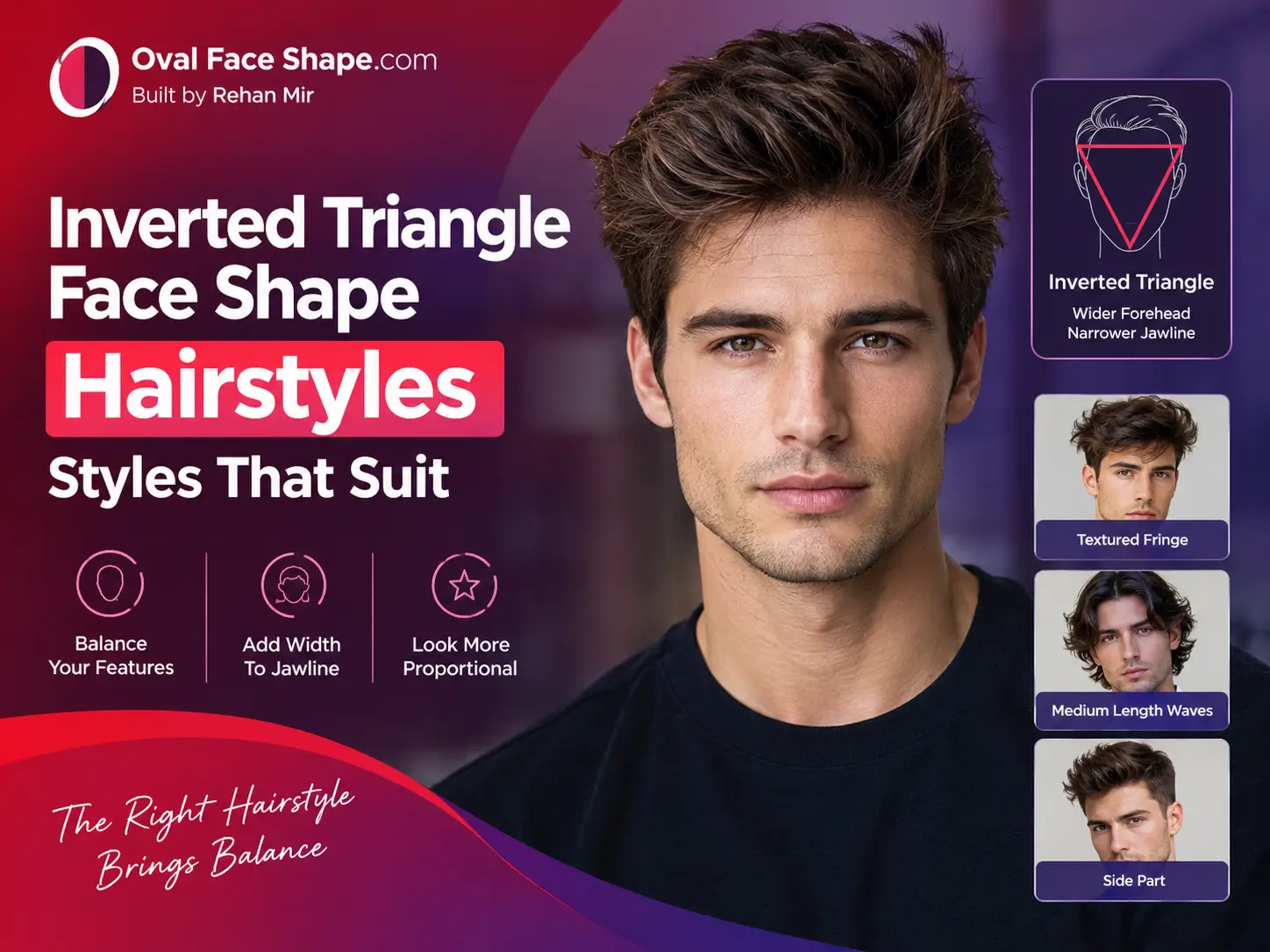
Quick Answer:
The best hairstyles for an inverted triangle face shape balance a wide forehead and narrow chin by adding width around the jawline. Good options include chin-length bobs, curtain bangs, and low-volume crowns.
If you have an inverted triangle face shape, your forehead and temples measure wider than your jaw, and the goal of every haircut recommendation below is the same: Soften that width up top and build visual weight down at the jawline.
Who this guide is for:
This guide walks through the best hairstyles for women and men with this shape, on OvalFaceShape.com, plus which cuts work against it.
This article is written for someone who has already identified — or strongly suspects — an inverted triangle face shape and is now choosing a specific cut before a salon visit.
If you haven’t confirmed your shape yet, OvalFaceShape.com’s free Face Shape Detector checks it from a photo in seconds, or you can use the quick hairline test below.
Inverted Triangle vs. Heart Face: A 10-Second Check
Inverted triangle and heart face shapes get confused constantly, because both have a wide top and narrow bottom.
The one reliable difference is the hairline:
A heart face has a widow’s peak (a visible point at the center of the hairline), while an inverted triangle has a straighter or rounder hairline across the same wide-forehead, narrow-chin proportions.
If your hairline points, the styling advice on OvalFaceShape.com’s Heart face shape guide fits you better; if it doesn’t, keep reading.
“Want to understand the key features of an Inverted Triangle Face Shape? Explore our complete guide for expert insights, identification tips, and styling advice.”
Why These Haircuts Work: The Styling Goal?
An inverted triangle face shape narrows from a wide forehead down to a narrow chin. Because the forehead is the widest point, wide-set at the bizygomatic arch, the styling goal is to visually widen the jaw and quiet the forehead — the opposite of what a triangle (jaw-widest) face shape needs.
This width difference isn’t just a visual impression:
Bizygomatic width, the maximum transverse facial measurement used in craniofacial anthropometry, is one of the most consistently sexually dimorphic facial measurements even after adjusting for overall face size, which helps explain why forehead-dominant proportions like this one show up more often in male faces. nih
Best Hairstyles for Women
- Chin-length bob: blunt ends land right at the jaw, adding width exactly where an inverted triangle face needs it.
- Curtain bangs or a deep side-swept fringe: breaks up forehead width without a hard, attention-drawing line across it.
- Lob (long bob) with outward-flipped ends: keeps volume low, near the chin and shoulders, instead of at the crown.
- Deep side part: shifts visual weight off-center, softening a symmetrical wide-forehead silhouette.
- Soft layers starting below the cheekbone: adds fullness at jaw level while keeping the crown flat.
Avoid a slicked-back style, a high ponytail, or heavy crown volume — all three pull attention straight to the forehead, the widest part of the face.
Best Hairstyles for Men
- Textured crop with a low, soft fringe: keeps height off the crown while the fringe softens the forehead line.
- Short-to-medium sides with slight length at the jaw: classic crew or taper cuts work, but avoid a high-and-tight buzz that exposes the full forehead width.
- Beard paired with a low-volume cut: a short beard adds jaw-level fullness — OvalFaceShape.com’s beard styles guide covers shapes that pair well with this face shape specifically.
- Side part over a center part: breaks the forehead’s horizontal line the same way it does for women’s styles.
Avoid tall pompadours, spiked styles, or any cut that adds height directly above the forehead.
Hair Length Comparison
| Length | Works well | Use caution with |
|---|---|---|
| Short (chin or above) | Textured crops, soft fringes, jaw-grazing bobs | Buzz cuts, slicked-back pixies with no fringe |
| Medium (chin to shoulder) | Lobs, layered bobs with flipped ends, curtain bangs | Center-parted styles with no jaw volume |
| Long (past shoulder) | Loose waves starting mid-length, layers that add fullness at the ends | Straight, flat-ironed hair with no movement below the jaw |
Key Takeaways
- An inverted triangle face shape is widest at the forehead and narrows to a slim chin — the opposite of a triangle (pear) face shape.
- The styling goal is always the same: soften forehead width, add fullness at the jaw.
- A straight or rounded hairline (no widow’s peak) is the quickest way to tell this shape apart from a heart face.
- Chin-length bobs and curtain bangs work for most hair types; slicked-back and crown-volume styles work against this shape.
- Confirm your shape first with the Face Shape Detector before committing to a cut.
FAQs
Which haircut is best for an inverted triangle face shape?
A chin-length bob or lob with outward-flipped ends is generally the strongest choice, because the blunt weight lands right at the jaw — the exact spot that needs visual width. Curtain bangs are a close second, since they soften the forehead without adding height.
Is an inverted triangle face attractive?
Yes — an inverted triangle face shape is often associated with strong, angular, athletic-looking features, and it’s a recognized, well-proportioned face shape rather than an imbalance to correct.
Attractiveness isn’t tied to any single face shape; the styling advice here is about balance and personal preference, not “fixing” anything.
Is a triangle face rare?
The classic triangle (jaw-widest) face shape is one of the less common categories in most face-shape breakdowns, and its mirror image, the inverted triangle, is also less frequently seen than shapes like oval or round.
Exact population percentages vary widely between sources and small surveys, so treat any specific number you see online with some caution.
Which is the cutest face shape?
There’s no single “best” or “cutest” face shape — beauty standards vary by culture, era, and personal taste, and every shape, including inverted triangle, has hairstyles, glasses, and beard or makeup choices that work well with it.
The more useful question is which cut balances your specific proportions, which is what this guide focuses on.