
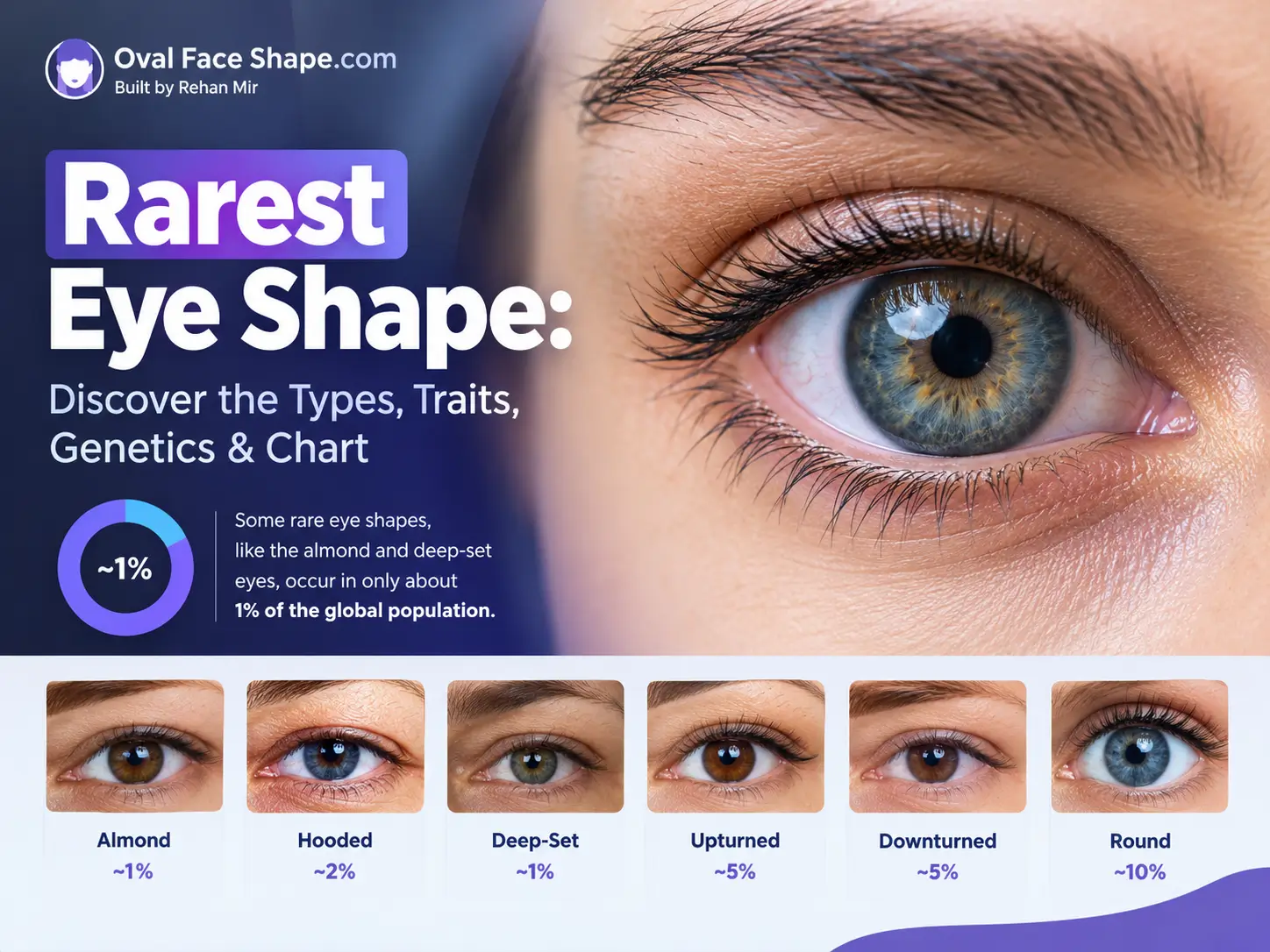
Quick Answer:
There’s no single rarest eye shape worldwide — it’s population-relative: true monolids are rare in Europe but common in East Asia, and pronounced upturned eyes are rare elsewhere.
What Is the Rarest Eye Shape, Really?
There isn’t one universal answer, and any page that gives you a single confident “it’s this one” is skipping a step. Eye shape — the visible pattern created by eyelid crease, eye opening, and outer-corner angle — varies by population in well-documented ways, so a shape that’s unusual in one part of the world is ordinary in another.
The honest answer is that rarity depends on where you’re measuring from.
That’s a genuinely different question from “which eye shape looks the most unique,” which is a matter of taste, not statistics.
OvalFaceShape.com already covers the equivalent question for facial structure on its Rarest Face Shape page.
This guide does the same job for eyes, for anyone comparing their own features after reading that one, or arriving here directly.
The Main Eye Shape Types
Most beauty and vision-health sources sort eyes into six to ten categories, built from three things: eyelid crease (or lack of one), the angle of the outer corner, and how much iris shows.
- Monolid — no visible upper-eyelid crease; the lid appears flat.
- Hooded — a fold of skin partly covers the crease.
- Almond — a visible crease with the iris touching both the top and bottom lid.
- Round — more white space (sclera) visible above and below the iris.
- Upturned — outer corner sits higher than the inner corner.
- Downturned — outer corner sits level with or below the inner corner.
- Protruding / deep-set — the eyeball sits further forward or further back in the socket.
- Close-set / wide-set — the gap between the eyes is narrower or wider than one eye’s width.
Eye Shape Comparison Chart
| Eye shape | Defining trait | Where it’s most common | How the sources describe its rarity |
|---|---|---|---|
| Almond | Crease visible, iris touches top and bottom lid | Frequently cited as the most common global type | Common, not rare |
| Monolid | No visible crease | East and Southeast Asia | Common there, unusual in Europe |
| Hooded | Skin fold partly covers crease | Increases with age, in any population | Common, not population-specific |
| Round | More white space visible | Frequently noted in South Asian populations | Common there |
| Upturned / downturned | Outer-corner angle | Varies by individual, not strongly population-linked | Less frequently highlighted |
| Protruding / deep-set | Eyeball depth in socket | Varies individually; true protrusion can also be medical | Genuinely uncommon in its pronounced form |
Which Eye-Shape Traits Are Actually the Rarest?
Ranked “top 10 rarest eye shapes” lists are common in search results — but no rigorous population survey has ever ranked ten eye shapes by exact frequency, so a precise ranking isn’t something this article can responsibly manufacture. What genuinely holds up across the sources that do exist:
- A true monolid outside East and Southeast Asia is uncommon. Epicanthic folds — the eyelid trait behind the monolid look — occur in roughly half of people of Asian descent, but at markedly lower frequency in European populations, per Cleveland Clinic’s clinical overview of the trait. Cleveland Clinic
- Pronounced, symmetrical protruding eyes with no medical cause are genuinely uncommon. Mild eyeball protrusion is a normal structural variation, but the more visible form is often linked to thyroid-related conditions such as Graves’ disease rather than being a purely cosmetic trait — worth a professional opinion rather than a styling one if it appears suddenly.
- A strong, symmetrical upturn or hooding at a young age (before age-related lid changes typically appear) is less frequently discussed in the styling literature than almond, monolid, or round eyes, though no source quantifies exactly how rare it is.
That’s a more honest answer than a fabricated top-10, and it’s consistent with why every source that attempts a precise percentage for “rarest eye shape” hedges its own numbers.
The Real Genetics Behind Eye-Shape Rarity
The clearest documented case is the epicanthic fold behind the monolid look. It’s caused by a thickened band of the orbicularis oculi muscle around the eye, and its frequency by ancestry is well mapped in the anthropological and surgical literature:
Near-universal in parts of East Asia (research on Asian eyelid anatomy has estimated it in as many as 9 in 10 adults in some Japanese and Korean samples), common across Central Asia, Polynesia, the Americas’ Indigenous peoples, and among some African groups including Khoisan and Nilotic populations, and present at lower frequency among Europeans, per the anatomical literature summarized in reference works on the trait.
A 2015 review of Asian eyelid anatomy in Seminars in Plastic Surgery covers the same anatomical basis in surgical detail. None of this is tied to a single “eye shape gene” the way eye color is tied to melanin — it’s muscle and fat-pad structure, which is why the fold can appear or fade slightly with age in anyone. Wikipedia
Does the Rarest Eye Shape Differ for Men and Women?
Not in kind — the same eight shapes above apply regardless of gender. What differs is which shape gets called “ideal” versus “rare” in gendered search behavior:
Content aimed at women tends to frame almond eyes as the flattering standard (making genuinely uncommon shapes like true monolid-outside-Asia or pronounced protrusion stand out more in that context), while content aimed at men rarely addresses eye shape at all, which is itself why “rarest eye shape male” returns thinner results than the female-framed query. The underlying biology doesn’t change; the framing around it does.
Eye Shape Rarity in India
This is a genuinely useful regional distinction rather than a rehash of the global answer. Epicanthic folds — the trait behind monolid and rounder-lidded eyes — occur at notably higher frequency among some Northeast Indian and Himalayan-border populations, including groups in Nepal, Bhutan, and Kashmir, than in most of the rest of South Asia, per the population data summarized in anthropological references on the trait.
So within India specifically, “rare” eye shapes in one region can be the regional norm in another — the same population-relative principle as the global answer, just at a smaller scale.
Eye Shape vs. Eye Color: Don’t Mix Up the Rarity Claims
A meaningful share of “rarest eye shape” search results are actually about eye color — green irises (roughly 2% of people globally) or heterochromia, where the two irises differ in color. These are unrelated traits: color comes from melanin distribution in the iris, shape comes from eyelid and orbital-bone structure.
Genuine heterochromia is rarer than most casual estimates suggest — one of the largest clinical surveys on record, examining roughly 25,000 people in Vienna, found non-pathological heterochromia in only about 0.06% of the sample, far below the “under 1%” figure commonly repeated online. If a “rarest eye” article is discussing colors like violet or grey, it’s answering a different question than this one.
How to Identify Your Own Eye Shape?
Look in a mirror at eye level, facing forward. Check the crease: if you can’t see one, that’s a monolid; if it’s partly covered by skin, hooded. Check whether your iris touches your top and bottom lid (almond) or shows white space above/below (round).
Then check the outer corner: higher than the inner corner is upturned, lower or level is downturned. Most people are a blend rather than a single textbook category — that’s normal, not a sign your eyes don’t fit a chart.
Curious about your face shape? Take our Face Shape Quiz, answer a few simple questions, and discover which face shape matches your features.
Key Takeaways
- “Rarest eye shape” doesn’t have one global answer — rarity is population-relative, not a fixed ranking.
- True monolids are common in East and Southeast Asia and comparatively rare in Europe; the reverse is true for some other traits.
- Pronounced, sudden eye protrusion is worth a medical opinion, not just a styling one.
- Eye shape and eye color are unrelated traits, and several top search results confuse the two.
- No credible source has ever produced a rigorous “top 10 rarest eye shapes” ranking — treat any page claiming one with caution.
Curious how your eyes compare to your overall facial structure? Run the free Face Shape Detector to see your face shape analyzed in your browser, or compare notes on the Rarest Face Shape page.
Muhammad Rehan Iqbal, Founder and Developer of OvalFaceShape.com, specializes in face-shape analysis, interactive facial-assessment tools, and educational styling guides.
FAQs
Is “rarest eye shape” a scientifically measured statistic?
No — unlike eye color, which has been surveyed at population scale, no global study has ranked eye shapes by precise frequency. Classification systems themselves vary, with different sources listing six to ten categories.
Is the rarest eye shape the same as the rarest eye color?
No, and this is the most common mix-up in search results for this topic. Color comes from iris melanin (green eyes are around 2% of the population); shape comes from eyelid and orbital-bone structure and is a completely separate trait.
How can I figure out my own eye shape at home?
Look straight into a mirror at eye level and check three things: whether a crease is visible, whether your iris touches your top and bottom lid, and whether your outer corner tilts up or down compared to the inner corner.
Can your eye shape change as you get older?
Yes — eyelid skin and the fat pads around the eye shift with age, which is why hooding tends to increase later in life even in people who didn’t have it as young adults.
What is the most common eye shape worldwide?
Almond is the shape most frequently described as the global default across beauty and vision sources, though no single unified survey has confirmed this at a population level.
Does eye shape run in families?
Yes, particularly traits like the epicanthic fold behind the monolid look, which follows clear ancestry-linked patterns documented in anthropological and surgical literature.