
Quick Answer:
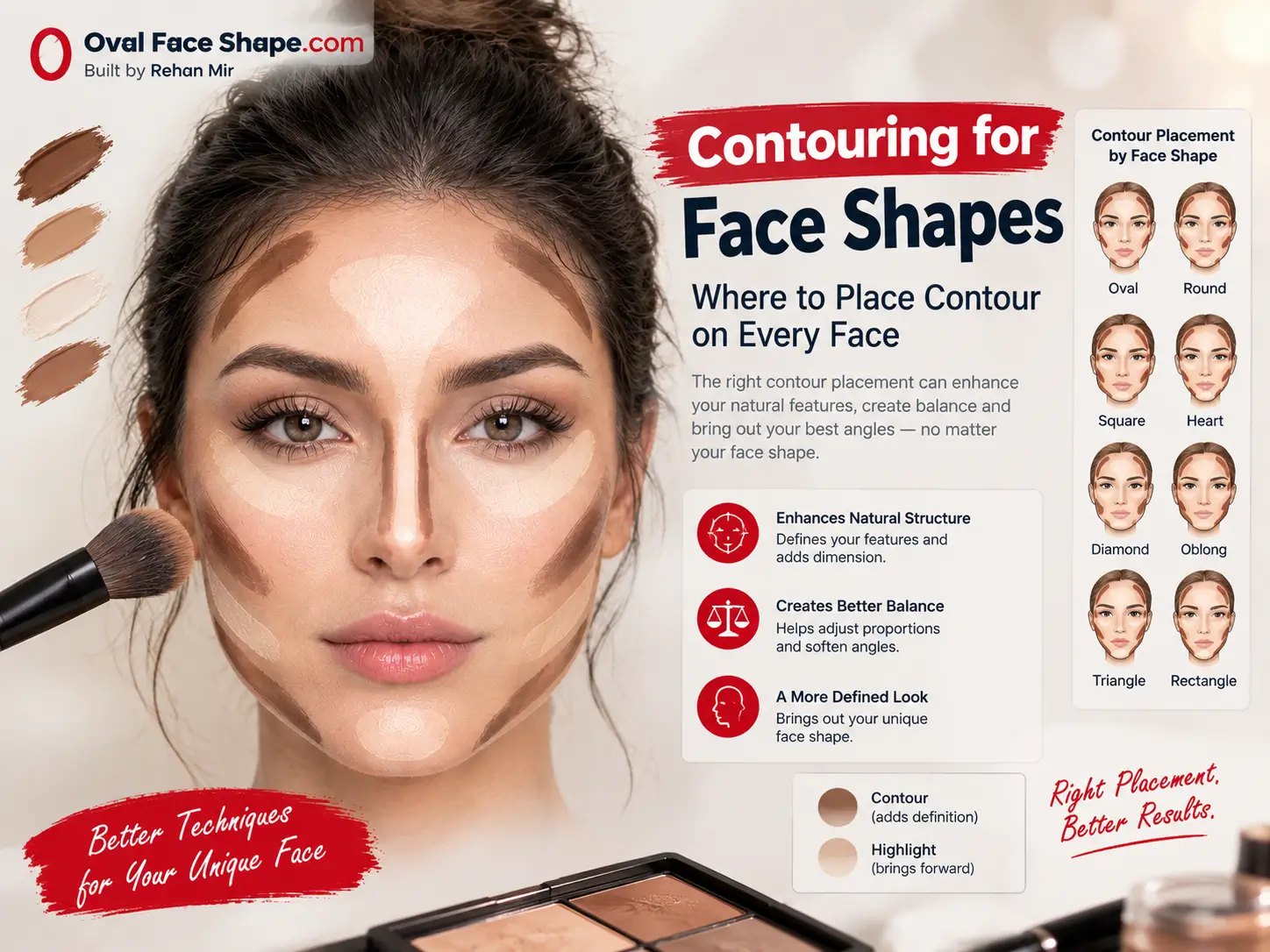
Contour where you want to narrow or shorten: temples and jaw for round or square; temples for heart; hairline and chin for oblong. Blend upward and keep it soft.
Contouring for Face Shapes
Contouring for face shapes means placing a shade slightly deeper than your skin tone where you want the face to look narrower, shorter or softer.
Highlighter goes where you want more light. Round faces take shadow under the cheekbones and along the jaw. Heart faces take it on the temples. Oblong faces take it at the hairline and chin.
Who this guide is for:
This guide is for anyone who knows or suspects their face shape and wants a map they can follow. Beginners get numbered steps. Fuller faces and mature skin get their own adjustments.
Find Your Face Shape First
Contour placement depends on your shape, so confirm it before you pick up a brush. The quickest route is the Face Shape Detector. To check by hand, divide face length by cheekbone width. On OvalFaceShape.com, a ratio of about 1.3 to 1.5 reads as oval. A ratio near 1.0 with a soft jaw suggests round.
Anthropometric measurement of the face has a long research history, including Farkas’s Anthropometry of the Head and Face. Shape labels are still guides, not diagnoses. Many faces sit between two shapes, so blend the two maps if that describes you.
Contour Steps for Beginners
- Prep the base. Moisturize, then apply foundation or skin tint and concealer.
- Pick the shade. Choose a contour a shade or two deeper than your skin, matched to your undertone.
- Place it. Start in the hollow under the cheekbone, from the ear to about halfway toward the corner of your mouth.
- Blend. Buff any hard edge until the color reads as shadow, not a stripe.
- Add highlight. Put it on the high points your shape needs (see the table), then set lightly.
Use a small amount at first. You can add more, but removing a heavy line is harder than building one.
Contour and Highlight Placement by Face Shape
| Shape | Contour | Highlight |
|---|---|---|
| Round | Sides of forehead, under cheekbones, jawline | Center of forehead, under eyes, center of chin |
| Heart | Temples and sides of forehead, under cheekbones (blend up), light on jaw | Tops of cheekbones, center of chin |
| Oval | Very light: temples and under cheekbones | Center of face; refine only what you want to change |
| Square | Outer forehead corners and jaw corners | Center of forehead, under eyes, chin |
| Oblong | Top of forehead, under chin, horizontal under cheekbones | Tops of cheekbones; skip the chin |
| Diamond | Outer cheekbones and jaw (soften width) | Forehead and chin |
Round Face: Contour for a Slimmer, Longer Look
A round face has similar length and width and no strong angles. The goal is to add definition. Sweep contour along the temples, under the cheekbones, and along the jawline.
Blend upward, not straight across. Horizontal bands widen the face, while angled placement adds structure. Keep highlight on the center of the face so light draws the eye inward.
Read the full shape guide: Round Face Shape.
Heart-Shaped Face: Contour and Highlighter
A heart face is wider at the forehead and narrower at the chin. Balance it by softening the top. Place contour on the temples and the sides of the forehead, then add a little under the cheekbones, blending upward.
For highlighter, use the tops of the cheekbones and the center of the chin. Sources disagree on chin contour: some skip it to keep the chin from looking smaller, others add a touch to soften the point. Start without it and add only if the point still dominates.
Discover everything about heart-shaped faces: Explore our complete Heart Face Shape guide, then learn how to enhance your features with our Heart Face Shape Makeup guide.
Oblong and Square Faces: Opposite Problems
Oblong faces need shortening. Put shadow at the top and bottom, not the sides. Square faces need softening at the corners. Shade the outer forehead and the jaw angles instead. Mixing these maps up is the most common mistake.
See the Square Face Shape guide for its corner placement.
Contouring a Fuller or Rounder Face
A chubby face (as many people search it) follows the round-face map with two adjustments. Keep contour angled up toward the ear rather than horizontal, and keep it soft. Focus shading under the cheekbones and along the jaw.
Contour creates the illusion of shadow, not a change in the face itself. A subtle, well-blended shade looks more natural than a dark one.
Discover the best makeup techniques for an oval face shape: Explore our Oval Face Shape Makeup Guide for expert styling tips.
Contouring Mature Skin and Older Faces
Cream and hydrating formulas generally suit mature skin better than dry powder, because powder can cling to dry patches and fine lines. Makeup artist Julie Unwin of Clarins says mature skin is all about dewiness.
Research supports pairing soft shading with a little color. A study of 289 faces aged 20 to 70 found that contrast between the lips, eyes and brows and the surrounding skin decreases with age. Faces with artificially reduced contrast were judged older. Blush, brow and lip color therefore matter as much as shadow.
The practical takeaway: contour lightly, blend well, and apply foundation and concealer first. Put cream contour on before any powder. No product makes a face look a specific age, but soft definition can make features look more lifted.
Common Contouring Mistakes
- Using a shade that is too dark or too orange for your skin.
- Leaving hard lines instead of a blended shadow.
- Using a round-face map on an oblong face, or the reverse.
- Applying dry product over a dry base.
- Contouring everywhere instead of the two or three areas your shape needs.
Key Takeaways
- Identify your face shape first, then follow that shape’s map.
- Contour narrows or shortens; highlight adds fullness.
- Round: shade under cheekbones and jaw. Heart: shade temples. Oblong: shade hairline and chin.
- Blend upward and keep it soft, especially on a fuller face or mature skin.
- Cream formulas and light application generally suit mature skin better.
Next step:
If you are not sure which map applies, run the Face Shape Detector before you contour.
FAQs
How can I contour my face based on my face shape?
Identify your shape, then shade the areas that make it look balanced. Round and square faces need softening at the sides and jaw. Oblong faces need shortening at the hairline and chin. Heart faces need the temples softened. Follow the table above, blend well, and keep highlight on the center of the face.
How do I contour my face as a beginner?
Apply foundation, place a shade one or two tones deeper in the hollow under your cheekbone, and blend upward until no line remains. Add highlighter to the high points, then set lightly. Use a small amount first and build gradually.
Does contouring change my face shape?
No. Contouring uses shadow to create an illusion of a different shape. It does not change your bone structure, and it looks best when it stays subtle and well blended.
Is contouring still worth doing?
Yes, when it is soft and blended. Reliable data on trend popularity is limited, but makeup artists consistently recommend subtle definition over heavy, sharp contour, especially on mature skin.
Cream or powder contour: which is better?
Cream is easier to blend and generally suits dry or mature skin. Powder tends to suit oily skin and is easy to control. If you are new to contouring, start with a cream or stick and set it lightly.
Do I need to contour an oval face?
Not for balance, since oval faces are usually the most proportional. Use a very light touch to refine specific areas, or skip contour and focus on blush and highlight.