
Quick Answer:
A diamond face shape is defined by high, prominent cheekbones that form the widest part of the face, with a narrower forehead and jawline.
By Muhammad Rehan Iqbal, Founder and Developer of OvalFaceShape.com, specializing in face shape analysis and interactive facial assessment tools.
Cheekbones affect face shape through their width compared with your forehead and jaw. Whether they sit high or low changes how your face looks, not which shape it is. This guide is for readers of OvalFaceShape.com who want to know if their cheekbones are high or low, what that means, and how to style around it.
Do Cheekbones Determine Face Shape?
Partly. Cheekbone width, compared with forehead and jaw width, helps sort a face into diamond, oval, heart or another shape. Height and projection don’t.
That is why two people with equally high cheekbones can have different shapes. One may have cheekbones wider than forehead and jaw. The other may have a forehead wider than both.
Height, Width, Projection and Fullness
Cheekbones are the zygomatic bones, a paired bone that forms the prominence of the cheek and part of the eye socket. Their prominence varies between individuals and between populations, so there is no single “normal”.
| Trait | What it describes | Changes face shape? |
|---|---|---|
| Height | Where the bone sits between eye and mouth | No |
| Width | How far across it reaches versus forehead and jaw | Yes |
| Projection | How far forward the bone stands | No |
| Fullness | Soft tissue over the bone | Only visually; it can hide width |
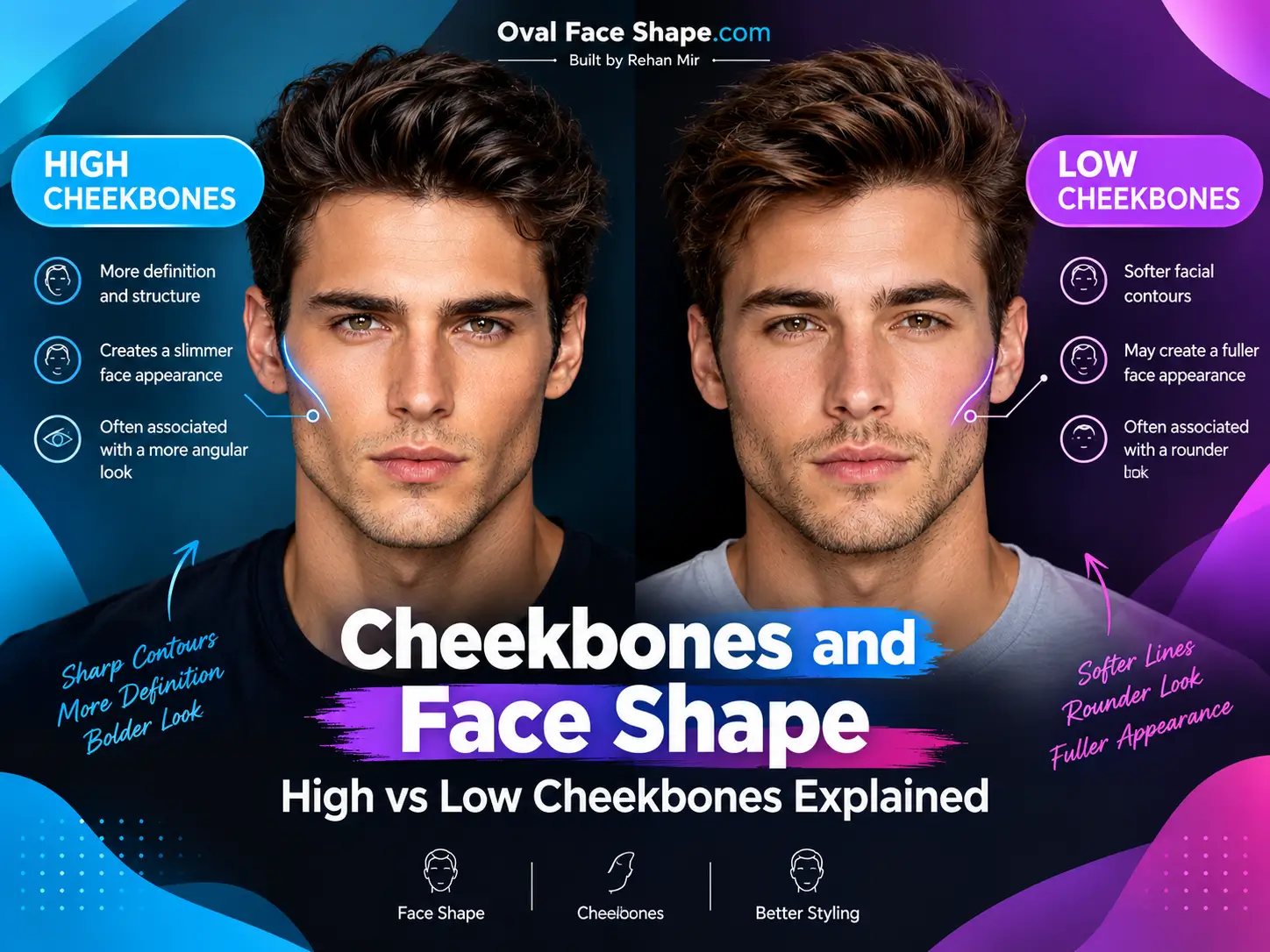
High Cheekbones vs Low Cheekbones
| High cheekbones | Low cheekbones | |
|---|---|---|
| Peak of the bone | Close to the outer eye | Nearer the level of the nose and mouth |
| Mid-face look | Lifted, widest area near the eyes | Fuller lower down, width nearer the jaw |
| Tied to one shape? | No | No |
Neither is better. Both describe position, and either can appear on several face shapes.
How to Tell If You Have High or Low Cheekbones?
This is an informal check, not a clinical measurement:
- Pull your hair back and face a mirror straight on, in daylight, with a neutral expression.
- Find the highest, widest point of the bone with your fingertips.
- Note where it sits between the outer corner of your eye and the bottom of your nose.
- Closer to the eye means high. Nearer the nose or mouth means low.
- For a measured comparison of cheek, forehead and jaw width, run a straight-on photo through the Face Shape Detector.
A smile lifts the cheek muscles and makes the bone look higher, so judge from a neutral face.
High Cheekbones: What They Mean?
High cheekbones are not a face shape. They appear most strongly in diamond faces and more softly in heart and oval faces. The full breakdown is in which face shape has high cheekbones, and the diamond face shape guide covers the most cheekbone-led shape.
Men and women:
The geometry is the same for both. What differs is the styling response: women often use fringes or layers to add width at the forehead and jaw, and men can use textured tops or a fuller beard line for the same balance. These are common conventions, not rules.
Attractiveness:
Research on female faces points toward a link. Cunningham and colleagues (1995) found strong agreement across Asian, Hispanic, Black and White raters, with high cheekbones among the features associated with higher ratings. Attractiveness is subjective, and evidence for male faces is thinner.
Low Cheekbones: Causes and What Can Change
Low cheekbones can come from bone position, from soft tissue sitting lower or fuller over the bone, or both. You can’t tell which from a mirror.
Age and weight change the soft tissue, not the bone. The JAMA Dermatology researchers note that loss of fat and muscle under the skin plays a role in the appearance of facial aging.
What can’t change is bone position. What can change is how defined the cheeks look, through styling, makeup and possibly cheek fullness. Cosmetic procedures exist, and a qualified clinician is the right person to discuss them with.
Cheekbones and Face Shape Chart
| Cheekbones vs forehead and jaw | Likely shape |
|---|---|
| Clearly the widest, forehead and jaw narrower | Diamond |
| Slightly the widest, face longer than wide | Oval |
| Forehead widest, cheekbones close behind | Heart |
| Jaw widest | Triangle or pear |
| All three similar | Round or square |
Curious about all face shapes? Explore our complete guide to types of face shapes to compare their key features, proportions, and defining characteristics.
Styling by Cheekbone Type
- High cheekbones: keep the sculpted midface visible. Side-swept fringes, chin-length layers and a blush placed along the bone are common choices.
- Low cheekbones: hairstyles with volume at the crown and temples, and blush and contour placed higher toward the temples, are common ways to suggest lift.
- Width balancing: if your cheekbones are your widest point, add width at forehead and jaw. If your jaw is widest, add volume higher up.
Our hairstyles by face shape section and the contouring guide go deeper.
Do Cheekbone Exercises Work?
Exercise cannot move bone. A 2018 JAMA Dermatology study by Murad Alam and colleagues found improved upper and lower cheek fullness after 20 weeks of home facial exercises in middle-aged women. The sample was small, had no control group and included only women, so treat it as an early signal about soft tissue.
Key Takeaways
- Cheekbone width helps decide face shape. Height and projection don’t.
- High and low cheekbones describe position and can appear on several shapes.
- Fullness over the bone can hide width and make shape harder to read.
- Age, weight and exercise change soft tissue, not bone position.
- Judge cheekbones from a neutral, straight-on view.
FAQs
What face shape has strong cheekbones?
Diamond. Its cheekbones are the widest point, with narrower forehead and jaw. Heart and oval faces also have high cheekbones, but less dominant ones.
Is cheekbone attractive?
Often, in studies of female faces, though preferences vary. Evidence for male faces is thinner.
Do high cheekbones mean I have a diamond face?
No. They appear on diamond, heart and oval faces. Diamond needs the cheekbones to be the widest point.
Are high or low cheekbones better?
Neither. They describe position, and each suits different styling choices.
Can you change low cheekbones?
Not the bone. Styling, makeup and possibly cheek fullness change how they look.
Can an AI or app measure my cheekbones?
Most estimate width from facial landmarks. Camera angle and hair across the face can shift results, so use a straight-on photo with hair back.
Is it still worth checking your face shape in 2026?
Yes, as a starting point. It ignores hair texture, density and personal taste, so treat it as a guide.
Next step:
Run the Face Shape Detector with a straight-on photo to see how your cheekbone width compares with your forehead and jaw.