
Quick Answer:
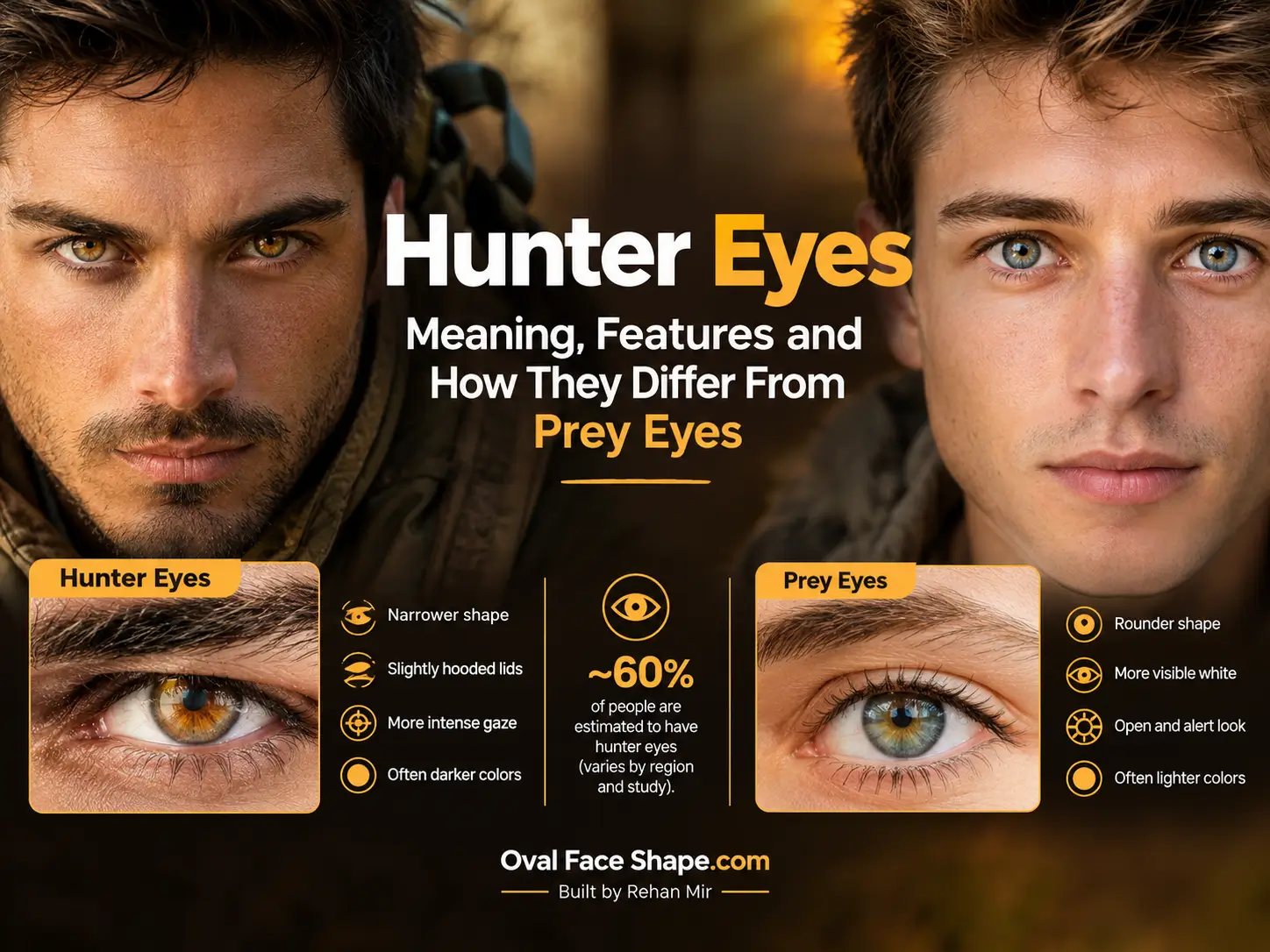
Hunter eyes have a positive canthal tilt, a minimal upper lid, little scleral show, and a deep-set, almond shape. Prey eyes are rounder, wider-open, and have a neutral or downward tilt.
By Muhammad Rehan Iqbal, Founder and Developer of OvalFaceShape.com, specializing in face shape analysis and interactive facial assessment tools.
Hunter eyes is an informal facial-aesthetics label, not a medical diagnosis or a recognized anatomical category. It describes eyes that sit deep in the orbit and tilt upward at the outer corner, with little visible upper lid and little white showing around the iris.
Who this is for:
Readers who saw “hunter eyes” online and want to know what it means, whether they have it, and what can realistically change. This page covers the facial feature. It does not cover song and lyric searches, Bloodborne’s Blood Drunk Hunter, or eye clinics in the Hunter region.
What Are Hunter Eyes?
The name borrows from animal biology. Predators such as lions and eagles have forward-facing eyes suited to depth perception, while prey animals such as zebras have side-set eyes for wide panoramic vision. Every human has forward-facing eyes, so the term is a metaphor about eye shape and expression, not about vision ability.
“Hunter’s eyes” and “hunter eye” mean the same thing. Prey eyes is the opposite descriptor.
Where the term comes from. Hunter eyes is not a clinical term. According to a 2023 VICE report, it grew out of online lookism communities and spread through TikTok, where tagged videos had passed 49 million views by mid-2023.
Clinicians measure canthal tilt, eyelid position and scleral show instead. The label bundles those measurements into one look, which is why definitions vary slightly from site to site.
Curious about the rarest eye shapes for different face shapes? Explore our complete guide to discover the key features, proportions, and characteristics behind them.
Hunter and Prey Eyes in Animals vs Humans
In mammals, predators tend to have forward-facing orbits for depth perception, while prey animals tend to have side-set orbits for panoramic vision. Comparative research on mammal orbits (Heesy, 2008) shows that ecology explains less than half of the variation, so this is a tendency, not a rule.
Humans, like all primates, have frontal eyes with roughly 140° of binocular overlap. Every person therefore has predator-style eye placement. The human “hunter vs prey” label describes eye shape, not vision.
Hunter Eyes Features
- Positive canthal tilt: the outer corner (lateral canthus) sits higher than the inner corner (medial canthus).
- Minimal upper eyelid exposure: little lid skin shows when the eye is relaxed, giving a narrowed, focused look.
- Deep-set position: the eyes sit further back under the brow ridge, so the brow casts a shadow over them.
- Almond shape: the outer corner tapers instead of ending in a round curve.
- Little scleral show: minimal white is visible between the iris and the lower or upper lid.
- Short brow-to-lid distance: the brow sits close to the lash line.
Hazel, brown or green irises do not make hunter eyes. Eye colour is separate from tilt and lid structure. “Almond” and “feline” describe the outline, which many people have without a deep-set position.
Hunter Eyes vs Prey Eyes
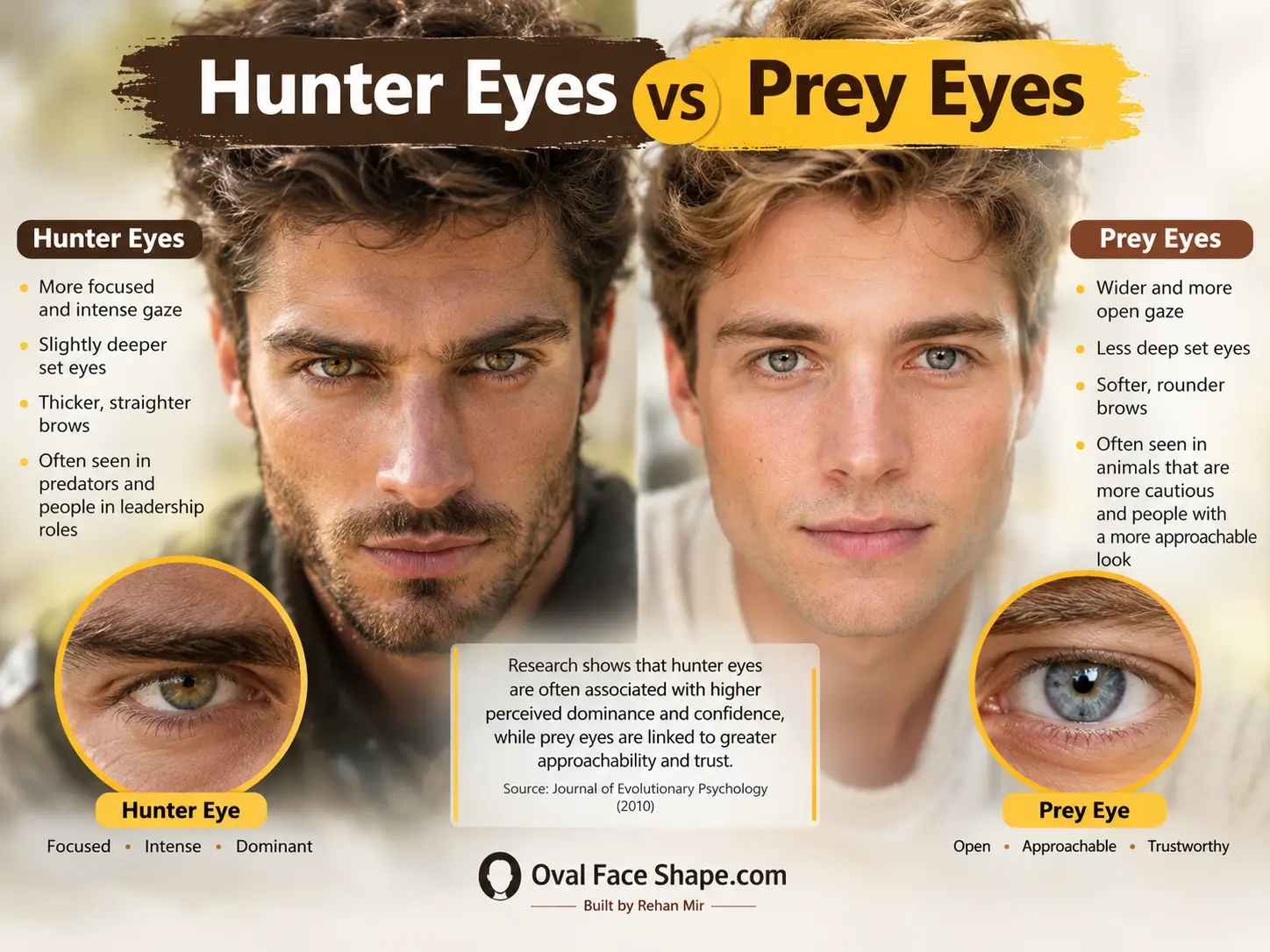
| Feature | Hunter eyes | Prey eyes |
|---|---|---|
| Canthal tilt | Positive (upward) | Neutral or negative |
| Upper lid exposure | Minimal | More visible |
| Scleral show | Little or none | Visible below or above the iris |
| Eye shape | Almond, narrowed | Rounder, wider open |
| Set depth | Deeper | More prominent |
| Brow-to-lid distance | Short | Longer |
| Impression | Focused, intense | Open, soft |
Prey eyes vs hunter eyes is a spectrum, not a binary. Most people mix features from both columns.
Neighbouring labels. Doe eyes show more white and look wide and open, which is closer to prey eyes. Fox and cat eyes are lifted at the outer corner, closer to hunter eyes, but they do not require a deep-set position. Definitions of prey eyes also differ: some sources say negative tilt only, while others include neutral tilt.
Hunter eyes also overlap with two other terms. Hooded eyes have a skin fold that covers the lid crease, which can come from age. Deep-set eyes describe orbital depth. Hunter eyes need the upward tilt and low scleral show as well, so hooded or deep-set eyes alone don’t qualify.
Do I Have Hunter Eyes?
Use this five-step check:
- Take a straight-on photo at eye level, with a neutral expression, relaxed brows and even light.
- Draw a line through the inner and outer corner of each eye and compare it to a horizontal line. An outer corner higher than the inner means a positive tilt.
- Look for white between the iris and lower lid. Little or none points toward hunter eyes.
- Check the upper lid. Little visible lid skin points toward hunter eyes.
- Count the matches. Meeting most of them means you lean hunter, and meeting few means you lean prey.
How to read your result: In a study of 76 Korean patients (Lee, Choung & Choung, 2020), average canthal tilt was about 8°, and no participant had a negative tilt. A photogrammetric study of Malaysian South Indian adults reported averages of about 4.7° in men and 7.0° in women. A positive tilt is therefore common, and the label is a spectrum rather than a rare trait.
Photo angle matters too. A surgeon quoted by VICE said many reference images are of models squinting, and a lowered chin or a squint can change how the eyes read.
Facial anthropometry, such as Farkas’s Anthropometry of the Head and Face, measures eye-fissure inclination, but natural variation is wide. No single angle separates “hunter” from “prey.”
Eye spacing is a separate proportion, covered in our eye spacing ratio guide. To see how your eye area fits your overall structure, run the Face Shape Detector.
Anatomy Behind the Look: Orbit, Lid and Age
Three things shape the look:
- Bone structure: orbital depth and brow-ridge prominence are inherited.
- Eyelid structure: the crease, skin laxity and the connective tissue anchoring the outer corner.
- Age: upper lids lower over time.
Surgery can usually correct a drooping eyelid in adults with age-related ptosis, per Harvard Health’s ptosis overview. Age-related hooding is not the same as hunter eyes, and a lid that droops suddenly needs prompt medical assessment.
Hunter Eyes in Men and Women
The structure is the same in both. The look is discussed more often for men because average brow-ridge prominence is higher, which deepens the shadow over the eye. In women, the same effect usually comes from a lifted outer corner, often styled with liner.
Brow and cheekbone structure also frame the eyes, as we explain in which face shape has high cheekbones. The broader pattern sits in our cheekbones and face shape guide.
Prey Eyes: Meaning and Fixes
Prey eyes are rounder, wider-open eyes with more visible white and a neutral or downward tilt. They are not a defect, and many people find them soft and approachable.
Research shows tilt can matter, but only up to a point. Bashour and Geist (2007) found that people preferred female faces with an accentuated tilt in a photo-editing experiment. An eye-tracking study of excessive aesthetic changes also found that exaggerating the lift of the outer eye corner lowered attractiveness ratings.
If you want a subtler lift, liner and brow shaping are the low-risk tools. Persistent drooping or uneven lids should be checked by a doctor.
How to Get Hunter Eyes: What Works and What Doesn’t?
- Exercises: there is no established clinical evidence that eye or face exercises, or “skin-stretching” routines, change eyelid or orbital structure.
- Mewing and posture: a 2019 Journal of Oral and Maxillofacial Surgery article examined mewing as a social-media alternative to jaw surgery. I found no controlled study showing it changes adult facial bone, so before-and-after photos usually reflect weight, angle or age.
- Brows: a lower, straighter brow shortens the visible brow-to-lid distance.
- Liner: a slightly lifted outer line and shading along the lower lash line approximate tilt and depth.
- Surgery: eyelid and canthal procedures exist, but they carry risks such as dry eye, eyelid malposition and asymmetry. VICE quoted one surgeon at roughly $2,486–$7,460 per procedure in 2023, with several often combined, so costs vary widely. Consult a qualified oculoplastic or plastic surgeon before considering them.
If thoughts about your eye shape are causing real distress, talking to a mental-health professional is worth considering before any procedure.
Key Takeaways
- Hunter eyes is an informal label, not a diagnosis.
- Core markers are a positive canthal tilt, little upper lid, little scleral show and a deep-set almond shape.
- Prey eyes are the opposite, and most people sit between the two.
- A positive tilt is common in measured samples, so having one does not make eyes rare.
- Hooded and deep-set eyes are related but not identical.
- Structure is mostly inherited and ages with the lids. Exercises and mewing lack evidence, while brows and liner can approximate the look.
FAQs
What does it mean to have hunter eyes?
It means your eyes show the aesthetic markers listed above: upward outer corners, minimal upper lid and little white around the iris. It describes appearance, not vision.
Are hunter eyes attractive?
Many people find them striking, especially in men, but attractiveness is subjective and culturally varied. No study establishes them as objectively more attractive.
What is the cause of hunter eyes?
Mostly inherited bone and eyelid structure: orbital depth, brow ridge and canthal position. Age can change lid position later.
Is hunter eye rare?
No reliable prevalence data exists, and the category has no formal definition, so any percentage you see online is unverified. Measured samples suggest a positive canthal tilt itself is common.
Get knowledge about the rarest eye shape in the entire world in our guide.
Can you get hunter eyes without surgery?
Partly in appearance, not in structure. Brows, liner and photo angle can approximate the look, but no clinical evidence shows exercises or mewing change eyelid or orbital structure.
Are hunter eyes the same as hooded eyes?
No. Hooded eyes have a skin fold covering the crease. Hunter eyes also need a positive tilt and little scleral show.
Can hunter eyes change with age?
Yes. Upper lids lower with age, so a hunter-like look can shift toward hooding. Sudden drooping needs a medical check.
Next Step:
Run the Face Shape Detector to see how your eye area fits your overall face structure.