
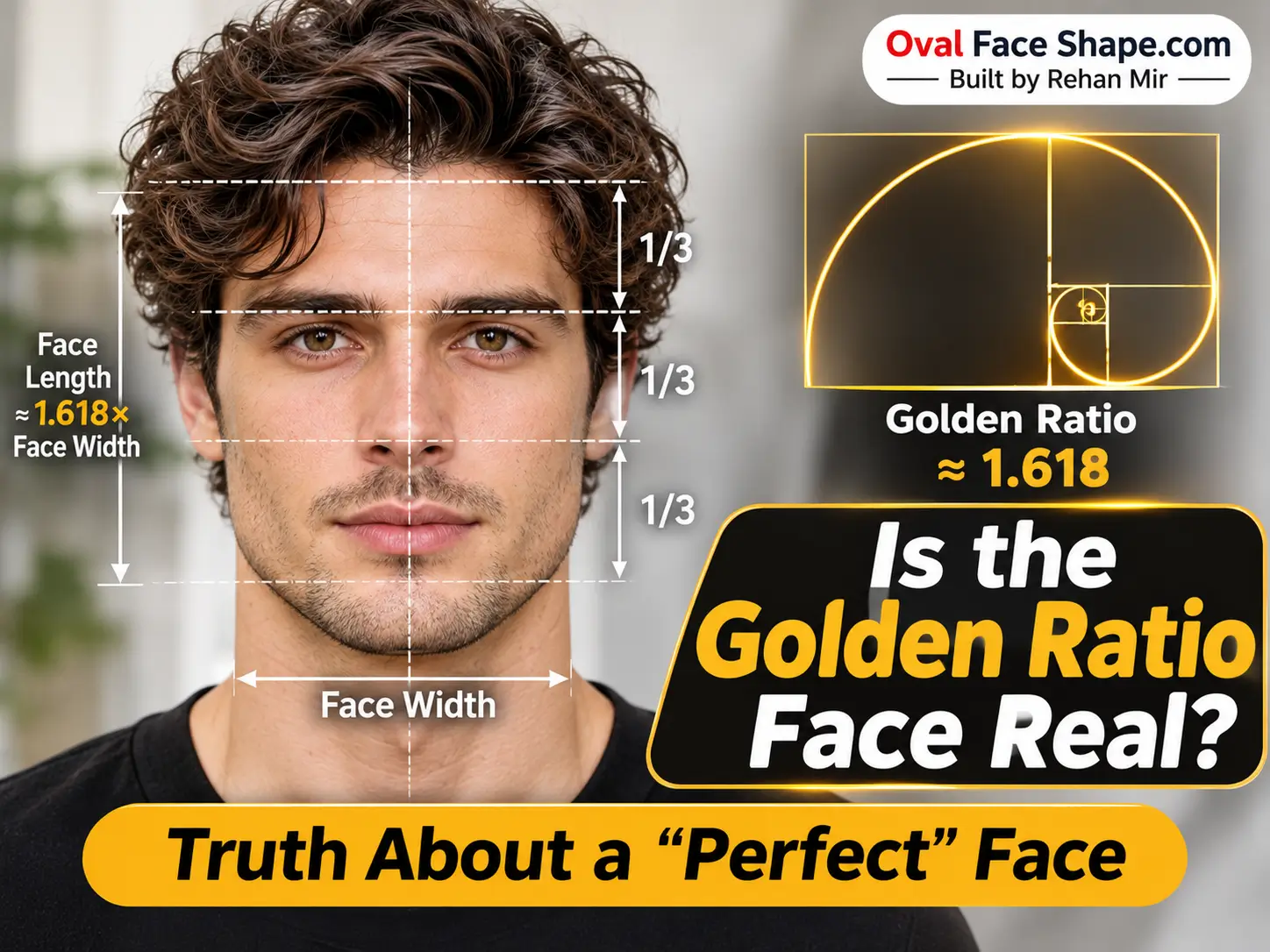
Quick Answer:
Not a beauty rule. The golden ratio (1.618) is real math, but studies find no proof it defines a beautiful face, and no real face matches it everywhere.
By Muhammad Rehan Iqbal, Founder and Developer of OvalFaceShape.com, who builds face shape analysis tools and styling guides.
A golden ratio face is a face whose measurements sit close to phi (1.618), a number from geometry. It overlaps with face shape, symmetry, and facial proportions, but it is not the same as any of them.
Is the golden ratio face real? As mathematics, yes. As a beauty standard, no: Published research finds no convincing evidence that phi makes a face attractive, so a “perfect golden ratio face” is a myth rather than a measurable category.
Who this guide is for:
This guide is for anyone who got a score from a golden ratio face calculator and wants to know what it means before acting on it.
What Is the Golden Ratio Face?
The golden ratio, known in mathematics as phi (φ ≈ 1.618), is the split where the whole relates to the larger part exactly as the larger part relates to the smaller. Euclid described it around 300 BC as “extreme and mean ratio,” with no mention of beauty (Naini, 2024).
The label “golden ratio of beauty” came much later. A golden ratio face applies the number to facial measurements, usually face length divided by face width, then to features such as nose and mouth width.
Is the Golden Ratio Real in Nature and the Human Body?
Phi is real, and Fibonacci numbers approach it. The famous examples mostly fail when measured, though. Naini’s 2024 review found no evidence that the Parthenon or the Vitruvian Man follows phi, and measured nautilus shells vary instead of tracing a golden spiral.
The same review points to the underlying problem: believers start with the ratio, then choose landmarks until it fits. The golden ratio in the human body and face inherits that flaw.
What Does Research Say About a Perfect Golden Ratio Face?
- No beauty link. Naini concludes there is no convincing evidence that phi is tied to idealized proportions or facial beauty.
- A different “golden” number. Pallett, Link and Lee (2010) found faces looked best when the eye-to-mouth distance was about 36% of face length and the gap between the eyes about 46% of face width. Those values match an average face, not phi, and only Caucasian female faces were studied.
- Popular tests lack support. An expert analysis in The Conversation found no evidence that phi determines visual beauty.
How to Know the Golden Ratio of Your Face?
- Measure face length from hairline to chin.
- Measure face width across the cheekbones.
- Divide length by width and compare with 1.618.
- Add the eye and mouth ratios below.
| Measurement | Target | Basis |
|---|---|---|
| Face length ÷ face width | 1.618 | Phi, calculator convention |
| Eye-to-mouth ÷ face length | ~0.36 | Pallett et al., 2010 (average face) |
| Distance between eyes ÷ face width | ~0.46 | Pallett et al., 2010 (average face) |
“How close is my face to the golden ratio?” simply means how far each result deviates from its target, averaged into a percentage. Every free golden ratio face calculator, test, or app picks its own landmarks, ratios, and weights, so one photo can produce different scores in different tools. Landmark placement alone can change a ratio.
For the full method, see golden ratio face proportions.
There is no validated “good” percentage. The score tiers some sites publish come without sources.
Who Has the Golden Ratio Face?
The most-cited score belongs to Bella Hadid, at 94.35% in a computer-mapping ranking by Harley Street surgeon Julian De Silva (press feature). Press coverage of his male ranking put Aaron Taylor-Johnson near 93%. Both come from one surgeon’s unreviewed method, so treat them as headlines, not findings.
More names sit in celebrities with a golden ratio face.
For BTS’s V, surgeons have praised his proportions in K-pop media, but I found no peer-reviewed measurement, and online percentages disagree.
Golden Ratio Face for Females
Pallett’s study used female faces only, so it is the closest thing to a published female reference. Even there, the numbers describe an average face.
Golden Ratio Face for Males
No peer-reviewed male standard came out of that work. Men’s faces are often wider relative to height, which lowers a length-to-width score regardless of attractiveness.
Does It Vary by Ethnicity or Country?
Naini notes that studies of professional models from different ethnic backgrounds found no plausible link between phi and attractiveness. I found no peer-reviewed golden ratio study specific to Pakistani faces, so treat any country-specific ranking with caution.
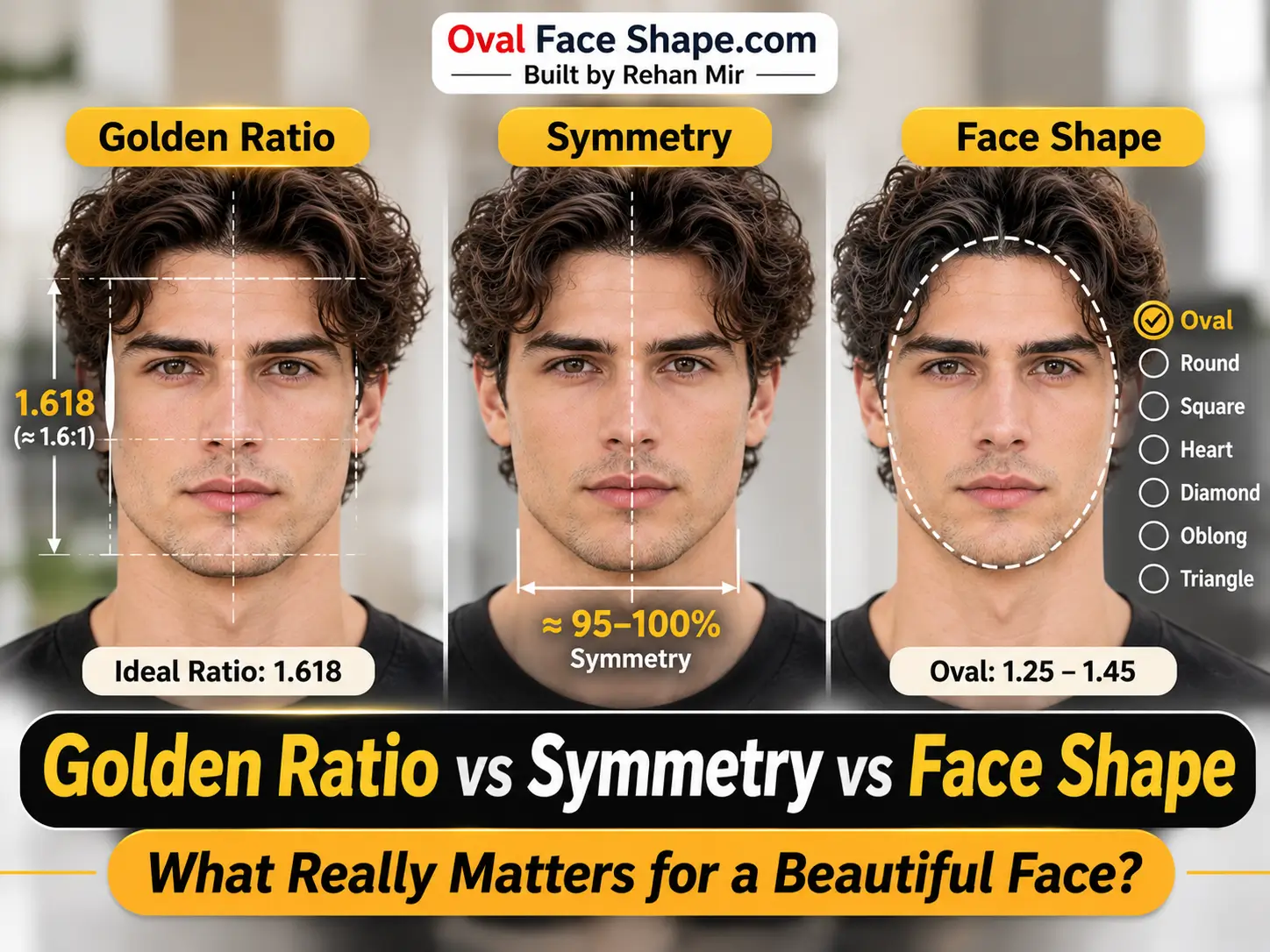
Golden Ratio vs Symmetry vs Face Shape
| Concept | What it measures | Tool |
|---|---|---|
| Golden ratio | Proportion between features | Ratio calculator |
| Symmetry | Left-right match | Face Symmetry Test |
| Face shape | Overall outline | Face Shape Detector |
The length ÷ width target of 1.618 is longer than a typical oval face, which OvalFaceShape.com defines as 1.3 to 1.5. Long faces therefore score closer to phi. That is arithmetic, not proof of beauty, and it is why celebrity face shapes rarely track golden ratio scores.
Key Takeaways
- The golden ratio is real math; “perfect golden ratio face” is not a scientific category.
- Research finds no convincing link between phi and facial beauty.
- Pallett’s 2010 ratios (0.36 and 0.46) match an average face.
- Scores differ between tools because landmarks and weights differ.
- Celebrity percentages come from unreviewed methods.
- Use proportions as styling input, never as a verdict.
Next step: Find your outline with the Face Shape Detector, then choose styles that work with your proportions.
FAQs
Does BTS V have a golden ratio face?
Surgeons have praised his proportions, but no peer-reviewed measurement exists, and online percentages conflict.
Who has the highest golden ratio face?
Bella Hadid, at 94.35% in one surgeon’s ranking. The method is not peer-reviewed.
What is a good golden ratio face percentage?
No validated threshold exists. A higher score means closer to a chosen target, not more attractive.
Does a perfect golden ratio face mean more attractive?
No. Research finds no convincing link, and Pallett’s attractive ratios match an average face.
Is a golden ratio face calculator accurate?
It can measure consistently, but what it measures is arbitrary. Different calculators return different scores.
What is the difference between golden ratio and symmetry?
Golden ratio compares proportions between features. Symmetry compares your left and right sides.
Is a golden ratio face test still worth using?
Only for curiosity or as one styling input. It cannot judge beauty.