
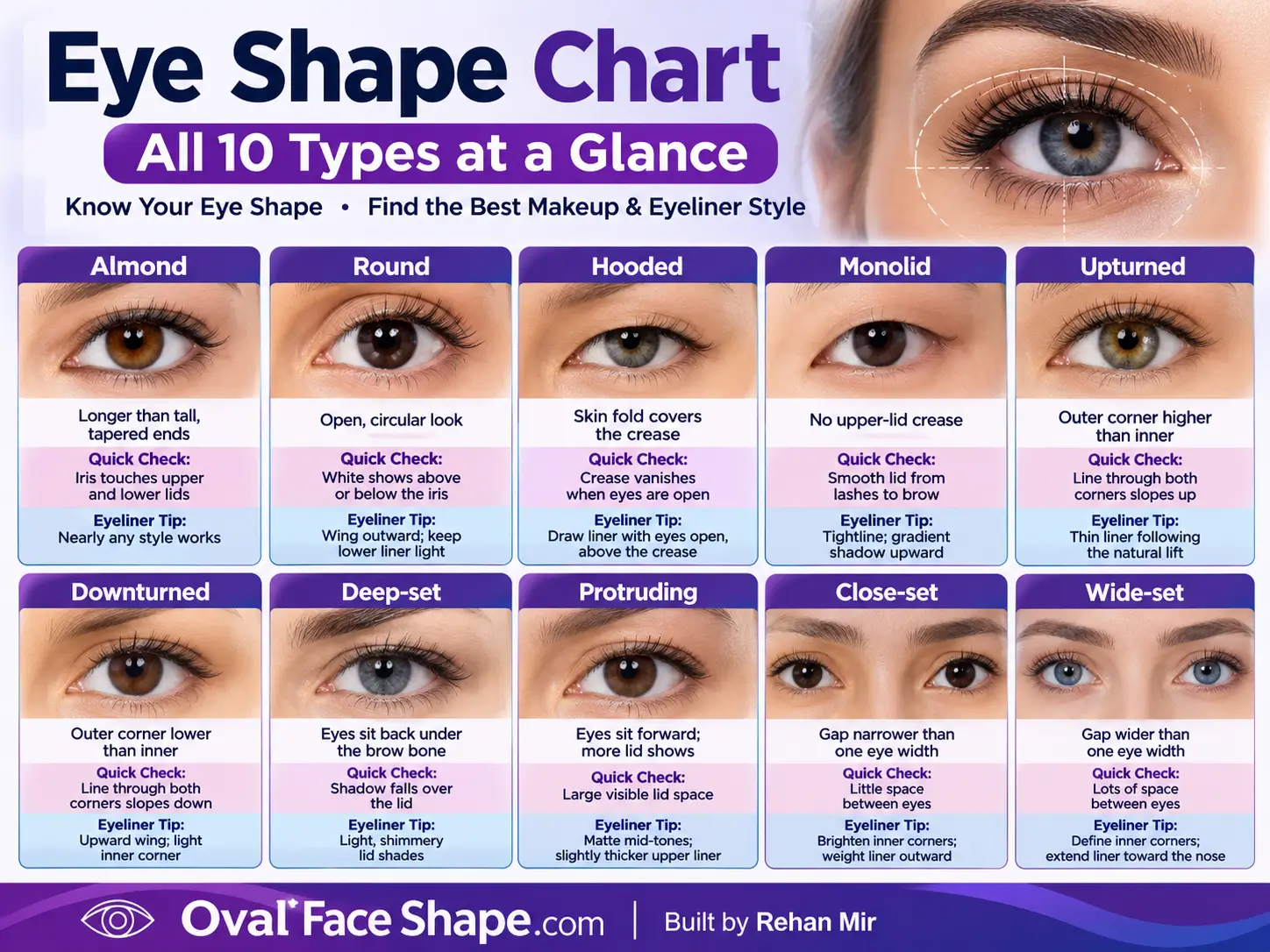
Quick Answer:
There are 10 common eye shapes: almond, round, hooded, monolid, upturned, downturned, deep-set, protruding, close-set, and wide-set. Most people combine two, so check lid, outline, tilt, and spacing.
An eye shape is the combination of your eye’s outline, eyelid crease, corner tilt, and placement on the face. This eye shape chart from OvalFaceShape.com names each type, gives a one-glance test, and connects eye shape to face shape, eyeliner, lashes and glasses. Before reading the guide find your eye shape with our eye shape detector.
Who it’s for:
Anyone asking “what is my eye shape?” before choosing eyeliner, lash extensions or frames, plus stylists comparing clients. It covers identification and styling, not medical diagnosis.
Eye Shape Chart: All 10 Types at a Glance
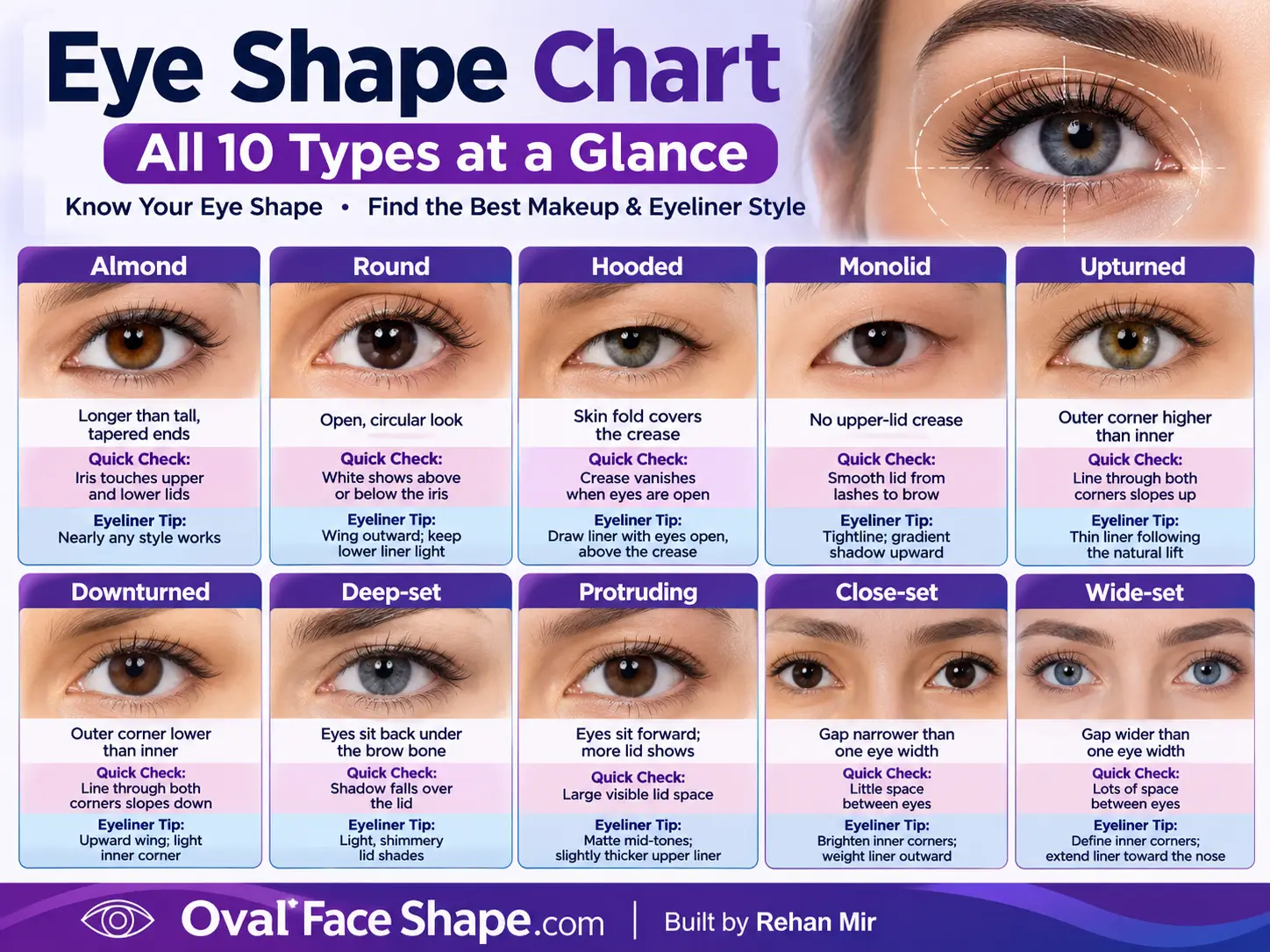
| Eye shape | What defines it | Quick check | Eyeliner tip |
|---|---|---|---|
| Almond | Longer than tall, tapered ends | Iris touches upper and lower lids | Nearly any style works |
| Round | Open, circular look | White shows above or below the iris | Wing outward; keep lower liner light |
| Hooded | Skin fold covers the crease | Crease vanishes when eyes are open | Draw liner with eyes open, above the crease |
| Monolid | No upper-lid crease | Smooth lid from lashes to brow | Tightline; gradient shadow upward |
| Upturned | Outer corner higher than inner | Line through both corners slopes up | Thin liner following the natural lift |
| Downturned | Outer corner lower than inner | Line through both corners slopes down | Upward wing; light inner corner |
| Deep-set | Eyes sit back under the brow bone | Shadow falls over the lid | Light, shimmery lid shades |
| Protruding | Eyes sit forward; more lid shows | Large visible lid space | Matte mid-tones; slightly thicker upper liner |
| Close-set | Gap narrower than one eye width | Little space between eyes | Brighten inner corners; weight liner outward |
| Wide-set | Gap wider than one eye width | Lots of space between eyes | Define inner corners; extend liner toward the nose |
How the Eye Shape Chart Works: Four Layers, Not Ten Boxes
These labels describe four separate traits: outline (almond, round), lid (hooded, monolid), tilt (upturned, downturned) and placement (deep-set, protruding, close-set, wide-set). One person can therefore be almond, hooded, upturned and wide-set at once.
As a developer of facial assessment tools, I treat the labels as overlapping descriptions. I found no validated width-to-height cutoff that separates almond from round, so use every check below as a guide.
Curious about the rarest eye shape? Explore our detailed guide to discover which eye shape is considered the rarest and learn about its distinctive features.
What Is My Eye Shape? A 4-Step Mirror Test
Stand in even light, remove eye makeup, and look straight ahead with a relaxed gaze. Check each eye separately, because eyelid asymmetry is common in studied groups. nih
- Lid: a visible crease means not monolid. A crease hidden under brow skin means hooded. No crease at all means monolid.
- Outline: iris touching both lids with tapered corners suggests almond. White above or below the iris suggests round.
- Tilt: imagine a line through the inner and outer corners. Outer higher is upturned, lower is downturned, level is neutral.
- Spacing and depth: about one eye width between the eyes is the classic guide, though a 2022 study measured inner-corner distance in a diverse population to test that canon. Less is close-set, more is wide-set. Shadowed lids under a prominent brow suggest deep-set.
Squinting, wide-angle selfies and head tilt all shift these results. For measured numbers, use our eye spacing ratio guide. Discover your eye shape using our free Eye Shape Detector and get a quick, easy-to-understand analysis of your eye shape.
When Protruding Eyes Are a Health Signal?
Protruding eyes are normal anatomy when they are your usual look. New bulging, gritty or red eyes, or double vision can signal thyroid eye disease, and the American Thyroid Association advises contacting a doctor. About one in three people with Graves’ disease develop eye symptoms. thyroid
Eyelid Types: Monolid vs Hooded, Asian and Chinese Eye Shapes
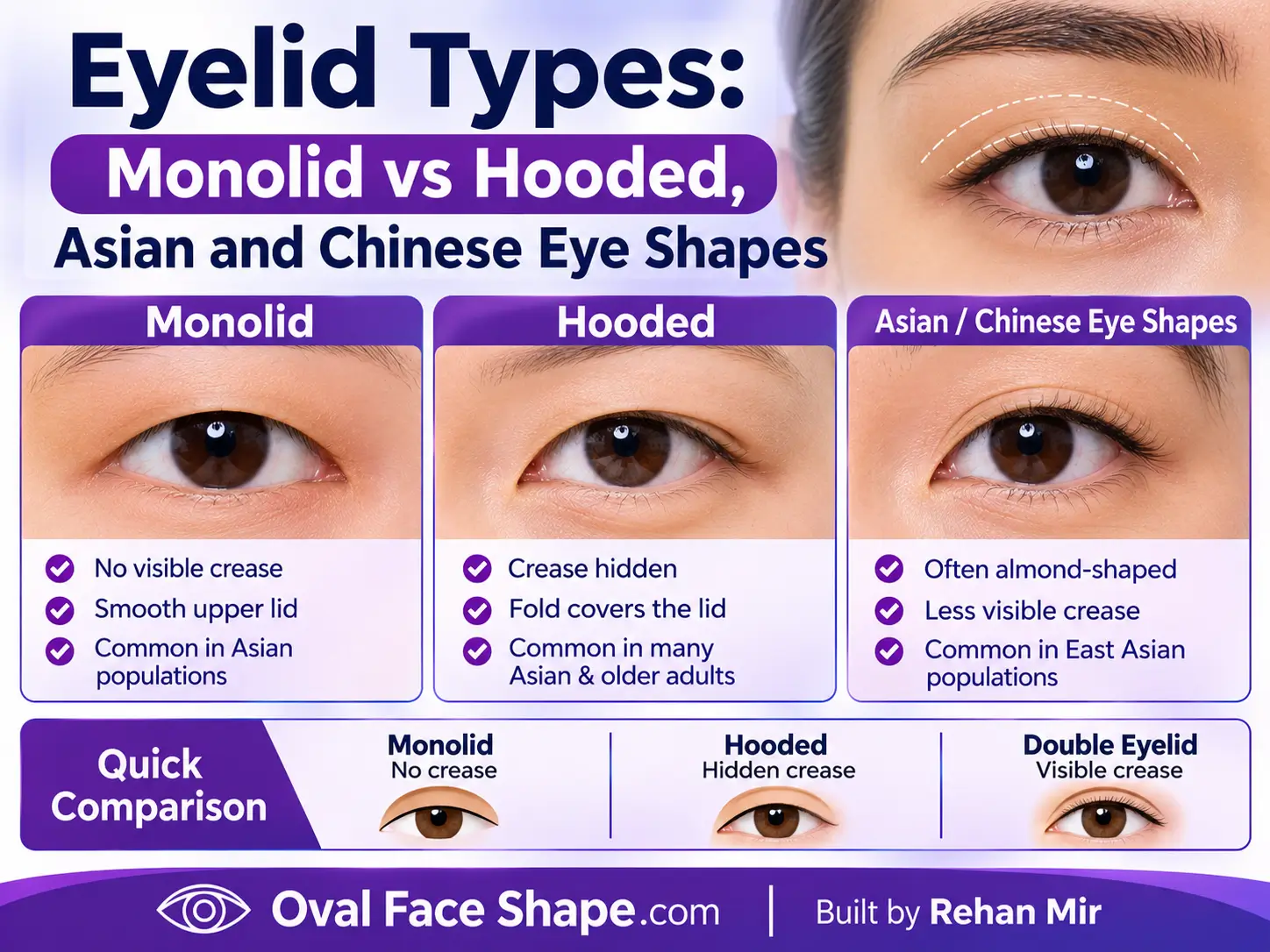
Monolid eyes have no crease. Hooded eyes have a crease that overhanging skin hides, so a hooded eye can have any outline. Eyelid guides list monolid, double eyelid, inner double and hooded types, with inner double meaning the crease merges into the inner-corner fold. perfectcorp
Eye shape is not a racial category, but lid types occur at different rates across populations. In one US study, 37% of African Americans had a double lid crease versus 15% of whites (Price et al., 2009). A 2012 study compared average and attractive configurations of the eyes across seven composite faces of different ethnicities, which is why no single template defines attractive eyes. bib-bvbspringer
Traditional Chinese beauty vocabulary uses descriptive names that map onto this chart: phoenix eyes (narrow, outer corner lifted), willow-leaf eyes (long and slim), apricot eyes (round and full) and peach-blossom eyes (soft, slightly upturned).
Curious about the rarest eyebrow shape? Explore our detailed guide to discover different eyebrow types and learn which one is considered the rarest.
Eye Shape Names: Doe, Cat, Fox and Hunter Eyes
| Nickname | Closest chart traits |
|---|---|
| Doe eyes | Large, round, often slightly downturned |
| Cat or fox eyes | Upturned, narrow outline |
| Hunter or prey eyes | Tilt and lid-exposure labels; see our hunter eyes guide |
Nicknames are informal and blend two or three traits, so confirm yours with the four steps above.
Eye Shape Chart for Lashes
Lash stylists commonly adjust length by shape. These are conventions, not rules:
| Eye shape | Common lash focus |
|---|---|
| Round | Longer outer lashes to elongate |
| Hooded | Well-curled, lifted lengths that clear the lid |
| Downturned | Longer outer lashes for lift |
| Monolid | Strong curl, even mid-length |
| Close-set | Weight toward the outer corners |
| Wide-set | Weight toward the inner and center lashes |
| Almond, upturned | Flexible, even lengths |
Our lash mapping guide covers named maps such as doll and cat-eye. Curious about the rarest eyelash type? Explore our detailed guide to discover the different eyelash types and learn which one is considered the rarest.
Glasses for Each Eye Shape, and for Men
Frame shape follows face shape first. Eye shape then fine-tunes the bridge and top edge: upswept frames lift downturned eyes, a straighter top edge balances upturned eyes, and lightweight frames suit hooded eyes. Our glasses by face shape guide covers the first step.
Eye shapes are identical for men and women. What differs is grooming: tidy brows, tightlined lashes, and well-fitted frames.
Do Eye Shapes Have Meanings?
In this chart, meaning is definition. I found no scientific evidence that eye shape reveals personality, and no source ranks one outline as most attractive.
Key Takeaways
- Ten labels cover four traits: outline, lid, tilt and placement.
- Most people are a mix, such as almond and hooded.
- Check crease, white around the iris, corner tilt and spacing.
- Nicknames like doe or cat eyes are informal blends.
- New bulging eyes need a doctor, not a chart.
FAQs
What are the most attractive eye shapes?
No study I found ranks one eye shape as most attractive, and preferences vary by culture and era. Styling balance matters more than the label.
How can I identify my eye shape?
Check the crease, the white around the iris, corner tilt and spacing in even light, one eye at a time.
What is the rarest eye type?
No reliable prevalence data exists for eye shape categories, because they overlap. If you mean eye color, that is a separate topic.
What are beautiful eye shapes?
Any of the ten. Beauty comes from balance with brows, lids and face, and each shape has techniques that highlight it.
Can eyes be both almond and hooded?
Yes. Outline and lid are separate traits, so almond-hooded is common.
How do hooded eyes differ from monolids?
Monolids have no crease. Hooded eyes have a crease covered by overhanging skin.
How accurate is the mirror test?
It is a good guide for clear cases. Borderline outlines are hard to call by eye, so compare photos taken straight-on in even light.
Next step: Now that you know your eye shape, match it to your face with the Face Shape Detector.